
Until October 7, and for a period of more than two decades, Israel pursued a policy of containment in the face of threats. The guiding principle was “tranquility at all cost”; Israel responded to attacks but did not act proactively to thwart threats. Following October 7, there was a shift in Israel’s strategic perception and a move from a policy of containment to a proactive, preemptive policy, neutralizing threats at an early stage in order to prevent the enemy’s buildup and an escalation of the security situation.
This policy is frequently criticized both by governments in the region and by international actors and the foreign media, and is described by them as aggression and unrestrained conduct by Israel, the behavior of a hegemon that attacks the enemy anywhere and at any time.
The strategy Israel has adopted over the past two years is a focused and calculated strategy; it is not offensive but defensive. It does not stem from a desire for expansion and control in the region, but from national security needs. Israel acts in a limited manner and with the aim of reducing harm and not injuring uninvolved civilians, but at the same time it no longer refrains from addressing threats, even when it is only a potential threat. The goal is to neutralize the threat before it materializes, and not to wait and act only after the fact and at a much higher cost.
The goal is to thwart potential enemy capabilities before the enemy realizes its intentions (which are very difficult to predict).
At the same time, Israel is advancing direct or indirect diplomatic channels and is willing to reach agreements as long as they meet Israel’s security needs and regional stability.
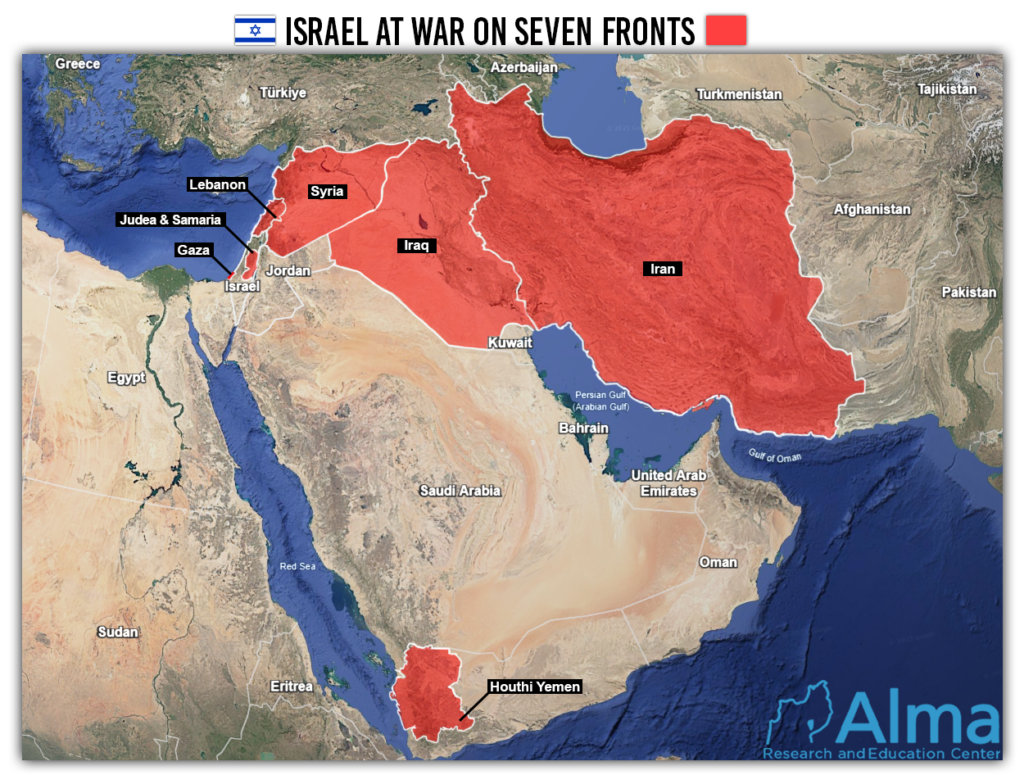
Israel acts on an ongoing basis across all fronts to thwart threats. In the northern front, Israel carries out airstrikes and ground raids against infrastructure and terrorist operatives in order to prevent a renewed entrenchment of Hezbollah and other terror organizations along Israel’s border. In Lebanon, since the ceasefire, more than 670 airstrikes have been carried out and over 200 Hezbollah operatives have been eliminated (and nearly 30 more operatives from other organizations, including Hamas). This is daily activity against any violation of the ceasefire agreement, intended to prevent Hezbollah’s rehabilitation efforts. The strategy, unlike in the past, is not to allow Hezbollah to recover and rebuild its capabilities, but to preserve the achievements of the war and keep Hezbollah weak. Israel also acts against civilian infrastructure because it is used as cover for Hezbollah’s military activity.
In Syria the situation is complex; the new regime is struggling to fully enforce law and order in the country, and therefore Israel acts against several threats it identifies in southern Syria: threats from terror cells that are still active in this area (terror cells operating under the auspices of Iran, Hezbollah, ISIS, Hamas, Palestinian Islamic Jihad, and al-Jama’a al-Islamiyya), attempts to smuggle weapons, and violent clashes between minorities and security forces that spiral out of control and could harm Israel’s allies.
Israel’s physical presence at five strategic points in Lebanon and at least nine points in the buffer zone in Syria does not stem from political interests such as territorial takeover, as is claimed, but from the need to push threats away from the line of contact and to protect Israeli communities near the border.
The war against Iran was also a defensive preventive action whose goal was to prevent Iran from becoming a nuclear state that would pose an existential threat to Israel. The obvious question is whether it would have been better to wait for the nuclear threat to materialize and then strike. The strategy Iran has been advancing against Israel for years is a combined attack from all fronts against Israel; therefore, Israel operates on all fronts against Iran’s proxies. Israel is confronting a determined enemy that does not hide its intentions to destroy Israel and does not hesitate to use any means, while Israel is required to exercise restraint.
A return to a policy of containment would be a mistake; Israel must continue to act decisively against every threat and maintain its strategic advantage over the enemy.
Israel is not acting aggressively—on the contrary. The policy it is pursuing today prevents dangerous escalation. Addressing threats at an early stage promotes regional security, strengthens the hand of more moderate actors, and paves the way for agreements and normalization in the region.



2 Responses
Dear Dr Zoe,
Amen.
To attempt to “contain” evil is only an illusion and a denial of reality, that provides the opportunity for evil to grow and metastasize. It is like a cancerous tumor. The tumor must be removed or destroyed before it spreads and becomes fatal to its host.
Dear Dr Zoe,
The ayatollah ring of fire radical jihaddist attempted genocide has been pushed back, but must now be COMPLETELY DEFEATED!
Likewise, the now attempted rival Ottoman caliphate with Turkish and Qatari offers to be members if the International Stabilization Force is just another sect of radical jihaddists ready to perform another attempted genocide with different management. This lie must be exposed. A better description would be the International Subversive Force. Both Turkey and Qatar have openly stated their hostility toward the existance of the State of Israel with empirical ambitions to conquer it. Turkey, Syria and Qatar must also be COMPLETELY DEFEATED. Genocidal, bribing maniacs have no right to rule or function in any destabilizing subversive activities. They cannot be negotiated with as equals, because they are not equal – they are Evil.