
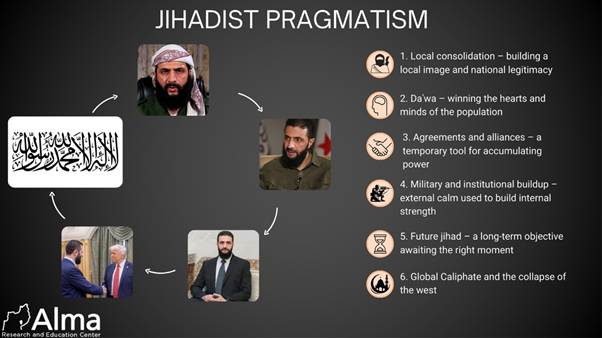
On December 8, 2025, a full year will have passed since the fall of the Assad regime and the transformation of Abu Muhammad al-Joulani, leader of Hay’at Tahrir al-Sham, into Ahmad al-Sharaa – President of Syria. Since then, under his leadership, Syria has renewed diplomatic ties with many Western countries, while he himself has been invited to Washington to visit the White House.
Outwardly, al-Sharaa emphasizes his focus on rebuilding Syria and strengthening and stabilizing the regime. He joined the U.S.-led coalition against ISIS, and already on November 30, U.S. Central Command (“CENTCOM”) announced for the first time, joint activity with the Syrian Ministry of Interior, that destroyed ISIS weapons depots through airstrikes.[1] He also presents himself as fighting Hezbollah’s weapons smuggling into Lebanon, and on December 5 Syrian security forces received a letter of thanks from the CENTCOM commander.[2] The letter stated that “the U.S. and its partners in the region have a shared interest in disarming Hezbollah and preserving peace and stability in the Middle East”.
Al-Sharaa has gone to great lengths to demonstrate his commitment to cooperating with the West, especially the United States, such that during the same week he travelled to Washington, it was reported that two assassination attempts against him by ISIS had been thwarted.
Al-Shar’a, whose ideological roots stem from Al-Qaeda and who until recently was wanted by the United States with a high monetary reward on his head, defined as a “global terrorist”, is now trying to craft an image of a pragmatic leader who has detached himself from the Al-Qaeda framework from which he emerged.
Is this truly the case, or is it pragmatism in the service of Islamist interests?
Syria today is a state of stability of instability. The state is in a period of transition and uncertainty, and although a year has passed since the fall of the Assad regime and the rise of al-Sharaa’s rule, significant knowledge gaps remain that have implications, among other things, on the intentions and goals of Syria’s current president.
Is the image of a pragmatic leader who is open to the West authentic, reflecting ideological change, or is it a type of tactical manipulation within jihadist pragmatism, intended to serve long-term ideological goals?
In this article, we attempt to present the strict approach, which argues that Ahmad al-Sharaa seeks to return to being Abu Muhammad al-Joulani, and in order to do so he is implementing, in practice, Al-Qaeda’s ideological strategy.
Thus, in fact, Abu Muhammad al-Joulani has not abandoned the jihadist ideology. He abandoned Al-Qaeda’s branding—not its strategic worldview. In practice, he is applying Al-Qaeda’s original principles, which include establishing local governance, institutional building, long-term patience, and tactical pragmatism, even toward the West, which he exploits to strengthen himself in the near and medium term.
In al-Qaeda’s view, the establishment of the Islamic Caliphate and the application of Sharia is a long-term vision, one which will be achieved only after broad and gradual power consolidation. This consolidation begins with “soft” measures: local entrenchment and avoidance of confrontation, forming alliances, spreading propaganda, and weakening opponents. Only afterwards is greater military control possible. This differs from ISIS, which viewed establishing a caliphate as an immediate goal and therefore declared it without any real and stable infrastructure.
This approach, seeing the caliphate as a long-term vision, is part of the “strategic patience,” a cornerstone of Al-Qaeda and other jihadist organizations. Al-Qaeda operates over many years, not through an abrupt revolution. It views its struggle as a generational one, not a conflict to be won within a few years. Its global goal is the slow erosion of the West until its collapse.
Since coming to power in Syria, al-Joulani has worked to promote a moderate image, and as part of this campaign, he changed his jihadist name to Ahmad al-Sharaa and altered his hairstyle and clothing. Yet it is possible that this rebranding is merely a tactical manipulation rather than ideological change.
Al-Joulani’s image shift is accompanied by presenting himself as a local leader, not a global jihadist, and by promoting rhetoric of sectarian and religious unity and internal peace within Syria. He also declares that he acts to integrate all factions into state mechanisms. This is the strategy that will enable him to consolidate power and strengthen stability. Al-Qaeda’s strategic patience includes gradual and cautious jihad, avoiding unnecessary confrontations, and building public support. The use of violence is calculated, avoiding excessive harm to Muslims in order not to lose support.
Additionally, as part of his efforts to gain internal support as Syria’s leader, al-Joulani often presents himself as a fighter for justice, attentive to the public, who throughout the years of fighting acted to protect the Syrian population and avoided harming civilians—in contrast to the Assad regime, which he claims committed widespread and ongoing crimes against its own people.
Al-Qaeda advocates expanding its support base through da‘wa activity, intended to shape public perception and win “hearts and minds.” Al-Qaeda’s propaganda apparatus is significant, tasked with explaining why Muslims should join the vision of establishing the caliphate. In parallel to da‘wa, military cooperation and unification with other actors, along with consolidating governance, together create conditions for the establishment of a comprehensive caliphate.

Thus, direct negotiations with Israel and agreements with the United States do not represent Western pragmatism but jihadist pragmatism.
In jihadist thinking, agreements are seen as a tactical tool, not a goal in themselves. Their purpose is to buy time during which power is built, institutions strengthened, positions improved, or the enemy weakened. This is a temporary mechanism that can, and is expected to, be violated once the balance of power shifts or when a “window of opportunity” opens for the next stage of the struggle. An agreement does not express recognition of the other side’s legitimacy; it reflects only strategic feasibility. An agreement does not mark the end of conflict, but rather a stage within a continuous process aimed at advancing long-term ideological goals. This is the same worldview held by Hezbollah, Hamas, Islamic Jihad, and other jihadist organizations fighting Israel.
In contrast, the Western worldview sees agreements as binding, stable acts with sincere intent to change reality. An agreement is viewed as a step meant to prevent escalation, build trust, and create a path toward conflict resolution. Westerners assume agreements are signed in good faith, recognizing sovereignty or legitimacy, and with the intention of being upheld over time. Violating an agreement is seen as a moral and diplomatic failure, not as an expected strategic act.
This is a deep cultural clash. It is the reason Western states often misinterpret the intentions of actors such as Al-Qaeda, the Taliban, Hamas, Hezbollah—and those of al-Joulani.
Al-Qaeda has historically used truces, ceasefires, diplomatic contacts, and temporary alliances. This is not a deviation from ideology—it is part of it. Negotiations with Israel and ties with the West by al-Joulani are justified within Al-Qaeda’s worldview as temporary alliances with infidels for a greater purpose. Al-Joulani’s pragmatism is not evidence of moderation; it is part of Al-Qaeda’s DNA.
Throughout the Syrian civil war, Ayman al-Zawahiri (Al-Qaeda’s leader after bin Laden, killed in Afghanistan in July 2022) repeatedly emphasized that Al-Qaeda’s goal and that of its partners is to establish an Islamic emirate in Syria based on sharia. Although al-Joulani softened his affiliation to Al-Qaeda and maintained relations with rebel organizations of various ideological currents as well as with states active in the arena, mainly Turkey, this does not mean he abandoned the path and ideology of jihad.
The reason al-Joulani did not declare the establishment of an Islamic caliphate when he rose to power is not ideological change, it is part of Al-Qaeda’s worldview. Al-Qaeda chooses a slow, gradual, strategic revolution based on public support, unlike ISIS, which advocates immediate, forceful, territorial terror-based revolution.
In an interview[3] at the Doha Forum (December 6, 2025), al-Joulani was asked about his past as an Al-Qaeda terrorist and his current beliefs regarding the future of Syria, the Islamic caliphate, and women’s rights.
Al-Joulani rejected the definition of himself as a “terrorist” and claimed the term is political. He argued that real terrorists are those who deliberately harm innocent civilians. To support his claim, he invoked international comparisons: the Gaza campaign, in which he claimed tens of thousands were killed, most of whom, he said, were “innocent”; the Syrian regime, which he said killed over a million people and made hundreds of thousands disappear; as well as the wars in Iraq and Afghanistan, which he described as actions in which mostly civilians were killed. Al-Joulani argued that “the murderers” are those who label others as terrorists in order to justify their own actions and claimed that after about 25 years of global conflicts (probably referring to the war on terror that began after the 9/11 attacks), international public awareness of who is a “true terrorist” has increased.
His answer points to a lack of substantive remorse for his jihadist past and demonstrates a conscious attempt to rewrite the narrative of his activity while shifting blame from jihadist actors to Western states—primarily the U.S. and Israel (without naming them)—which he claims use the label “terrorist” as a political tool.
Outwardly, al-Joulani seeks to adopt a pragmatic image, as a responsible local actor with whom dialogue can be conducted based on shared interests regarding Iran and more extreme jihadist actors. Yet in practice, his basic rhetoric—delegitimizing the U.S. and Israel, portraying them as “aggressors,” and completely avoiding any internal criticism of jihadist ideology—indicates that he has not abandoned the Salafi-jihadist worldview.
Al-Joulani uses engagement with the West as a tactical means to improve his standing and maintain his rule in Syria, but he still adheres to his jihadist worldview. His public distancing from Al-Qaeda is not ideological but stems from an effort to reduce international pressure and improve his image, thereby gaining domestic and international legitimacy as the leader of Syria—legitimacy which will serve as the foundation for an Islamic state (the caliphate) in the future.
[1] https://www.centcom.mil/MEDIA/PRESS-RELEASES/Press-Release-View/Article/4344515/us-syrian-forces-locate-and-destroy-isis-weapons-caches-in-southern-syria/
[2] https://x.com/CENTCOM/status/1996988668171431947
[3] https://x.com/Osint613/status/1997395060204114013



2 Responses
Dear Dana,
I fully agree with your assessment of the caliphate jihaddist empirical long term objectives. Deception with lies is a means to their radical ideological vision to rule the world under sharia law. The war of ideological world visions and outcomes is currently being waged. The JudeoChristian world vision of Liberty founded upon higher law delivered through Moses, versus oppression and tyrrany under radical islamic caliphates who rule with terrorism and death threats. They have been chanting “death to Israel” and “death to America” for decades. Their objectives have not changed. To negotiate deals for “golden calf financial illusions” is the path of self-destruction. Any country that will not swear to the right for the State of Israel to exist in the entirety of their ancient homeland as an independent sovereign nation, should be isolated and all military, financial aid, and ALL financial ties should be diminished and/or terminated completely.
Dear Dana,
Most if not all of the radical jihaddists currently sprouting around the world come from the propaganda and muslim brotherhood genocidal grand mufti, the partner in crime with Nazi genocidal Hitler and their cooperation to execute the “final solution.” The genocidal indoctrination of generations has been supported and funded by the sinister subversion of the United Nations, its affiliates, governments and NGO’S throughout the world. It is time to drain the swamp.