
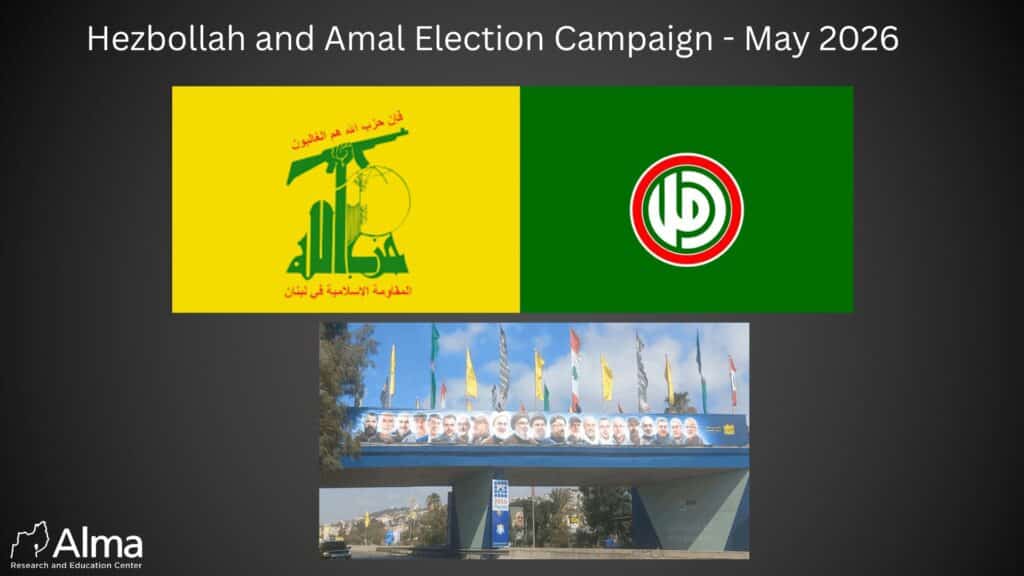
Hezbollah is preparing to preserve its political power in Lebanon. Although the parliamentary elections are not expected to take place until May 2026, in recent months Hezbollah and the “Shiite duo,” the Amal Movement, have begun launching campaigns and formulating strategies ahead of the election race. The upcoming elections will determine whether Lebanon is headed toward substantive political change, including state and economic reforms, or a return to the same dysfunctional system and Hezbollah’s control over the Shiite population.
The government that was appointed in February 2025 included two minister from Hezbollah were appointed (the Minister of Health and the Minister of Labor) and three ministers from Amal (the Minister of Finance, the Minister of Administrative Development, and the Minister of Environment). In the municipal elections held in May 2025, Hezbollah also managed to maintain its strength among its Shiite base, but voter turnout was low.
One of the reasons for the early preparations for the elections is Hezbollah’s concern over attempts by its political rivals, including the Christian Lebanese Forces party, to promote independent Shiite candidates who could “capture” Shiite seats in parliament and thereby “steal” votes from the “Shiite duo.” At the same time there are also efforts to prevent the election of allies from other sectors, with the aim of reducing the organization’s political power as much as possible.
The Dispute over the Electoral Law
Tensions are also rising regarding the dispute over the electoral law. Hezbollah and Amal oppose a change that would allow Lebanese expatriates to vote for all 128 parliamentary seats (instead of a quota of six seats, allocated according to religious–sectarian affiliation). This initiative is being led by the Christian parties – the Lebanese Forces and the Kataeb – in the hope that expatriate votes will weaken Hezbollah.
Sources in Hezbollah and Amal define the issue as “existential,” arguing that the electoral law is not an “ordinary law” but rather a mechanism that determines the political balance of power for the next four years. They therefore demand that any change be made through broad consensus, rather than by a simple parliamentary majority.
Clashes in parliament have also revolved around technical issues, such as early registration and the method for calculating the preferential vote – clashes that reflect deeper power struggles and political influences.
Against the backdrop of these disputes, the possibility of postponing the elections has arisen. However, there is concern that such a delay would lead to political paralysis, a phenomenon familiar from Lebanon’s past (both distant and recent), and would actually play into the hands of Hezbollah and Amal by entrenching the status quo instead of strengthening government sovereignty. A postponement could lead to chaos and internal conflicts in Lebanon and allow Hezbollah to further consolidate its control. Hezbollah has denied claims that it is interested in postponement or in extending the term of the current parliament.
Amal’s Rebranding
In response to changes in the political arena, the Amal Movement launched a new campaign last November titled “Al-Tahaddi al-Akhdar” (The Green Challenge – التحدّي الأخضر). This is a relatively new electoral rebranding effort, aimed at creating an innovative public image and reinforcing a message of political resilience. The campaign presents Amal as an organized, mobilized, and self-confident force, equipped with a modern, broad, and well-publicized electoral mechanism.
This is effectively the first time Amal has launched a clear and branded electoral framework under an independent name, beyond past generic labels such as “the Green Movement” or “the National Movement.” To date, the movement has established a network of regional and central electoral committees, recruited more than 15,000 observers, and anticipates that most members of the current parliamentary bloc will run again, with only limited, localized changes to the slate of candidates.
Despite the new branding and the desire to strengthen control on the ground, the strategic relationship between Amal and Hezbollah remains solid. “The Green Challenge” is not a separate list but an internal Amal campaign that fully upholds the historic “Resistance” alliance with Hezbollah. There is no intention to conduct a campaign at the expense of the partnership, and both movements are working jointly against attempts to undermine their strength in Shiite seats.
Mustafa Fawani, head of Amal’s Executive Administration and its election operation, emphasized the stability of the alliance with Hezbollah across all districts and claimed that there is no concern about diverting Shiite votes. He also stated that the movement is “100% ready” for the elections and asserted that it enjoys “overwhelming popularity.” Regarding the issue of expatriate votes, he stressed that Amal is addressing the matter systematically through the movement’s Foreign Relations Office, and that voting will take place in accordance with the existing law – via the “16th district” abroad or by voters traveling to Lebanon.
On December 20, it was reported that Amal’s electoral apparatus in the Kafr Sidon–al-Zahrani district held a large meeting with the participation of mukhtars from all the localities in the area, as part of ongoing preparations for the upcoming parliamentary elections. The meeting was held in the presence of the head of the district’s electoral committee, Dr. Hassan Wazna, Adnan Jazini, head of the Office for Municipal Affairs and Elections in the South, and representatives of the various villages and towns.
Hezbollah’s Campaign: Reinforcing Legitimacy, Consolidating Alliances, and Preventing vote poaching
On December 17, it was reported that Hezbollah is operating a broad network of contacts to recruit candidates and allies to run alongside it, particularly in districts where it lacks a clear support base, such as the Druze Shouf–Aley area. According to the reports, the organization is using several channels to build significant alliances but is delaying their announcement in order to ensure careful coordination.
According to various sources, Hezbollah is facing difficulties in mobilizing financial resources for the election campaign. At the same time, erosion within Hezbollah’s support base following the war may lead to low voter turnout (as was the case in the municipal elections).
Hezbollah assesses that the upcoming election campaign will be difficult and will require the creation of significant electoral momentum. Accordingly, it has defined broad political objectives that go beyond merely securing a certain number of seats:
Raising voter turnout among the Shiite public – a goal perceived as a political achievement in its own right, reflecting mobilization capacity, discipline, and the resilience of the support base during a challenging internal and regional period. High turnout is intended to refute claims of erosion or a profound shift in social support for the organization.
Preventing the poaching of Shiite votes in parliament – although the existing law makes it difficult for rivals to achieve such gains, Hezbollah has identified limited risk areas, foremost among them the Jbeil district, where sectarian considerations and preferential votes could produce surprises. To this end, it relies on calculated alliances aimed at preventing vote poaching and preserving control over Shiite representation.
For example, on December 17 it was reported that Hezbollah is facing a real challenge from several candidates identified with it or close to it, but who operate outside the party framework. These candidates, who in the past stood by Hezbollah after periods of political disagreement, have become a problematic factor ahead of the elections. The organization faces two options: including them on its lists – a scenario considered unlikely – or allowing them to run independently, which could indirectly harm it. Whether, in such a case, the organization would adopt a confrontational or even violent approach toward them remains unclear at this stage.
Securing a blocking third in the government – the results of the parliamentary elections will determine the balance of power in future negotiations to form the government. The broader the Shiite bloc’s parliamentary representation, the greater its weight will be in negotiations over the distribution of portfolios and the number of ministers in the cabinet, and a blocking third will be created that will allow decisive influence over legislation and sensitive appointments, foremost among them the presidency of the republic. This goal is not presented as a certain necessity but is being examined as feasible through the rearrangement of alliances and the reclaiming of seats previously granted to partners.
Hezbollah and Amal view the upcoming elections as a struggle of an existential nature, aimed at reestablishing their political and public standing in the face of internal, regional, and international pressures. Hezbollah is contending with challenges related to alliances, resources, and growing erosion among residents of the south – challenges that will constitute a significant test of its ability to preserve its power in the Lebanese arena.


One Response
Dear Dr Zoe,
Lebanon must outlaw hezbollah as a terrorist cancer that is incompatible with legitimate good government before elections. The invasive hezbollah consuming cancer will only subdue and destroy any possibility of a strong and healthy Lebanon. This is an attempted Iranian second proxy invasion. It is a jihaddist ideological strategic operation in progress to overthrow the government.