
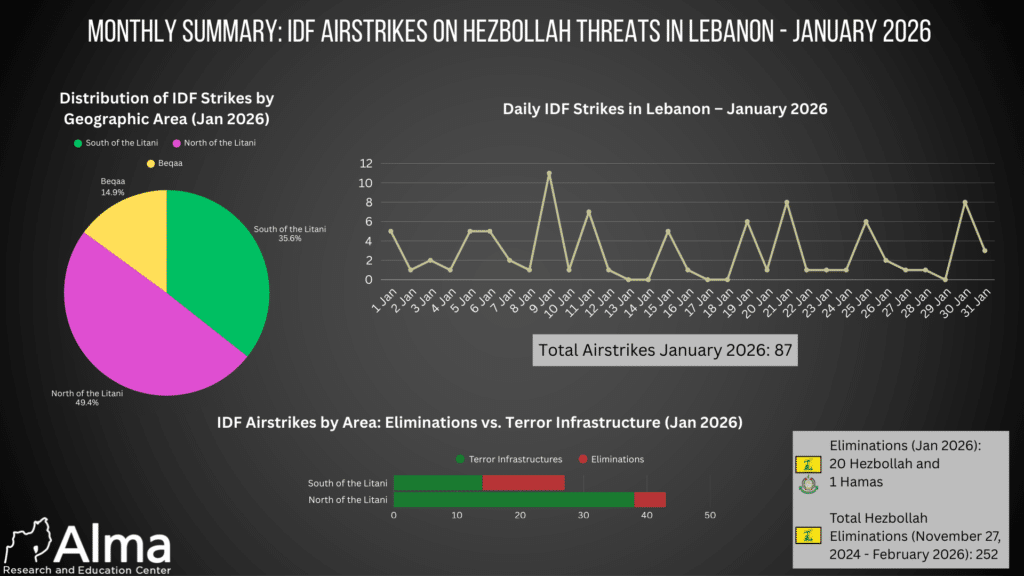
The month of January 2026 was characterized by a significant increase in the number of IDF strikes against threats in Lebanon. A total of 87 airstrikes were conducted, more than twice the number recorded in December 2025, when 41 strikes took place.
To our understanding, as of the time of writing, there has been no change in IDF policy regarding the nature of the strikes, despite fluctuations in their intensity.
43 strikes (49.4% of the total monthly strikes), nearly half of all strikes, were carried out in the area north of the Litani, which currently serves as Hezbollah’s main operational center of gravity. Of these, 38 targeted terror infrastructure, while only 5 were aimed at targeted eliminations.
31 strikes (35.6% of the total monthly strikes) were carried out in the area south of the Litani, where the strikes were divided almost equally between strikes against infrastructure (14) and targeted eliminations (13), indicating continued activity and presence of Hezbollah operatives south of the Litani.
An additional 13 strikes, accounting for 14.9%, were carried out in the Beqaa area, all against terror infrastructure, since the area constitutes the organization’s logistical and operational rear.
Overall, 18 airstrikes were carried out in which 21 terror operatives were eliminated – 20 Hezbollah operatives and one Hamas operative (clarification – in two strikes, two operatives were eliminated in each strike, rather than a single target).
Since the beginning of the ceasefire, a total of 252 Hezbollah operatives have been eliminated.
Note – The database of eliminated operatives on which our information is based includes only those operatives whose details were publicly released and independently verified through open sources.
Breakdown of IDF Airstrikes by Area: Elimination of Operatives vs. Damage to Terror Infrastructure (January 2026)
As stated, in January 2026 most strikes were carried out against Hezbollah’s terror infrastructure in the area north of the Litani.
Across all regions, strikes targeting terror infrastructure hit weapons production facilities, Radwan training camps, rocket launchers, multiple above- and underground weapons depots, and tunnel shafts used for weapons storage. Additionally, four illegal border crossings with Syria—used by Hezbollah to smuggle weapons—were also attacked.
During January 2026, seven additional strikes targeted engineering equipment (such as bulldozers), which Hezbollah regularly uses to rebuild military infrastructure under civilian cover. At the same time, Hamas weapons production sites were also struck during the month.
In terms of eliminating operatives, during January 2026, 20 Hezbollah operatives were eliminated. Most of the eliminations (13) were carried out south of the Litani, while 5 eliminations were carried out north of the Litani, indicating a focus of elimination activity in the southern sector.
In addition, during January, four strikes were conducted that were apparently intended as elimination attempts, during which the targets were injured but not killed. All these attempted eliminations took place in the area south of the Litani.
Among the senior Hezbollah operatives eliminated were the Rabat of Kfar Yanouh, a key weapons trader and smuggler, the artillery commander in the village of Arzoun, and the commander of an artillery team in the village of Al-Harash.
Likewise, during the month, a Hamas operative was eliminated in the village of Braikeh, north of the Litani.
IDF Airstrikes Against Hezbollah in Lebanon by Monthly Distribution (27 November 2024 – 31 January 2026)
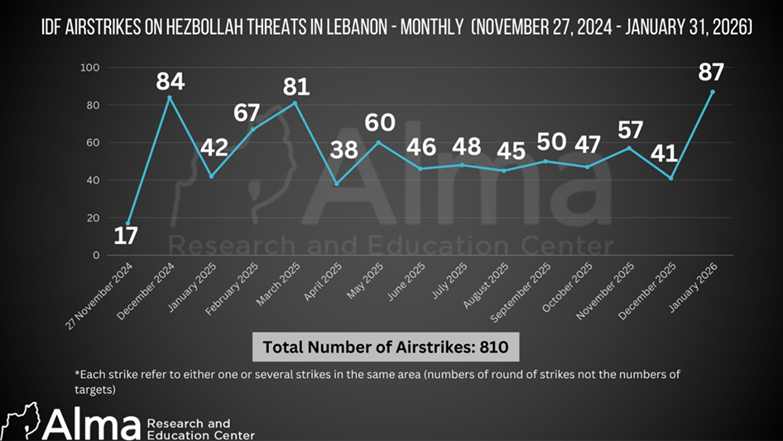
The graph illustrates the monthly volume of IDF airstrikes against Hezbollah in Lebanon, from the start of the ceasefire on 27 November 2024 through 31 January 2026.
January 2026 was the month in which the highest number of airstrikes was recorded since the beginning of the ceasefire in November 2024, with a total of 87 strikes, more than double the number of strikes carried out in December 2025 (41 strikes).
During January 2026, the strike rate averaged about two strikes per day, indicating a high and ongoing level of operational activity.
Since the ceasefire in Lebanon came into effect on 27 November 2024, a total of 810 airstrikes have been carried out.
Note – the term “strike” refers to a single strike or several strikes carried out in the same area and does not reflect the number of targets/objectives that were attacked.
Geographic Distribution of IDF Strikes in Lebanon (January 2026)
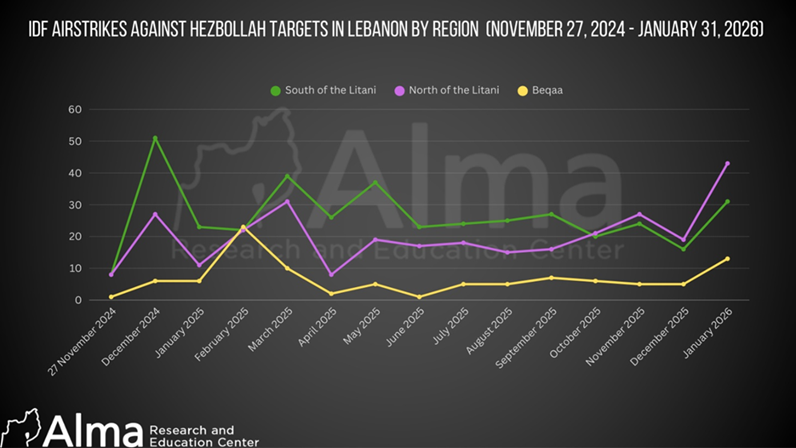
The above graph presents the distribution of IDF airstrikes against Hezbollah targets in Lebanon by geographic area since the beginning of the ceasefire on 27 November 2024 until 31 January 2026. Throughout the period, it is evident that most strikes were carried out south of the Litani.
Over the past three months, beginning in November 2025, there has been a steady rise in strikes north of the Litani. This trend peaked in January 2026, reflecting an expanded scope of aerial operations in that area. In the Beqaa region, activity remained more limited overall, yet consistently present, suggesting a sustained effort to target Hezbollah’s infrastructure and logistical depth.
Like the last two months (November–December 2025), most of the IDF strikes in January 2026 were carried out in the area north of the Litani.



One Response
Dear Dana,
Thanks for the report, and thanks to the IDF and IAF for executing the peak month of successful missions for Justice in Lebanon in recent history. May G_d continue to inspire and bless the Israeli Armed Forces to bring victory over all the liars and evil forces of darkness unto the Light of Day.