
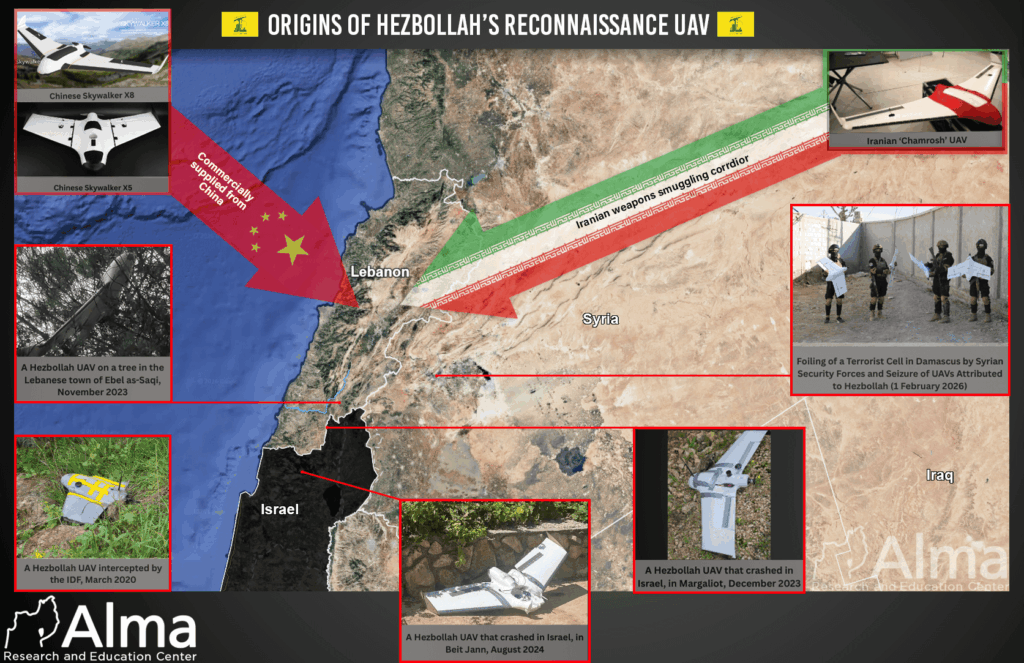
On February 1, 2026, Syria’s Ministry of Interior announced that Internal Security Forces had exposed a terrorist cell active in the Damascus area that had carried out rocket launches toward the Al-Mezzeh district and the adjacent military airport. During the raids, all members of the cell were detained, and UAVs prepared for further terrorist activities were seized.
According to the official Syrian announcement, the detainees admitted to ties with external actors and claimed that the weapons seized originated from Lebanese Hezbollah. Nevertheless, Hezbollah quickly issued an official statement in which it rejected and condemned all allegations attributed to it.
What insights can be drawn regarding the UAVs seized in Damascus in early February when compared to the findings from the most recent war against Hezbollah, during which the organization launched a range of different UAV types (see appendix) at military and civilian targets in Israel?
There are several documented cases of Hezbollah reconnaissance / intelligence-gathering UAVs that crashed in Israeli territory and remained relatively intact, allowing for technical examination of their characteristics. These include a UAV intercepted by the IDF in March 2020; a UAV that crashed in Margaliot in December 2023 which remained intact; and another UAV that crashed in Beit Jann in August 2024, also without significant structural damage.
These UAVs, beyond their designation for reconnaissance / intelligence-gathering, apparently also served as decoy platforms intended to occupy, expose, or disrupt air defense systems, as part of a broader operational array.
It should be emphasized that we cannot state with certainty that the UAVs confiscated from the terror cell in Damascus are identical to any of Hezbollah’s UAVs described in this document. Nevertheless, a visual comparison of some of the aforementioned platforms (for example, the Hezbollah UAV that crashed in Beit Jann in August 2024) indicates a clear similarity to the UAVs seized by Syrian Internal Security Forces in Damascus — a similarity that is unlikely to be coincidental. Despite the fall of the Assad regime, Iran and Hezbollah continue to maintain an active presence in the Syrian arena, which they exploit, among other purposes, as a base for terrorist activity against both the new regime and Israel.
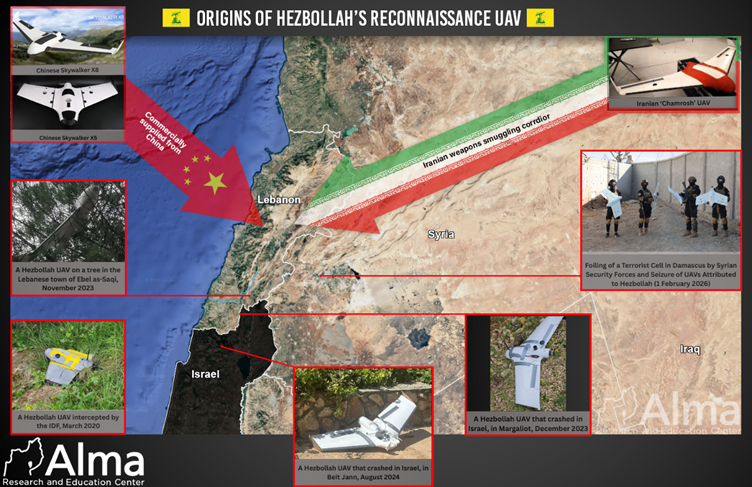
Although it is difficult to accurately determine their exact dimensions based solely on visual evidence, technical and visual analysis suggests that the UAVs that crashed in Israeli territory are platforms originating in China (Skywalker X8 and Skywalker X5). At the same time, similar models are known to be produced in Iran (see below), which raises the possibility of either direct or indirect supply via Iran, or alternatively licensed production with local adaptations.
The Skywalker X8 and Skywalker X5 are widely used Chinese UAV platforms designed for medium-range reconnaissance missions. Both are common in amateur and professional use alike and can be purchased directly from online vendors and external suppliers—sometimes even as kits for on-site assembly. These aircraft can be hand-launched and recovered by gliding landings, allowing for flexible operation without the need for dedicated infrastructure.
Chamroush: From Chinese Inspiration to Iranian Proxy Use
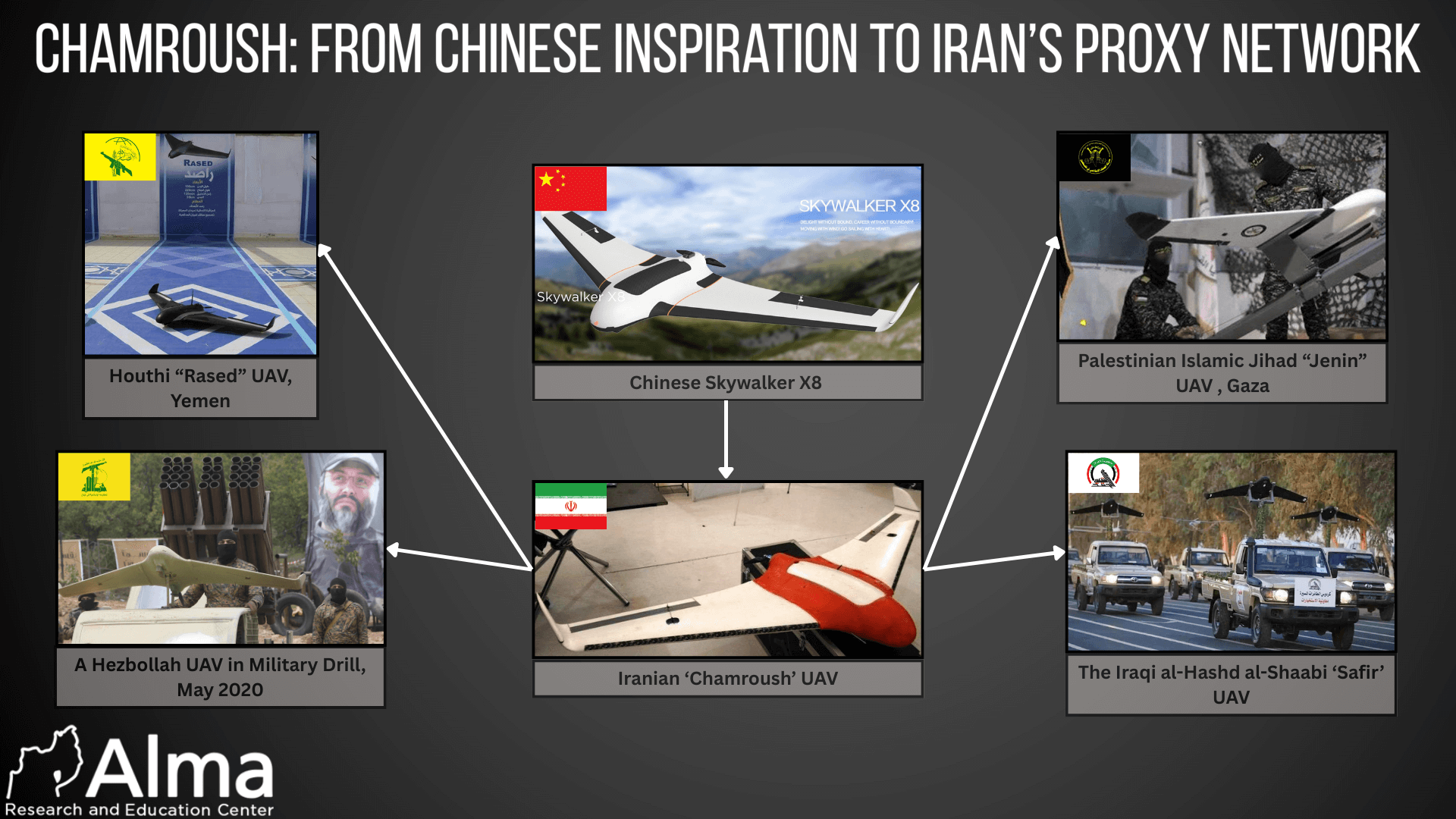
The Iranian UAV Chamroush (چمروش) is likely a development inspired by the Chinese Skywalker. The meaning of the name Chamroush is the name of the “mythical bird that protects the skies of Iran” – a bird in Persian mythology said to live on a mountain peak. It is a small UAV that is usually hand-launched and used for reconnaissance and intelligence gathering.
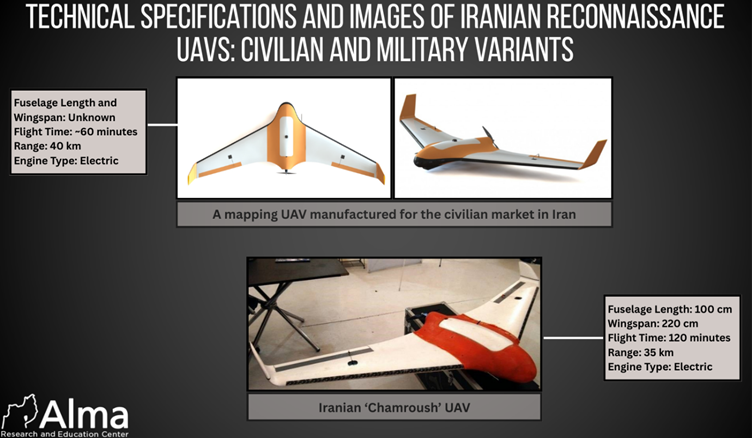
From a technical standpoint, the Chamroush has a fuselage length of 100 cm and a wingspan of 220 cm. It can remain airborne for approximately 120 minutes and has an operational range of about 35 km. The UAV is driven by an electric motor.

The Chamroush UAV is widely used across multiple arenas in the Middle East and is operated by Iranian-backed proxies and affiliated organizations. Among the Houthis in Yemen it is referred to as “Rased,” by the Palestinian Islamic Jihad in Gaza as “Jenin,” by Shiite militias in Iraq as “Safir,” and, as noted, by Hezbollah in Lebanon.
It is highly likely that the platform initially reached these organizations from an Iranian source, whether through direct transfer or through intermediary networks. At the same time, the possibility of independent supply channels or parallel procurement cannot be dismissed. Since the platform originates from the civilian market, it, or its individual components, can be purchased online at relatively low cost. This enables organizations to order parts separately, conceal procurement patterns, and assemble the system independently in the field.
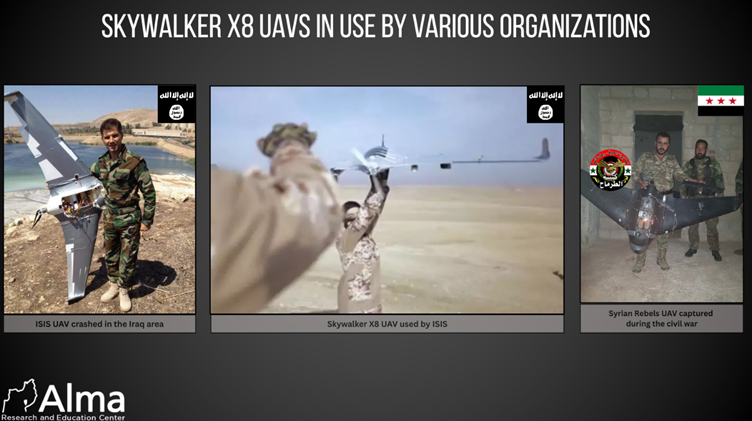
Additionally, there is documented evidence that other groups have used the Chinese-made Skywalker X8 reconnaissance UAV, including ISIS and Syrian rebel organizations (during the civil war).
The Iranian Civilian Version of the “Chamroush”?
In Iran’s civilian market, a comparable UAV known as the Tareqh PPK (طارق) is available. It is designed as an aerial mapping and remote sensing platform equipped with a PPK (Post-Processed Kinematic) system that enhances geographic and data accuracy. The UAV is primarily intended for civilian applications such as mapping, agriculture, and remote monitoring, and supports the integration of advanced cameras and sensors with high-precision positioning enabled by PPK technology. It is marketed by an Iranian company called Tareq for Drones, which is based on Azadi Street at Sharif University of Technology in Tehran.
Appendix:
In the strategic aspect, the continued development of the UAV array constitutes a central objective for Hezbollah in preparation for a future confrontation with Israel. The UAVs are integrated into the organization’s asymmetric warfare doctrine, enabling it to balance gaps vis-à-vis Israeli air and technological superiority. Thus, the UAV array is not merely a tactical tool, but a central pillar in force build-up and in the organization’s strategic preparation for the next war.
The UAVs constitute a relatively inexpensive weapon to produce and operate, and are used for a variety of main missions:
Attack (primarily suicide UAVs) – through them it is possible to precisely strike pinpoint targets while reducing risks to personnel and increasing operational flexibility. During the most recent war, Hezbollah carried out attacks using suicide UAVs against military and civilian targets and high-value targets. It claimed responsibility and announced attacks on the aerial detection system – “Tal Shamayim,” defense factories, attacks against Iron Dome battery sites, and additional military sites using suicide UAVs.
Reconnaissance and Intelligence – these UAVs significantly improve intelligence-gathering capabilities, obtaining an “reconnaissance imagery of the enemy,” as well as the accuracy of long-range fire (ballistic trajectory / anti-tank). During the war, Hezbollah presented several UAV videos engaged in these activities. On June 18, 2024, Hezbollah published a 10-minute video allegedly showing a photography sortie carried out by a UAV in the Haifa Bay area. The video shows several areas, including the “Rafael” factory complex, the civilian and military Haifa port, Haifa airport, parts of the Krayot cities, and more. Throughout the video, Hezbollah emphasizes and points to potential targets for attack. In addition, there were several Hezbollah publications after attacking a specific target that presented aerial photographs from the day preceding the attack and the damage at the site afterward. These publications served not only to demonstrate operational capabilities, but also as part of a perceptive and psychological campaign intended to amplify deterrence and influence public opinion.
Disruption, Attrition, and Deception of Defense Systems – these UAVs are primarily intended to overload air defense arrays, expose their locations, and compel them to activate expensive interception means against relatively inexpensive targets. By launching in large numbers, sometimes in successive waves or in a “swarm” configuration, it is possible to create saturation of detection and interception systems, reduce their availability for more significant threats, and increase the likelihood of penetration by primary weapons systems.
Such UAVs may also serve as a deception tool – for example, mimicking the radar signature of larger aircraft, flying on routes intended to draw fire, or launching in parallel with rocket fire and loitering munitions. Moreover, compelling the adversary to activate its radar and command-and-control systems creates opportunities to gather electronic intelligence (ELINT) on how those systems operate and their response times. In terms of attrition, consistent use of inexpensive tools to wear down stocks of costly interceptors and create operational and cognitive burden may constitute an effective strategy in prolonged warfare.



One Response
Dear Dana,
Your reporting clearly indicates the drone threat is increasing. Option one is to destroy all drone production facilities throughout the entire CRINK axis of evil and unstable empires. Option two is to rapidly deploy new laser technology to take down drones in high numbers. Option three is to crush the head of the serpent in Iran and eliminate the entire den of snakes. I recommend all three options be applied.