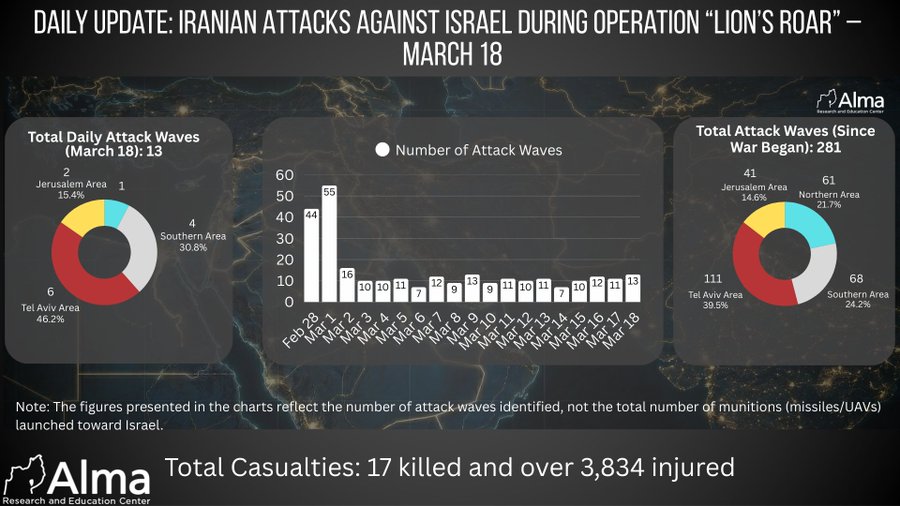
On March 18, 13 Iranian attack waves against Israel were identified, carried out using ballistic missiles. Geographically, most of the attacks were directed toward the Tel Aviv area, which sustained 6 attack waves (46.2%). In addition, 4 attack waves (30.8%) were recorded in the south, 2 attack waves (15.4%) in the Jerusalem area, and 1 attack wave (7.7%) in the north. Since the beginning of the campaign, a total of 281 Iranian attack waves against Israel have been identified. In the cumulative geographic distribution, the central region—particularly the Tel Aviv metropolitan area—remains the primary target, with 111 attack waves (39.5%). This is followed by the southern region with 68 attack waves (24.2%), the northern region with 61 waves (21.7%), and the Jerusalem area with 41 attack waves (14.6%). In one of the attacks targeting central Israel in the early hours of March 18, a ballistic missile equipped with a cluster warhead struck a residential apartment in Ramat Gan, resulting in the deaths of two civilians in their 70s. The use of a cluster warhead reflects an effort to expand the impact area by dispersing submunitions across multiple points, thereby increasing the damage potential, particularly in dense urban environments. It should be noted that, according to recent assessments, approximately 50% of the ballistic missiles launched by Iran toward Israel have carried cluster warheads. Furthermore, most Iranian fire is directed toward central Israel, an area characterized by high population density, while employing munitions designed to maximize the spread of damage across a wide area. This combination underscores an intent to inflict significant harm on the civilian rear. An examination of the daily trend indicates relative stability in the pace of attacks since March 2, when a decline in intensity followed the initial phase of the campaign. Since a consistent operational tempo has been maintained, an average of 10 attack waves per day. This pattern reinforces the assessment that Iran is operating within a strategy of attrition, based on sustained, continuous attacks over time, alongside a focus on central Israel and complementary geographic dispersion to other regions. Impact on the civilian sphere in Israel: Since the beginning of the war, 17 civilians have been killed in Israel, and more than 3,834 individuals have been injured to varying degrees as a result of direct impacts, falling interceptor debris, and secondary damage. In addition, extensive damage has been caused to residential buildings and civilian infrastructure.