
By: Gideon Harari
Despite the statements that have been heard, the current fighting in Lebanon, which began on March 2 and, at the time of writing, is under a ceasefire, did not include the dismantling or de facto destruction of Hezbollah; this was never on the agenda. The current military move was intended to create significant leverage over the Lebanese government on the one hand, and, on the other, to substantially weaken Hezbollah and create the option of a diplomatic move.
This objective has been partially achieved. Hezbollah remains relatively isolated in the campaign and is under heavy pressure from losses, loss of territory, and perhaps also a certain/partial erosion of trust in it, partly even among the Shiites themselves. This situation strengthens the opportunity that has emerged for a diplomatic arrangement with Lebanon on the one hand, while on the other, it creates a risk that, in light of the distress Hezbollah has found itself in, it may initiate a move that would ignite a new civil war in Lebanon.
The direct negotiations with Lebanon, which we are at the beginning of, are an opportunity in which Israel must take the lead, while involving another significant player, with the United States serving as a sponsor and nothing more.
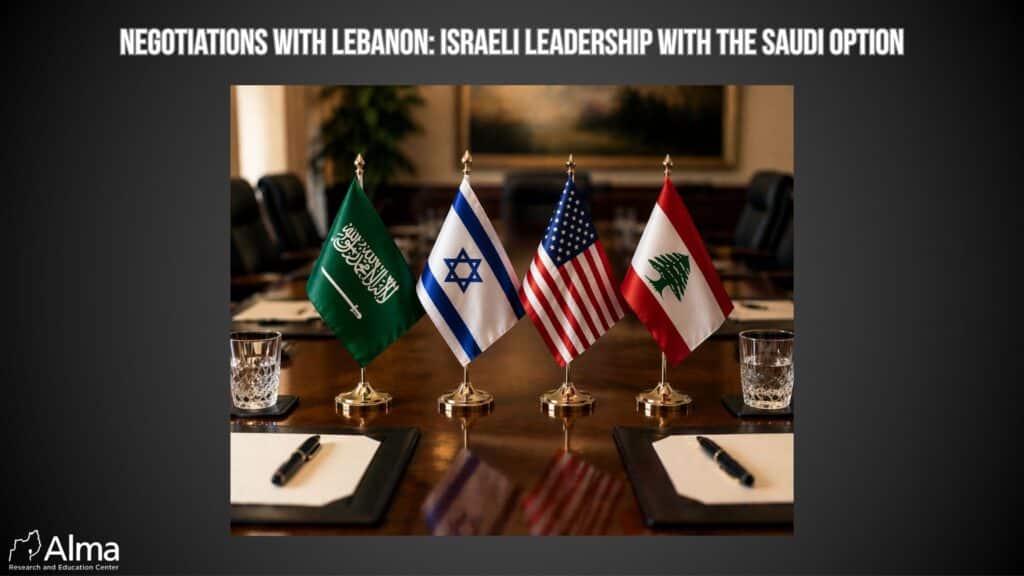
Israel should invite Saudi Arabia to be an equal partner in managing the negotiations with Lebanon and “bring out into the open” the semi-overt relationship that exists between the two countries. It is possible that involving the Saudis in the negotiations will provide them with a pretext to stop presenting the Palestinian issue as an obstacle in their relationship with Israel and to focus on the shared interest of a settlement in Lebanon, a matter of greater importance to Saudi interests.
Saudi Arabia has been involved in developments in Lebanon over the past fifty years, both in the formulation of the Taif Agreement, which was effectively signed in 1991 and officially ended the Lebanese civil war, and in its support for prime ministers in Lebanon and for the Sunni community.
Israel and Saudi Arabia share common interests both in the Lebanese context and in the regional context. The central issue in the Lebanese arena is curbing Iranian takeover and influence in Lebanon by eliminating Hezbollah, positioning Saudi Arabia as the leader and protector of the Sunni community, and leading Lebanon’s reconstruction and economic development.
In the regional context, this includes establishing a strong alternative to Turkish influence in Syria, technological and security cooperation with Israel in the fields of the military, agriculture, water, and high-tech, creating a coalition with Israel and the moderate Sunni states in the Persian Gulf, and eliminating the Captagon industry that harms Saudi society.
The United States should take part in the negotiations with Lebanon as a sponsor. Such an agreement, which would also lead to an agreement between Israel and Saudi Arabia, is a top-tier interest for the United States.
Israel enters the negotiations from a position of strength, as a regional military and technological power, and with leverage over the state of Hezbollah and the state of Lebanon. Israel should assume a leading role in striving to sign a diplomatic agreement with Lebanon, while allowing for the possibility that it may sign interim arrangements, such as a non-belligerency agreement or another type, that would enable the other side to agree to it and also cope with it domestically.
*Gideon Harari is a geopolitical spokesperson by avocation. A resident of the Upper Galilee, he serves voluntarily as the head of the emergency response team in his community. He previously served as a senior intelligence officer and is currently a partner in a business intelligence company.
The article was also published in Hebrew in “Israel Defense” on April 17, 2026.





3 Responses
Hezbollah exists for only one reason, to destroy Israel. Currently Hezbollah with the support of Lebanese Army & government are moving back south. Iran controls Lebanon. Negations have always allowed space for Hezbollah to rebuild and rearm. Hezbollah next moves against Israel will be more than launch a SCUD missile, the next series of strikes will cripple Israel. Hezbollah must be disarmed now.
Hezbollah exists for only one reason, to destroy Israel. Currently Hezbollah with the support of Lebanese Army & government are moving back south. Iran controls Lebanon. Negations have always allowed space for Hezbollah to rebuild and rearm. Hezbollah next moves against Israel will be more than launch a SCUD missile, the next series of strikes will cripple Israel. Hezbollah must be disarmed now.
Dear Gideon,
Thank you for sharing your perspective. Due to Saudi societal perceptions of Israel, the inclusion of Saudi Arabia before defeating hezbollah would at best seem to be very complicated with problematic outcomes. As I see things, hezbollah must be defeated to unconditional surrender, or eliminated as an organized force; just as was done with the Nazis and the SS command and control for a sustainable peace to occur.