
Turkey’s involvement in Syria also creates technological and strategic implications that could potentially challenge freedom of aerial operations in the region.
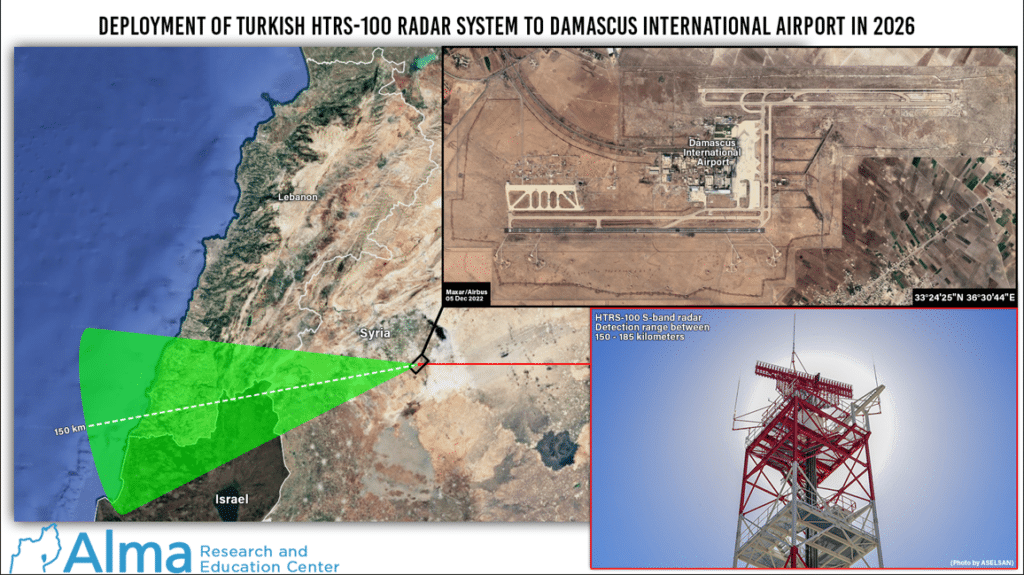
The peak of this process was reflected in January 2026, with the revelation of the deployment of an advanced radar system manufactured by the Turkish defense industry company ASELSAN – the HTRS-100 system – at Damascus International Airport.
This move was officially and diplomatically defined by Syria’s civil aviation authorities, as well as by the Turkish ambassador in Damascus, Nuh Yilmaz, as a civilian infrastructural upgrade intended to improve flight safety and air traffic management.
However, an analysis of the system’s technical characteristics indicates a dual-use military-intelligence potential with significant implications.
The HTRS-100 system provides an accurate three-dimensional aerial picture within a radius of 80 to 100 nautical miles (approximately 150 to 185 kilometers), a range that covers not only the skies of Damascus but also large parts of Lebanon and even extends into the airspace of northern Israel.
The system combines a primary surveillance radar operating in the S-band frequency and incorporating advanced algorithms to suppress environmental and weather noise, together with a secondary surveillance radar that includes an interrogation system for Identification Friend or Foe (IFF), supporting complex military interrogation modes.
Its technological uniqueness lies in a redundancy-based architecture that enables the system to continue functioning partially even under damage or electronic failure, granting it very high survivability against advanced electronic warfare (EW) measures.
These features turn it into a strategic collection tool that produces real-time data at a high level of reliability.
This system does not operate in a vacuum. It replaces and complements Russian and Iranian detection systems (such as the S-300 arrays and the Iranian Borz or Bavar-373 systems), which sustained severe damage or proved insufficient in recent campaigns.
From Israel’s perspective, this move appears to constitute a certain threat to Israeli aerial freedom of movement in the region.




One Response
Dear Yaakov,
Any Turkish armaments in Syria, whether offensive or defensive, pose a direct threat to Israeli sovreignty: just listen to the venomous jihaddist rhetoric coming from the “Erred Again” islamo-nazi regime with threats to rule over Jerusalem. This is dangerous, delusional incitement towards violence. No Turkish weaponry should be allowed in Syria, period.