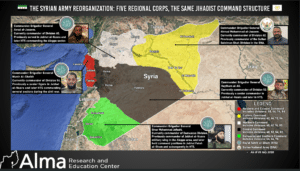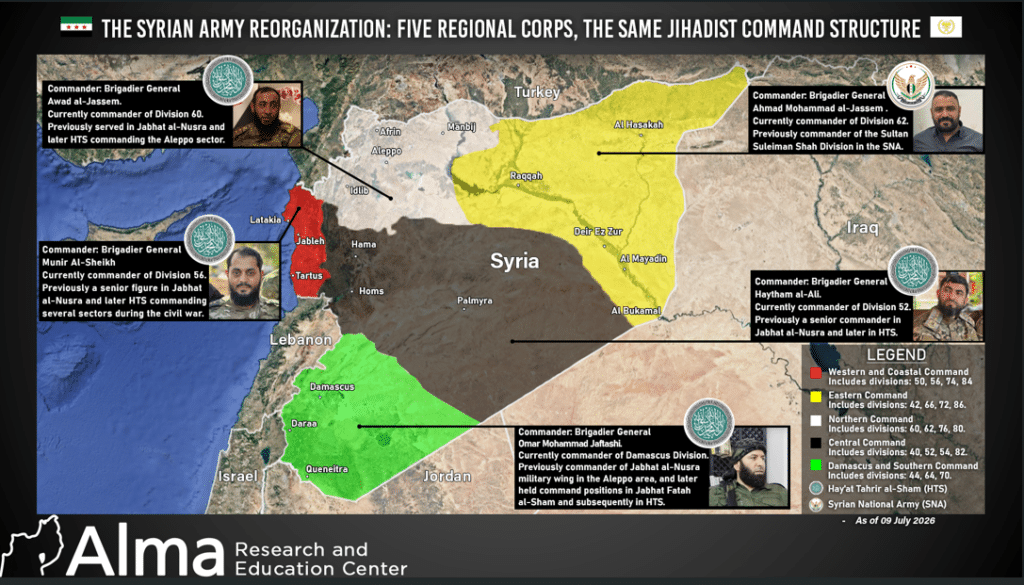
At the end of June 2026, several Syrian media and Telegram channels reported that the Syrian Ministry of Defense is advancing a comprehensive reform of the structure of the new Syrian Army. According to these reports, the army is expected to transition from a structure based on separate divisions to one organized into five regional corps, with each corps serving as a regional command responsible for a defined geographic sector and overseeing several divisions.
At first glance, this appears to be an organizational reform intended to improve command and control within the military. However, an examination of the identities of the new corps commanders suggests that the reform is not accompanied by a significant change in the senior command structure. Four of the five corps commanders are former senior commanders in Hay’at Tahrir al-Sham (HTS), the organization that evolved from Jabhat al-Nusra, al-Qaeda’s former affiliate in Syria. The fifth commander, Ahmad Mohammad al-Jassem, comes from the ranks of the Turkish-backed Syrian National Army (SNA). In other words, while the organizational structure is changing, the command hierarchy continues to rely on the same rebel commanders who led military operations throughout the Syrian civil war.
In July 2025, the Alma Research and Education Center published a special report on the new Syrian Army, mapping its structure, order of battle, divisions, commanders, and their organizational and ideological backgrounds. The recent reports regarding the reorganization into five regional corps represent another stage in the army’s force-building process and provide an opportunity to examine whether the organizational changes are accompanied by changes in the command echelon.
The apparent objective of establishing regional corps is to reorganize the chain of command, unify the various military formations established since the creation of the new army, and build a regular military with a clearer command structure capable of deploying forces rapidly and efficiently across the country’s various fronts.
It is important to emphasize that, as of the time of writing, the Syrian Ministry of Defense has not issued an official statement confirming the reform, nor has a presidential decree or government document been published formally establishing the new structure. The information is based on reports published on June 29, 2026, by several Syrian media outlets and Telegram channels, which described the move as a decision that emerged from internal discussions within the Ministry of Defense.
Nevertheless, the existence of a broad military reorganization is consistent with the ongoing force-building process within the Syrian Army, which has continued under Turkish patronage since early 2025. From its first days in office, the transitional government began working to unify dozens of rebel factions under a single military framework, rebuild the command hierarchy, and establish regular military formations. Therefore, even if the details of the five-corps structure have not yet been officially confirmed, they fit logically within the broader process of building the new Syrian military.
Five Regional Corps – The New Division of Responsibilities
Eastern Corps
Commander: Brig. Gen. Ahmad Mohammad al-Jassem (أحمد محمد الجاسم). Currently commander of the 62nd Division; previously commander of the Sultan Suliman Shah Division, which operated within the Turkish-backed Syrian National Army (SNA).
Divisions: 42nd, 66th, 72nd, and 86th Divisions.
Area of Responsibility: Deir ez-Zor, Al-Bukamal, Raqqa, Hasakah, and the Iraqi border.
Primary Missions: This is one of Syria’s most strategically important regions, encompassing the Iraqi border, the country’s principal oil fields, and the main areas of ISIS activity. Accordingly, the corps is expected to be responsible for combating ISIS, securing the eastern border, integrating the Syrian Democratic Forces (SDF) into the new Syrian Army, and consolidating the regime’s control over northeastern Syria.
With regard to the Kurdish issue, it is noteworthy that the designated corps commander, Ahmad Mohammad al-Jassem, is under international sanctions for actions committed during the Syrian civil war, particularly against Kurdish communities, including kidnappings, murder, torture, and other abuses.
Northern Corps
Commander: Brig. Gen. Awad al-Jassem (عواد الجاسم). Currently commander of the 60th Division; previously served as a commander in Jabhat al-Nusra and later in Hay’at Tahrir al-Sham (HTS), where he commanded the Aleppo sector during the civil war and was wounded in battles against Assad’s forces.
Divisions: 60th, 62nd, 76th, and 80th Divisions.
Area of Responsibility: Aleppo, Afrin, Manbij, and the Turkish border.
Primary Missions: Northern Syria remains the primary area of Turkish influence, where Turkish-backed rebel organizations operating under the Syrian National Army (SNA) have been active for years. The corps is expected to oversee the Turkish border, confront Kurdish forces, and preserve control over areas where Turkey continues to maintain a significant military and political presence.
Central Corps
Commander: Brig. Gen. Haytham al-Ali (هيثم خالد العلي). Currently commander of the 52nd Division; previously a senior commander in Jabhat al-Nusra and later in Hay’at Tahrir al-Sham (HTS).
Divisions: 40th, 52nd, 54th, and 82nd Divisions.
Area of Responsibility: Homs, Hama, and the Syrian Desert.
Primary Missions: The Central Corps is expected to be responsible for central Syria and the desert region, which has become one of ISIS’s principal operational areas in recent years. It will also be responsible for securing the M5 Highway, Syria’s main transportation artery connecting Damascus and Aleppo.
Damascus and Southern Corps
Commander: Brig. Gen. Omar Mohammad Jaftashi (عمر محمد جفتشي), known as “Mukhtar al-Turki” – and he is a Turkish citizen. Currently commander of the Damascus Division; previously headed Jabhat al-Nusra’s military wing in the Aleppo area and later held senior command positions in Jabhat Fatah al-Sham and subsequently Hay’at Tahrir al-Sham (HTS). He is considered one of al-Sharaa’s most trusted and closest associates and has been identified as one of the founders of Hay’at Tahrir al-Sham (HTS). In addition, according to numerous reports, Jaftashi maintains close ties to Turkish intelligence and has served as a liaison on its behalf.
Divisions: 44th, 64th, and 70th Divisions.
Area of Responsibility: Damascus, Rif Damascus, Daraa, Quneitra, the Israeli border, and the Lebanese border.
Primary Missions: From Israel’s perspective, this is the most significant regional command. It is responsible for the border with Israel, the border with Lebanon, southern Syria, and the capital, Damascus. Consequently, virtually every security development on the Golan Heights, within the buffer zone, or elsewhere in southern Syria is expected to fall under this corps’ responsibility.
Western and Coastal Corps
Commander: Brig. Gen. Munir al-Sheikh (منير الشيخ). Currently commander of the 56th Division; previously a senior commander in Jabhat al-Nusra and later Hay’at Tahrir al-Sham (HTS). During the Syrian civil war, he commanded several sectors in northwestern Syria, including Hama, Jabal al-Zawiya, and southern Aleppo, as well as the Abu Bakr al-Siddiq and Uthman ibn Affan Brigades within HTS.
Divisions: 50th, 56th, 74th, and 84th Divisions.
Area of Responsibility: Latakia, Tartus, Jableh, and the Alawite Mountains.
Primary Missions: This corps is expected to be responsible for Syria’s Mediterranean coast, where major clashes with the Alawite population took place during 2025. In addition to securing the coastline, it will oversee the country’s strategic ports of Latakia and Tartus while further consolidating regime control over the region.
The geographic area under this corps also includes the presence of Russian military forces, including Khmeimim Air Base.
The Significance of the Reform
In practice, this is not merely an organizational reform but a conceptual transformation of the army’s command structure.
Until now, the new Syrian Army has been based primarily on divisions operating with a considerable degree of autonomy, many of which retained close ties to the rebel organizations from which they originated. The Ministry of Defense now seeks to introduce an additional command level – a regional geographic corps – that will oversee multiple divisions and assume responsibility for all military activity within its designated sector.
Through this reform, the regime aims to establish a clearer chain of command, improve control over military forces, shorten decision-making processes, and enable more flexible force deployment in response to changing threats across Syria’s various fronts.
However, even if the organizational structure changes, the central question remains unchanged: Who are the individuals commanding these regional corps?
The reform does not indicate a fundamental transformation in the nature of the new Syrian Army. Rather, it reflects the continued institutionalization of the same military force that was built upon the foundations of the former rebel organizations—a reorganization of the same centers of power under a new organizational framework.
From Israel’s perspective, the key question is not merely how the army is organized, but who commands it. The fact that four of the five regional corps commanders are former senior HTS (formerly Jabhat al-Nusra) figures, alongside one commander drawn from the pro-Turkish Syrian National Army (SNA), demonstrates that the new Syrian Army continues to rely on a command structure rooted in former rebel organizations, most of which are characterized by a Salafi-jihadist ideological background. Understanding the organizational and ideological backgrounds of these commanders is therefore of direct importance in assessing the future character of the Syrian Army and the security challenge it may pose to Israel.