
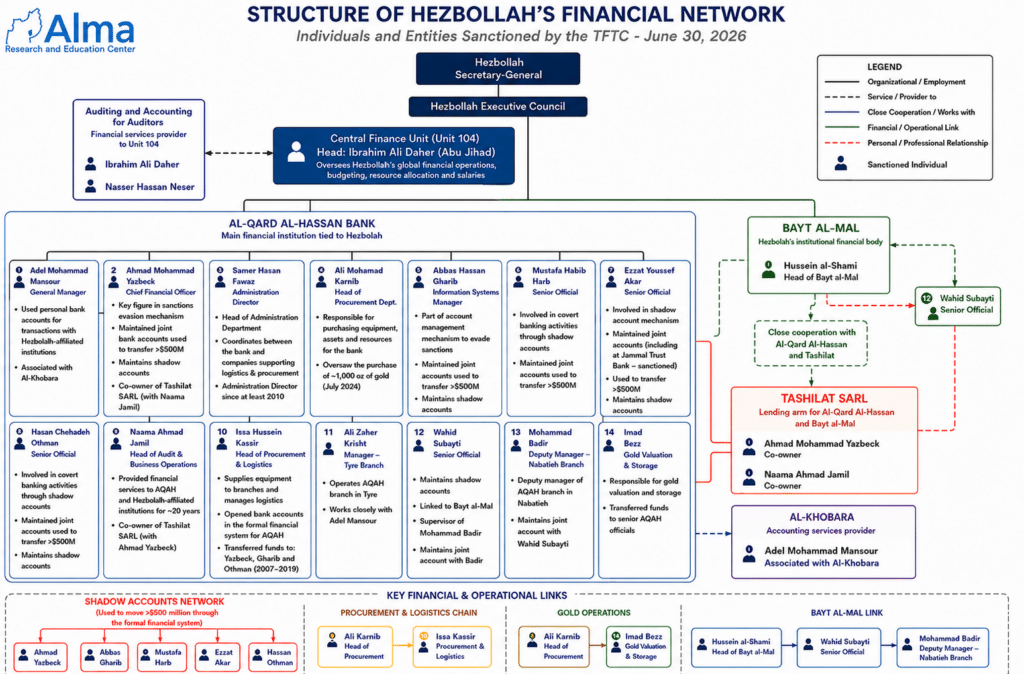
In a statement published on the U.S. Department of the Treasury’s website on June 30, the member states of the Terrorist Financing Targeting Center (TFTC) announced the imposition of joint sanctions on five entities and 16 individuals who constitute a central part of Hezbollah’s financial network (see details in the appendices). The TFTC is a multilateral coalition established in 2017 to combat international terrorist financing networks. The sanctions focus on the core of Hezbollah’s economic infrastructure, headed by Al-Qard Al-Hassan and Bayt al-Mal, as well as a number of senior officials, companies, and professionals that enable their operations. All of the entities and individuals included in the designation had already been sanctioned by OFAC (Office of Foreign Assets Control), the U.S. Department of the Treasury’s sanctions enforcement.
In recent years, the Alma Research and Education Center has published several articles on Hezbollah’s financial network, covering, among other topics, Al-Qard Al-Hassan, Bayt al-Mal, the Central Finance Unit, and several key figures within the network.
The sanctions do not indicate the establishment of new financial infrastructure. Rather, they publicly expose the organizational structure of Hezbollah’s financing mechanism and the methods it has developed over the years to circumvent sanctions and continue operating within the Lebanese and international financial systems.
This is one of Hezbollah’s most important sources of strength, enabling the organization to finance not only its military activities, but also its welfare network, propaganda apparatus, reconstruction efforts, procurement, and force build-up.
Al-Qard Al-Hassan and Bayt al-Mal – The Core of Hezbollah’s Financial System
The sanctions once again underscore that Al-Qard Al-Hassan is not merely a social charity, but in practice serves as Hezbollah’s central financial institution. Operating under the guise of a civilian organization, it provides banking services, manages cash and gold assets, operates a loan system, and facilitates the transfer of funds on behalf of the organization. In doing so, it provides Hezbollah with an almost independent financial system that reduces its reliance on the Lebanese banking sector and helps it cope with the sanctions regime.
Alongside it operates Bayt al-Mal, which serves as Hezbollah’s unofficial treasury. Unlike Al-Qard Al-Hassan, which operates publicly as a financial institution, Bayt al-Mal does not function openly. It manages the organization’s assets, oversees its investments, and serves as Hezbollah’s senior financial arm under the direct supervision of the organization’s Secretary-General.
Over the years, the two institutions have evolved into a complementary system. Following the damage inflicted on Bayt al-Mal during the Second Lebanon War and the sanctions imposed on it in 2006, a significant portion of its financial activities was transferred to Al-Qard Al-Hassan, which substantially expanded its role.
The Central Finance Unit (Unit 104) – The Nerve Center of the Financial System
At the head of Hezbollah’s financial network is Ibrahim Ali Daher (Hajj Jihad), the head of the organization’s Central Finance Unit. The unit is responsible for consolidating Hezbollah’s revenues from around the world, preparing its budget, allocating resources among its various units, overseeing expenditures, and paying the salaries of the organization’s operatives. Daher serves within Hezbollah’s Executive Council and reports directly to the organization’s Secretary-General, indicating that the financial network is not merely a technical body but an integral part of Hezbollah’s decision-making structure.
The Sanctions Evasion Mechanism
One of the most significant findings revealed by the sanctions is the extensive use of financial concealment mechanisms. Several senior officials at Al-Qard Al-Hassan, including Ahmad Yazbeck, Abbas Gharib, Mustafa Harb, Izzat Akar, and Hasan Othman, maintained joint bank accounts and “shadow accounts” registered in their personal names for more than a decade. Through this mechanism, they succeeded in transferring more than half a billion dollars through the formal financial system despite the sanctions imposed on the organization.
These findings demonstrate that Hezbollah does not rely solely on covert financial transfers or informal systems such as hawala (see our report on the use of money changers and the hawala system, published in July 2025). Rather, it also makes systematic use of the Lebanese banking system through nominees, personal bank accounts, and commercial companies.
Civilian Companies as Part of Hezbollah’s Financing Network
The sanctions also expose the role of civilian companies within Hezbollah’s financial network. Al-Khobara provided accounting services to the organization’s financial institutions and operated from the Al-Qard Al-Hassan building, while Tashilat SARL served as the lending arm for Al-Qard Al-Hassan and Bayt al-Mal. In addition, Auditors for Accountingand Auditing, a company controlled by Ibrahim Daher, provided financial services directly to Hezbollah’s Central Finance Unit.
The involvement of civilian companies, accountants, financial managers, and logistics personnel demonstrates that Hezbollah’s financial system operates as a sophisticated business network rather than as a terrorist organization relying on a single source of funding.
The new sanctions are not expected to immediately cripple Hezbollah’s financial network. Over the years, the organization has demonstrated a strong ability to adapt to sanctions regimes, establish sanctions-evasion mechanisms, and shift its activities among institutions, companies, and individuals. Nevertheless, the public disclosure of the entities and individuals involved is of considerable importance. It makes it more difficult for them to operate within the international financial system, increases the risk for institutions and individuals that maintain business relationships with them, and provides an unprecedented exposure of the internal structure of one of Hezbollah’s most important power centers.
Particularly at a time when Hezbollah is working to rebuild its capabilities following the war, the sanctions demonstrate that disrupting the organization’s financial network is a necessary condition for limiting its ability to finance its activities and restore its capabilities.
Appendix – Individuals
* The data are based on information from the U.S. Department of the Treasury and publications by the Alma Research and Education Center.
1. Ibrahim Ali Daher
Ibrahim Ali Daher (Abu Jihad) is the head of Hezbollah’s Central Finance Unit (Unit 104), the body responsible for consolidating the organization’s revenues from around the world, preparing its budget, allocating resources among its various units, and paying the salaries of its operatives. The unit operates within Hezbollah’s Executive Council and reports directly to the organization’s Secretary-General. Daher is regarded as the most senior figure in Hezbollah’s financial network because he oversees not just a single institution, but the organization’s entire budgeting mechanism. In addition, he is affiliated with Auditing and Accounting for Auditors, which provided financial services to the Central Finance Unit.
2. Adel Mohammad Mansour
Adel Mansour serves as the General Manager of Al-Qard Al-Hassan Bank. He also used his personal bank accounts to conduct transactions with various Hezbollah-affiliated institutions. In addition, he is associated with Al-Khobara, which operated from the Al-Qard Al-Hassan building and provided accounting services to the organization’s financial institutions.
3. Ahmad Mohammad Yazbeck
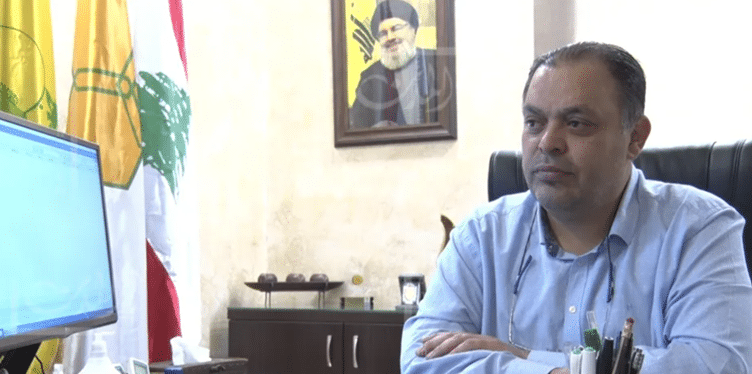
Ahmad Yazbeck serves as the Chief Financial Officer of Al-Qard Al-Hassan Bank. He is one of the key figures in Hezbollah’s sanctions-evasion mechanism and, together with other senior officials, maintained joint bank accounts at Lebanese banks. Through these accounts, more than $500 million was transferred through the formal financial system despite the sanctions imposed on Al-Qard Al-Hassan. Yazbeck also maintained “shadow accounts” that were used to conduct financial transactions on behalf of Hezbollah. In addition, he is a co-owner of Tashilat SARL together with Naama Ahmad Jamil.
4. Samer Hasan Fawaz
Samer Fawaz heads the Administration Department of Al-Qard Al-Hassan Bank. He is responsible for the institution’s day-to-day management and for coordinating between Al-Qard Al-Hassan and various companies that support its logistics and procurement activities. His role is significant because it links the bank’s financial operations with the operational infrastructure that enables it to function on a large scale. He has also served as the Administrative Director of Al-Qard Al-Hassan since at least 2010.
5. Ali Mohamad Karnib
Ali Karnib is a senior official at Al-Qard Al-Hassan Bank and serves as the head of the bank’s Procurement Department. His responsibilities include the acquisition of equipment, assets, and other resources for the bank. As of July 2024, he oversaw the purchase of more than 1,000 ounces of gold for Al-Qard Al-Hassan. This illustrates the use of gold as a key financial asset within Hezbollah’s financial network, alongside cash and bank accounts.
6. Abbas Hassan Gharib
Abbas Gharib serves as the Information Systems Manager of Al-Qard Al-Hassan Bank. Beyond his technological role, he was part of the account management mechanism used to circumvent sanctions. Together with Ahmad Yazbeck, Mustafa Harb, Izzat Akar, and Hasan Othman, he maintained joint bank accounts that enabled the transfer of more than $500 million through the Lebanese banking system. In addition, Gharib maintained “shadow accounts” that were used to conduct financial transactions on behalf of Hezbollah.
7. Mustafa Habib Harb
Mustafa Harb is a senior official at Al-Qard Al-Hassan Bank who was involved in covert banking activities through the use of “shadow accounts.” He was among the group of senior officials who maintained joint bank accounts to transfer funds on behalf of Hezbollah through the formal financial system. His significance lies primarily in his role as part of the collective mechanism that enabled the organization to continue operating financially despite the sanctions. His activities illustrate the method by which Hezbollah used private individuals to conceal institutional financial activity.
8. Ezzat Youssef Akar
Izzat Akar is a senior official at Al-Qard Al-Hassan Bank who was involved in Hezbollah’s “shadow account” mechanism. Together with other senior officials, he maintained joint bank accounts at Lebanese banks, including Jammal Trust Bank, which was itself subject to U.S. sanctions. These accounts were used to transfer more than $500 million through the formal financial system. Akar also maintained several shadow accounts through which financial transactions were conducted on behalf of Hezbollah.
9. Hasan Chehadeh Othman
Hassan Othman is a senior official at Al-Qard Al-Hassan Bank who participated in covert banking activities through the use of shadow accounts. He was part of the same group of senior officials that maintained joint bank accounts to transfer large sums of money on behalf of Hezbollah. These accounts enabled the organization to move funds through the formal financial system despite the sanctions. He also maintained shadow accounts that were used to conduct financial transactions on behalf of the organization.
10. Naama Ahmad Jamil
Naama Ahmad Jamil is a senior official at Al-Qard Al-Hassan Bank and serves as the head of the bank’s Audit and Business Operations Departments. For nearly twenty years, he has provided financial services to Al-Qard Al-Hassan and Hezbollah-affiliated institutions. In addition, he is a co-owner, together with Ahmad Yazbeck, of Tashilat SARL, which served as the lending arm for Al-Qard Al-Hassan and Bayt al-Mal. His role links the bank’s internal audit system with the civilian companies that supported the organization’s financial activities.
11. Issa Hussein Kassir
Issa Kassir is a senior official at Al-Qard Al-Hassan Bank who heads the department responsible for supplying equipment to the organization’s branches and managing its procurement and logistics activities. He opened bank accounts within the formal financial system to conduct business activities on behalf of Al-Qard Al-Hassan. Between 2007 and 2019, he transferred nearly $1 million to the bank accounts of Ahmad Yazbeck, Abbas Gharib, and Hasan Othman. This indicates his role as an operational-financial figure linking procurement activities with the organization’s fund transfer mechanism.
12. Ali Ahmad Krisht
Ali Krisht served as the manager of the Tyre branch ofAl-Qard Al-Hassan Bank. He previously maintained at least three bank accounts on behalf of Hezbollah and worked in close coordination with Adel Mansour, the General Manager of Al-Qard Al-Hassan, as well as with other senior officials within the organization. His role demonstrates that regional branch managers were also part of a broader financial mechanism, rather than merely managing local banking services. The Tyre branch is particularly significant due to its location in southern Lebanon, a key area of Hezbollah’s operations.
13. Nasser Hassan Neser
Nasser Neser managed Auditing and Accounting for Auditors together with Ibrahim Daher. He served as the company’s managing partner, held a minority ownership stake, and acted as its authorized signatory, director, and legal representative. Neser reported on the company’s activities to senior members of Hezbollah’s Executive Council and to senior officials in the Central Finance Unit, including Ibrahim Daher. In this capacity, he served as the link between an ostensibly civilian company and Hezbollah’s central financial apparatus.
14. Wahid Mahmoud Subayti
Wahid Subayti is a senior official at Al-Qard Al-Hassan Bank who was involved in conducting financial transactions on behalf of Hezbollah through the use of “shadow accounts.” He played a similar role in managing bank accounts registered in his own name, together with other senior officials from Bayt al-Mal. This activity formed part of a mechanism designed to circumvent sanctions by using personal identities and private bank accounts. Subayti represents the connection between Al-Qard Al-Hassan and Bayt al-Mal within Hezbollah’s financial concealment mechanism.
15. Mohammad Suleiman Badir
Mohammad Badir served as the Deputy Manager of the Nabatiehbranch ofAl-Qard Al-Hassan Bank, under the supervision of Wahid Subayti. Together with Subayti, Badir maintained a joint bank account that was opened as part of a Hezbollah program designed to circumvent the formal financial system. The program relied on opening bank accounts in the personal names of Hezbollah members and associates. His role indicates that even mid-level branch managers were involved in the organization’s covert financial mechanism.
16. Imad Mohammad Bezz
Imad Bezz heads the Valuation and Storage Department at Al-Qard Al-Hassan Bank and is responsible for the organization’s gold transactions. According to the document, he conducted numerous transactions with senior Al-Qard Al-Hassan officials who were involved in covert banking activities. Among other transactions, he transferred more than $2.5 million to a bank account jointly held by three other senior officials within the organization. His role is significant because it highlights the central importance of gold within Hezbollah’s financial network, both as a store of value and as a means of circumventing banking restrictions.
Appendix – Entities
1. Al-Qard Al-Hassan Bank
Al-Qard Al-Hassan is one of the core institutions of Hezbollah’s financial network and a central pillar of the organization’s ability to maintain financial independence and support its military, political, and civilian activities. Established in 1983, it presents itself as a non-profit lending association operating in accordance with the principles of Islamic law, with the stated purpose of providing interest-free loans to the Lebanese population. In practice, however, Al-Qard Al-Hassan has evolved over the years into a large-scale financial institution that functions as a full-fledged bank for Hezbollah’s support base.
Through dozens of branches across Lebanon, it provides loans, deposit services, gold-backed lending, money transfers, and other financial services, while operating largely outside the oversight of Lebanon’s financial authorities. Beyond its economic role, Al-Qard Al-Hassan serves as a strategic tool for strengthening Hezbollah supporters’ dependence on the organization, expanding its social influence, and creating a parallel financial system that reduces its reliance on the Lebanese banking sector. This capability became particularly important following Lebanon’s economic crisis and the tightening of international sanctions, enabling Hezbollah to continue managing its resources and financing its activities even during periods of economic and political pressure.
2. Bayt al-Mal
Bayt al-Mal (بيت المال, House of Money), also known as Bayt al-Mal Lil Muslimeen (بيت مالالمسلمين, House of Money for the Muslims), is not a conventional commercial company. Rather, it is Hezbollah’s institutional financial body, serving as an internal treasury, investment arm, and credit mechanism. As early as 2006, the U.S. Department of the Treasury described it as an entity that provides financial services to Hezbollah, operates under the direct supervision of the organization’s Secretary-General, and functions as a bank, lender, and investment arm. Its headquarters are located in Dahiyeh, Beirut.
According to the U.S. Department of the Treasury, Bayt al-Mal managed Hezbollah’s investments and assets and acted as an intermediary between the organization and conventional banks. It also used Yousser Company for Finance and Investment to obtain loans and finance transactions on behalf of Hezbollah-affiliated companies.
According to OFAC records, Bayt al-Mal operates from several locations across Lebanon, including Haret Hreik, Burj al-Barajneh, Sidon, Tyre, Nabatieh, Baalbek, and Hermel.
The principal figure associated with Bayt al-Mal is Hussein al-Shami (حاج حسين الشامي). The U.S. Department of the Treasury identified him as the head of Bayt al-Mal, a senior Hezbollah official, and an individual involved with several Hezbollah-affiliated entities, including the Islamic Resistance Support Organization. According to U.S. sources, al-Shami also served as a link between Bayt al-Mal, Al-Qard Al-Hassan, and other companies such as Tashilat.
The Alma Research and Education Center published an article on Hussein al-Shami, the head of Bayt al-Mal, in August 2022.
3. Al-Khobara Co. (“The Experts Company”)
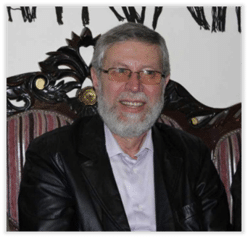
Al-Khobara for Accounting, Auditing, and Studies (الخبراء للمحاسبة والتدقيق والدراسات) is an accounting, auditing, and financial reporting firm. It is also known as Al Khobara Co. Accounting-Auditing Studies. Its Lebanese registration number is 81396.
On the surface, the company operates as a civilian professional services firm providing accounting, auditing, research, and financial services. It ostensibly offers bookkeeping, auditing, financial reporting, tax and financial consulting, and regulatory compliance services. Based on publicly available information, we were unable to identify a commercial website, client list, annual reports, project portfolio, or an independent corporate profile.
According to the U.S. Department of the Treasury, Al-Khobara operated from the Al-Qard Al-Hassan building, provided accounting services to Al-Qard Al-Hassan, and was managed by senior Al-Qard Al-Hassan officials.
One of the most significant findings is that Hezbollah financial personnel assisted Al-Khobara employees in their dealings with the Lebanese Ministry of Finance regarding tax payments. This places the company in a particularly sensitive position: it did not merely maintain financial records, but appears to have served as a professional interface between Hezbollah’s financial network and the Lebanese state.
4. Tashilat SARL (“Facilitations”)
Tashilat SARL (also known as Al Tasheelat Company LLC شركة التسهيلات ش.م.م.) is a Lebanese SARL (limited liability company). According to OFAC, it was established on October 18, 2006, and its Lebanese registration number is 2008980. It is also listed under the names Al Tasheelat Company LLC and Tashilat.
According to publicly available information, the company provides short- and medium-term personal loans, financing for individuals and small businesses, credit and accounting consultancy, as well as payment and clearing services.
The company’s role in providing loans and mortgages following the 2006 Second Lebanon War is particularly notable. According to the U.S. Department of the Treasury, Tashilat provided mortgage loans after the war and served as an integral part of the activities of Al-Qard Al-Hassan and other Hezbollah-affiliated financial institutions, including Bayt al-Mal and Yousser Company for Finance and Investment.
5. Auditing and Accounting for Auditors
Auditing and Accounting for Auditors (المدققون للمحاسبة والتدقيق) is a Lebanese accounting and auditing firm. The company is registered under Lebanese registration number 278, and according to OFAC, its registration/incorporation date is February 22, 2006.
On the surface, the company operates in the fields of accounting, financial auditing, and tax consultancy. It is described as a firm providing accounting, auditing, and tax advisory services. The company operates within a network of companies and financial institutions associated with Tashilat, Bayt al-Mal, and Al-Qard Al-Hassan.
The company’s primary known activity is the provision of financial services to Hezbollah’s Central Finance Unit. Since the Central Finance Unit is responsible for the organization’s budget, expenditures, salaries, and resource allocation, the company appears to have been more than an external accounting firm; rather, it was part of the oversight and management structure supporting Hezbollah’s internal budgeting system.


2 Responses
Dear Dr Zoe,
Good work exposing terrorist dark money and operatives. Those who fund, support and cooperate with terrorists to perform terrorist activities are guilty of terrorism, and must be eliminated from the terrorist infrastructure. We will find you and we will kill you, just like the nazi death camp operators.
Dear Dr Zoe,
I am wrestling with the existence of moral ambiguity. Perhaps the only thing worse than the despotic terrorist ayatolla/IRGC death cult oppression and murder of innocents would be the denial of what they do by those who hide under lies of tolerance for reasons of profit, power or cowardice. The tolerance of Evil is also Evil. Hitler should have been stopped early in the 1930’s. Due to “tolerance” of his evil, genocidal and power mongering warfare and extermination camps, 80 million people died. Have we learned this lesson of history?