
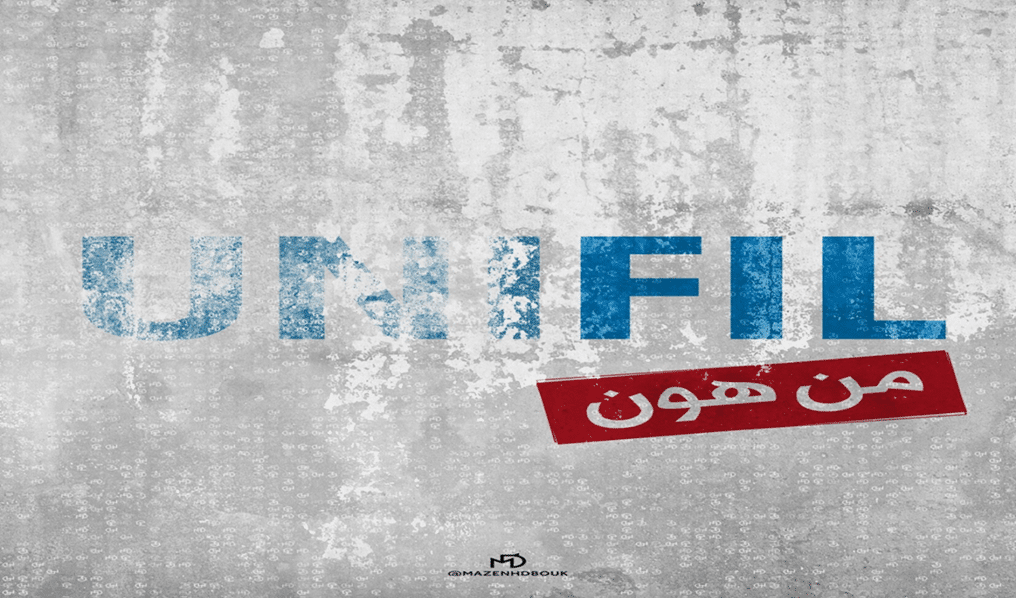
Note – The Arabic text in the visual is part of the phrase “Get out of here.” (“FIL MIN HON” / فل من هون) – a play on words based on an old Hezbollah campaign slogan, combining the word UNIFIL with the phrase “Get out of here.”
Why Is There No Place for the Continued Activity of a Foreign Force in Southern Lebanon?
On 23 July, a Lebanese parliamentary delegation delivered a letter to the Representative of the UN Secretary-General in Lebanon, signed by 86 Members of Parliament, demanding that the continued operation of UNIFIL in southern Lebanon be ensured.
On 24 July, Lebanese President Aoun met with European Union Ambassador Sandra De Waele together with ambassadors and representatives of European and Western countries. During the meeting, Aoun stated that the continuation of UNIFIL’s activity is the preferred option. He added that if the mandate cannot be extended, an alternative force should be established to assist the Lebanese Army in clearing mines and ammunition, clearing the area, and accompanying the implementation of the agreement.
Nearly fifty years after the establishment of UNIFIL, and approximately twenty years after the adoption of UN Security Council Resolution 1701, the time has come to recognize reality: the model of a peacekeeping force in southern Lebanon has failed. Extending UNIFIL’s mandate (as Lebanon seeks) or granting a mandate to a foreign force (as proposed in various European initiatives, foremost among them a French initiative) operating in a framework similar to UNIFIL—even under a different name, with a different composition, or with minor adjustments—is not expected to improve security stability. On the contrary, it is liable to preserve the very failures that enabled Hezbollah to transform southern Lebanon into the most heavily fortified military area constructed within the framework of the Shiite Axis outside Iran.
The problem lies not only in UNIFIL’s performance or in the quality of the forces that have participated in it over the years. The failure is structural. UNIFIL was designed as a peacekeeping force, whereas in southern Lebanon there has never been peace to keep. In the existing reality, in which one of the principal actors is an armed military terrorist organization enjoying Iranian support, possessing independent military power, and operating from within a civilian population contrary to the interests of the Lebanese state, a force such as UNIFIL, which is based on consent, neutrality, and the avoidance of friction, is incapable of achieving its objectives.
Resolution 1701 itself also reflects this gap. The resolution tasks UNIFIL with assisting the Lebanese Army in creating an area free of illegal weapons between the Blue Line and the Litani River, yet it does not grant the force genuine enforcement authorities (such as, first and foremost, acting against Hezbollah under clear rules of engagement, the authority to conduct searches, enter private property, and confiscate weapons).
In practice, responsibility for enforcement remained with the Lebanese Army—a body that was neither prepared nor, in many cases, willing to confront Hezbollah. Moreover, it submitted false reports claiming to have undertaken weapons dismantlement activities during the ceasefire between November 2024 and March 2026.
Thus, a mechanism was created in which responsibility exists on paper, yet no party actually implements it.
The outcome was clear. For almost two decades following the Second Lebanon War, Hezbollah succeeded in rebuilding an extensive military infrastructure south of the Litani River. Thousands of weapons were concealed in villages, underground infrastructure was constructed, combat compounds were established within civilian populations, and an offensive system designed to enable an invasion of the Galilee was built. All of this took place in an area where thousands of UNIFIL soldiers (and Lebanese Army soldiers) operated continuously.
The most recent war demonstrated the depth of this failure. IDF forces uncovered enormous quantities of weapons, fortified compounds, and tunnels that had never been reported by UNIFIL. At the same time, Hezbollah exploited the proximity of UN positions as part of its human shield tactics, assuming that the presence of the international force would limit Israel’s freedom of action.
During the ground maneuver, there were even cases in which UNIFIL’s presence in combat zones actually complicated IDF operations instead of contributing to stability. This was in addition to cases in which UNIFIL soldiers cooperated (quite literally) with Hezbollah.
Even after the ceasefire entered into force, no fundamental change occurred. Hezbollah continued its military activity and its violations of Resolution 1701, while UNIFIL (and the Lebanese Army) did not prevent Hezbollah operatives from returning to the south, did not stop the rehabilitation of infrastructure, and did not provide an effective enforcement mechanism. In practice, it was the IDF, through its operational activity, that enforced the security arrangement—not the international force (nor the Lebanese Army).
Despite this reality, one of the recurring proposals in the international discussion is to establish a new foreign force to replace UNIFIL. However, replacing the emblem on the helmet or changing the name of the mission does not change the problem. If the new force is likewise based on the same principles—the consent of the Lebanese government, the absence of enforcement powers, dependence on cooperation with the Lebanese Army (which in any event will not disarm Hezbollah), and a commitment to neutrality—it is expected to produce precisely the same results.
Europeans argue, and fear, that dismantling UNIFIL would create a “security vacuum.” However, this claim ignores the fact that the vacuum already existed for many years, while Hezbollah built, without interference, one of the largest and most sophisticated military infrastructures in the Middle East. The failure does not stem from the absence of an international force, but from the fact that the force that existed did not fulfill its mission and was incapable of preventing Hezbollah’s military buildup.
Quite often, expressing pessimism regarding the Middle East in general, and the Shiite Axis in particular, is in fact simply being realistic. Even if a new foreign force were established and granted significant powers to act against Hezbollah, would soldiers from the international community truly risk a genuine confrontation with Hezbollah by attempting to disarm it? Would these foreign forces really ignore the consequences of such a confrontation—such as car bomb attacks against them? Gunfire directed at them? Kidnappings?
This does not mean that there is no place for international involvement in southern Lebanon. On the contrary. The international community can and should continue contributing to the stabilization of the area through the civilian track, by providing economic assistance, civilian reconstruction, infrastructure development, support for Lebanese state institutions, and the application of political and economic pressure on the Lebanese government to advance Hezbollah’s disarmament. All of this, of course, while implementing effective oversight mechanisms that prevent Hezbollah from benefiting from such assistance.
Assistance to the Lebanese Army? Only after reforms have been implemented, foremost among them the dismissal of all those collaborating with Hezbollah (and there are many of them at every level).
There is no place for preserving or re-establishing a large-scale international military force operating in southern Lebanon. Past experience demonstrates that forces of this kind struggle to deal with a terrorist organization possessing significant military power, enjoy the status of observers more than enforcers, and in practice may provide the armed organization with a safer operating environment rather than restricting it.
Accordingly, any discussion of the future of security in southern Lebanon must begin with a simple recognition: the problem is not UNIFIL alone, but the very assumption that an international “peacekeeping” force is capable of dealing with a reality in which there is no peace, and there will be no peace as long as a terrorist organization stronger than the state in which it operates continues to exist.
The real challenge is not how to prolong the life of a failed model, but how to avoid repeating it and creating different mutations of it.
Any future permanent arrangement with Lebanon must be based on preserving Israel’s freedom of action against any attempt by Hezbollah to reconstitute its military capabilities.
Extending UNIFIL’s mandate or establishing another mutation of it will not achieve these objectives—it may only postpone the next confrontation instead of preventing it.
We have learned the lesson in southern Lebanon well: not UNIFIL, not another alternative force, not the Lebanese government, and not the Lebanese Army. Only Israel can act effectively against Hezbollah, and it is desirable that the international community internalize this.
What can the Lebanese government and the Lebanese Army do? See the Policy Recommendation document we published on 15 March 2026.


One Response
Dear Tal,
I agree. UNIFIL is a parasitic leach transferring extorted “peacekeeping” funding for terrorism infrastructure, arms, and actions. It must be totally dismantled and removed by the roots. Lebanon must be governmentally restructured to eliminate hezbollah parasites, and adopt a policy to recognize the state of Israel to exist as a sovereign state. Anything less is delusional.