
The First Pilot Area: Hezbollah’s Mechanisms Are Already Back in Operation
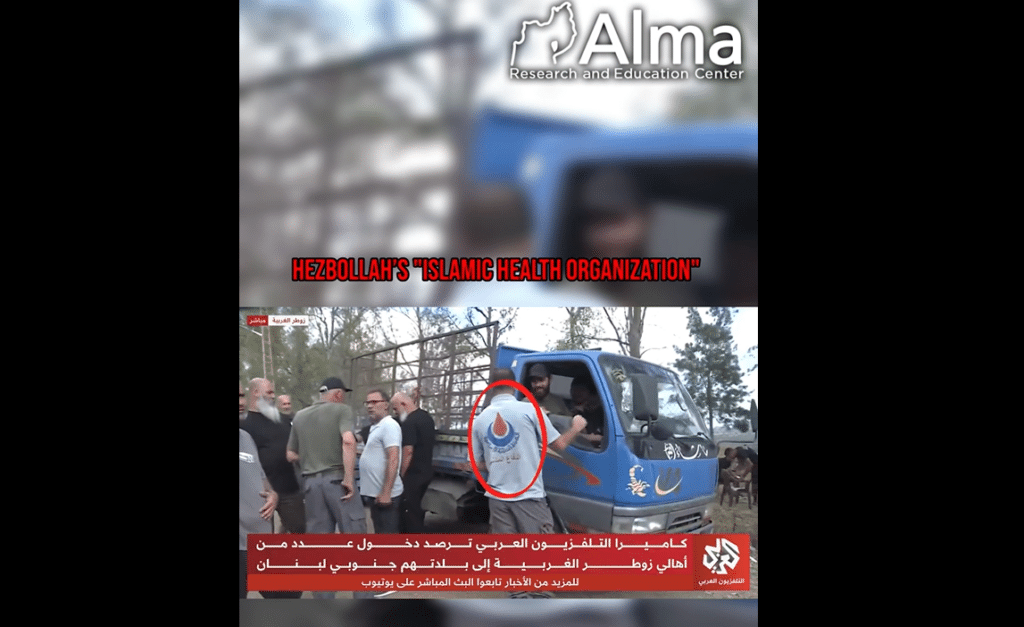
Following the deployment of the Lebanese Armed Forces (LAF) in Zawtar al-Gharbiyah under the Israel-Lebanon understandings, a collection of recent documentation, including an official publication by Hezbollah’s Islamic Health Organization, shows the organization’s activity inside the village.
The significance is clear: it is not only the residents who are returning, but also one of Hezbollah’s key operational mechanisms. Where there are Shiites, there is Hezbollah.
The videos show members of Hezbollah’s Islamic Health Organization operating in the village to recover the bodies of Hezbollah operatives while being accompanied by the Lebanese Army. The fact that the organization is openly and officially publicizing its activities indicates that it is not operating covertly, but rather openly, despite the presence of the Lebanese Army.
Zawtar al-Gharbiyah is one of the pilot areas agreed upon during the negotiations between Israel and Lebanon. These areas were intended to demonstrate that the Lebanese Army is capable of enforcing the understandings on the ground, preventing Hezbollah’s return, and acting against its infrastructure.
Despite its civilian appearance, Hezbollah’s Islamic Health Organization, which operates under the group’s Executive Council, is an integral part of Hezbollah’s military support network. In addition to providing medical services, it effectively serves as Hezbollah’s medical corps, supporting its forces during combat and participating in its operational activities. Throughout the war, the organization’s personnel and infrastructure served as platforms for activities unrelated to healthcare, including transporting operatives and weapons in ambulances, establishing command centres in clinics and hospitals, and more.
The documentation from Zawtar al-Gharbiyah illustrates how Hezbollah is resuming operations through one of its civilian mechanisms. The Islamic Health Organization is only one example. Hezbollah’s other civilian institutions- including those operating in the fields of healthcare, welfare, education, construction, and finance- do not function independently of its military wing. Rather, they form part of the infrastructure that supports it, enables its operations, and contributes to preserving and strengthening the organization’s capabilities.
The purpose of the Israel-Lebanon understandings is to prevent Hezbollah from rebuilding and re-establishing its presence in southern Lebanon. That objective cannot be achieved by addressing only weapons stockpiles and members of Hezbollah’s military wing. Alongside dismantling military infrastructure, action must also be taken against Hezbollah’s civilian mechanisms, which constitute an inseparable component of the organization’s military support network. So far, we have seen little evidence of meaningful enforcement even against Hezbollah’s military infrastructure. The documentation from Zawtar al-Gharbiyah suggests that, at least in this case, one of Hezbollah’s civilian mechanisms has already resumed operations on the ground. This raises an important question: why are the Lebanese Army’s own medical units—or Lebanon’s official state medical services—not carrying out the relevant recovery operations in Zawtar al-Gharbiyah?




2 Responses
Dear Dana,
Again hezbollah must be defined as public enemy #1, in every cancerous cellular form: health ministry = life extraction terrorism
law enforcement = life ending terrorism
medical services = hospital terror operations
aid distribution=feed terrorists, charge hungry
financial aid=terrorist infrastructure funding
Dear Dana,
Need to add a few more to list above:
News reporters= trained propagandists
Education= child indoctrination: to kill Jews
Geography teacher= remove Israel from map
Construction= building terror infrastructure
Industry= build rockets, missles, launchers
The time has come to REMOVE hezbollah!!!