Back in our March policy paper, we at the Alma Center recommended that the disarmament of Hezbollah should begin in Beirut, where the Lebanese government supposedly exercises more sovereignty, rather than in southern Lebanon. Ultimately, this recommendation was not adopted.
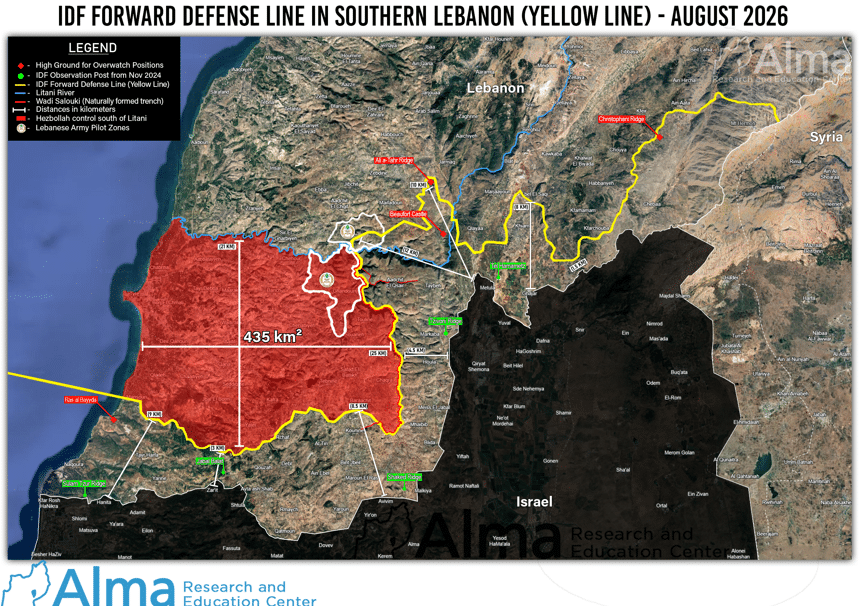
Instead, the current framework established “pilot zones” in areas from which the IDF is withdrawing, designed to give the Lebanese government a sense of achievement.
However, the events of the past week have proven that the Lebanese government’s ability to fulfill its promise and prevent Hezbollah from entering these areas is somewhere between partial and non-existent.
We have seen Hezbollah operatives infiltrating these zones under the guise of the Islamic Health Organization. They use affiliated ambulances for military purposes, including the transport of operatives and weapons, under the cynical pretext of evacuating bodies, a task that the Lebanese Red Cross or official state rescue forces could easily handle.
Furthermore, as Lebanese civilians begin to return to the villages, Hezbollah is exploiting them, actively using the returning population as a human shield to mask its movements. Meanwhile, the Lebanese Armed Forces (LAF) remain paralyzed by fear. LAF Commander Rudolph Hekel recently stated that he will not allow the country to be dragged into a civil war. This reluctance is compounded by Hezbollah’s blatant intimidation tactics; recently, two Hezbollah explosive devices targeted LAF forces to send a clear message of fear regarding any disarmament efforts. Consequently, relations between the LAF and Hezbollah are facing their most dangerous test since the Taif Agreement.
This brings us to a massive blind spot that everyone seems to be ignoring. While the international community argues over the fate of the areas the IDF has already cleared, no one is asking what will happen to the areas the IDF did not clear.
There is a continuous area south of the Litani River, roughly 10 to 30 kilometers from the Israeli border, where the IDF did not maneuver on the ground. In this area, Hezbollah’s infrastructure remains entrenched from house to house and village to village. The Lebanese government promised to disarm Hezbollah in this exact region 20 years ago. If the LAF truly wants to build trust and pressure Israel to withdraw from other zones, why don’t they deploy there?
Why aren’t we seeing the LAF entering those specific Shiite villages and dismantling Hezbollah’s weapons? The stark reality is that Hezbollah has not given up its motivation to attack Israel. In these uncleared areas, Hezbollah is actively and aggressively working to recover and rebuild militarily. We have learned the hard way that without ground operations, the terrain is never fully cleared. Airstrikes alone are simply not enough to stop Hezbollah’s military rehabilitation. Until the Lebanese government takes genuine action in the areas Hezbollah still controls, the threat to Israel’s north remains entirely active. There’s no reason for Israelis to accept any further pilot zones at risk to themselves until Lebanon proves it can deal with areas north of the Israeli security zone.