
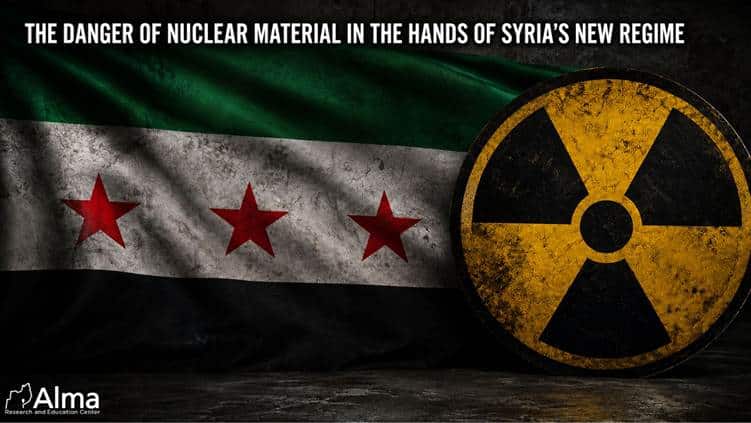
On August 10, it was reported that the United States had reached understandings with Syria and Israel under which the International Atomic Energy Agency (IAEA) would oversee the removal of nuclear material from “Site 99” in Syria. According to the report, the site contained remnants of the Assad regime’s clandestine nuclear program, including uranium yellowcake. Israel had been monitoring the site and made clear that it would not tolerate the material remaining there.
On August 18, Syria and the IAEA issued an official joint statement presenting a different, and potentially contradictory, picture from the August 10 report: the nuclear material declared by Damascus would remain in Syrian custody and be placed under international safeguards. IAEA inspectors visited the Deir ez-Zor site, as well as another site associated with material that Syria declared only in July 2026.
At present, it is unclear whether the reports refer to the same material and the same site. The material at “Site 99” may still be intended for removal, while another stockpile will remain in Syria; it is also possible that the earlier understandings were revised.
The discrepancy between the reports has not been publicly explained and requires clarification.
According to reports, the nuclear material is linked to the Assad regime’s “Al-Kibar” program. At the center of the program was a clandestine nuclear reactor built in the Deir ez-Zor area with North Korean assistance and based on a design similar to the Yongbyon reactor, a nuclear reactor in North Korea that was used to produce plutonium for its nuclear weapons program. The reactor was reportedly intended to enable the production of plutonium that could eventually have been used in nuclear weapons. Israel destroyed it in September 2007, shortly before it became operational. Following the strike, the Assad regime demolished the remains of the structure, concealed information, and restricted the IAEA’s access for years to sites and individuals associated with the program.
“Yellowcake” is a concentrated powder composed of uranium compounds, produced after the initial processing of uranium ore. It is not enriched material and is not suitable on its own for use in nuclear weapons, but it is a raw material used in the uranium processing and enrichment cycle. According to an Axios report, the material at “Site 99” referenced in the August 10 report cannot be used directly in a nuclear weapon, but could serve, among other things, as radioactive material in a “dirty bomb.”
Storing yellowcake does not require a reactor or a specially hardened facility. It is generally stored as a dry powder in sealed metal drums inside a covered and secured building. The risk from external radiation is relatively low, but dispersal, inhalation, or ingestion of the powder could create radiological and chemical hazards. Access controls, inventory management, container inspections, and continuous monitoring are therefore required.
The al-Sharaa regime’s willingness to cooperate with the IAEA is a positive development. However, this should not be taken to mean that the risk has been resolved. The IAEA can verify declared material, inspect sites to which it has been granted access, and install monitoring measures. The IAEA is not a security force, does not secure the sites itself, and cannot independently prevent theft, transfer, or a takeover by an armed actor.
Physical responsibility remains with the Syrian state, and this is the principal vulnerability.
Syria remains unstable and does not exercise full and continuous control over its entire territory. ISIS continues to operate cells and exploit security gaps, while the Shiite axis is working to maintain a foothold in the country. At the same time, the new military and security services are still being built, and many of their commanders are veterans of jihadist organizations with extremist ideological backgrounds.
Under these circumstances, a scenario in which a hostile actor such as ISIS cells, Iran-linked networks, or criminal organizations attempts to gain access to some of the material cannot be ruled out. There is also the possibility of an internal “rebellion” against al-Sharaa by security elements within Syria that oppose a particular regime policy. Such actors could seize the nuclear material and use it as leverage against the regime and the international community.
The risk is not that Syria will produce a nuclear weapon tomorrow, but that radioactive material could be stolen, smuggled, sold, or used for extortion and terrorism.
It is also important to consider a scenario in which the risk stems not only from theft or a takeover by an external organization, but from a change in the conduct of the regime itself. At present, the al-Sharaa government is cooperating with the IAEA and seeking international legitimacy, and there is no evidence that it intends to misuse the material. However, if the regime adopts a more radical course in the future, if radical elements within it gain strength, or if its relations with the international community deteriorate, the retention of the material on Syrian territory could turn from solely a security issue into a proliferation concern. In such a situation, Damascus could restrict inspectors’ access, conceal part of the inventory, transfer it to another actor, or use it as political and security leverage. The history of the al-Kibar program demonstrates that even a regime subject to international oversight can develop a clandestine nuclear program over an extended period.
Above all, it remains unclear whether all the sites and stockpiles have been disclosed. A September 2025 IAEA report found chemically processed natural uranium particles in samples taken from one of three sites and stated that the new Syrian authorities were unable to explain their origin. Material has now been discovered at another site that had not previously been declared. The continued discovery of additional information and material indicates that the picture is likely still incomplete.
IAEA oversight is essential, but it is not sufficient. A comprehensive mapping of the sites and stockpiles, access to former members of the nuclear program, reliable physical security, continuous monitoring, and transparency regarding the involvement of foreign countries are required. Until a complete picture emerges, Israel cannot rely solely on statements from Damascus or on international oversight. It must continue conducting independent intelligence monitoring of the material, the sites, and the actors seeking access to them.




One Response
Dear Dr Zoe,
Thank you for addressing this important topic. Syria today is a hotbed of radical jihaddist snakes of every breed still calling for Jewish blood and death to Israel. Under NO circumstances should they have possession of any nuclear materials that could be weaponized. ALL nuclear materials should be managed by the IAEA or USA.
NO EXCEPTIONS!! When all jihaddist actions, rhetoric and child indoctrination are eradicated from both Syria and Turkey some discussions can then begin on this topic.