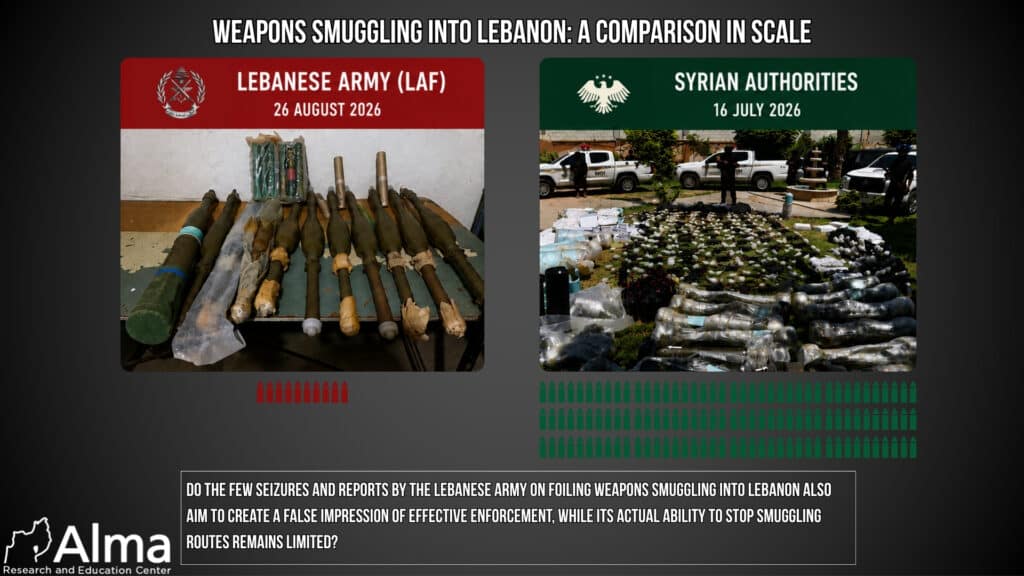
On August 26, the Lebanese Army announced that it had arrested a Syrian national in the town of Aaiha, in the Rashaya area near the Lebanon–Syria border, while he was attempting to smuggle several RPG rockets into Lebanon.
The incident joins a small number of isolated seizures reported by the Lebanese Army along the border. Over time, however, a significant gap becomes apparent: the seizures presented by the Lebanese Army are mostly small and limited, and generally consist of limited quantities of old weapons in poor condition.
On the Syrian side, the picture is different. In recent months, Syrian security agencies have published documentation of significant weapons shipments seized en route to Lebanon, including rockets, advanced Kornet anti-tank guided missiles, RPG launchers, weapons, and ammunition. In July 2026, a shipment of drones reportedly destined for Hezbollah, according to the Syrian authorities, was also seized.
There are also weapons that do succeed in crossing the border: on August 3, the Lebanese Army announced that it had seized 122 mm Grad rockets in the Arsal area after they had already been smuggled from Syria into Lebanon.
This gap takes on additional significance in light of the experience during the ceasefire period between November 27, 2024, and March 2, 2026, when the Lebanese Army presented a picture of effective action against Hezbollah and even claimed that no Hezbollah infrastructure or weapons remained south of the Litani River. During Operation “Lion’s Roar,” it became clear that the reality on the ground was different.
Are the Lebanese Army’s limited seizures and reports of foiled weapons-smuggling attempts into Lebanon once again intended to create a false impression of effective action, while in practice its ability to disrupt the smuggling routes remains limited?