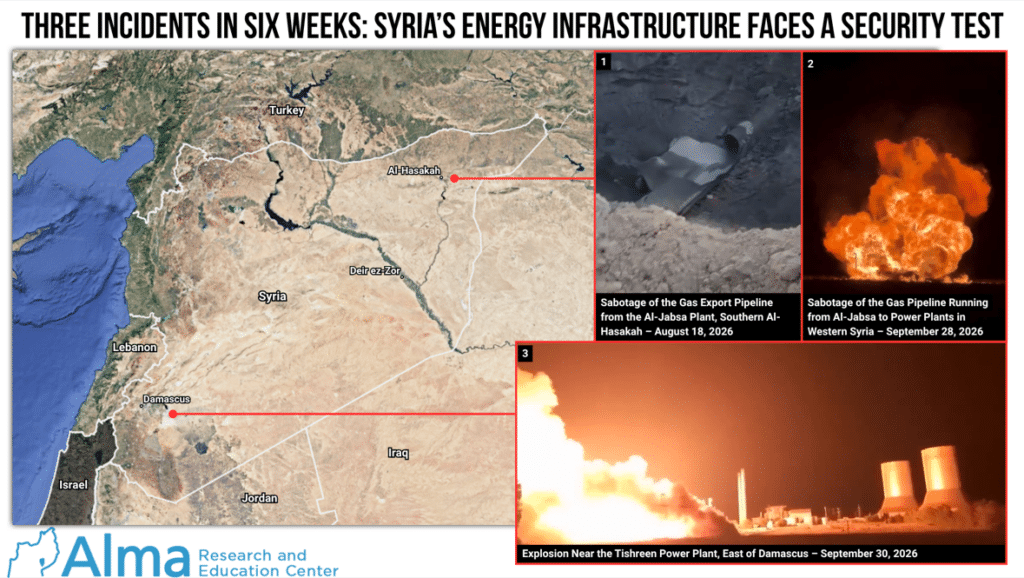
Within roughly six weeks, three significant explosions occurred along gas pipelines in Syria:
- On August 18, the gas export line from the Jbessa Gas Plant (معمل غاز الجبسة) in southern Hasakah Governorate was damaged.
- On September 28, another section of the same supply chain was hit, this time along the pipeline carrying gas from Jbessa through Deir ez-Zor to power stations in western Syria, after explosives were detonated against one of the pipeline’s valves.
- On September 30, another explosion occurred along the gas line supplying the Tishreen Thermal Power Plant (محطة توليد تشرين الحرارية), east of Damascus, temporarily knocking the Deir Ali and Nasiriyah power stations out of service as well.
As of this writing, it has not yet been determined whether the September 30 explosion was the result of sabotage, an attack, or a technical failure. However, the fact that it occurred only two days after confirmed sabotage of the gas pipeline in Deir ez-Zor, and amid a sequence of incidents affecting gas infrastructure, raises the possibility that it was not an isolated event but rather part of a broader pattern of deliberate and targeted attacks on Syria’s energy infrastructure.
At this stage, there is no evidence linking the three incidents, and no group has claimed responsibility. Nevertheless, at least two of them were officially defined as deliberate acts of sabotage. Their occurrence within a short period and against infrastructure vital to the energy sector raises the possibility of an attempt to target one of the key systems on which the functioning of the Syrian regime and its economic reconstruction efforts currently depend.
The damage is not limited to the pipeline itself. Interruptions to gas flows can shut down power stations, prolong electricity outages, disrupt industrial activity, and increase economic pressure on the population.
This is particularly significant at a time when Syria is seeking to establish itself as a regional energy hub linking Iraq and the Gulf with Turkey and the Mediterranean.
Since August 2025, gas from Azerbaijan has been flowing into Syria through Turkey, primarily for electricity generation. At the same time, Syria has increasingly served as a transit route for Iraqi energy supplies through the port of Baniyas, a trend that has accelerated amid disruptions in the Strait of Hormuz and Iraq’s desire to reduce its dependence on Gulf maritime routes. Alongside transportation by truck, plans are also being advanced to connect Iraq to the Syrian coast through pipelines.
One possible perpetrator of the sabotage is ISIS. Two of the incidents occurred in areas where the organization remains active, Hasakah and Deir Ezzor. Deir Ezzor in particular remains one of ISIS’s main areas of activity. Between February and May 2026, 26 ISIS attacks were documented in government-controlled areas of the governorate. The third explosion occurred in eastern Rural Damascus, which is not one of the organization’s primary areas of activity, but where ISIS cells are also present. During 2026, the organization demonstrated that it retains the ability to carry out attacks in Damascus and its surrounding areas.
ISIS also has a history of targeting Syria’s gas infrastructure. During the years in which it controlled large territories, the organization seized gas fields in order to deprive the regime of revenue and energy supplies. In 2015, it also blew up a gas pipeline in the Furqlus area.
ISIS, however, is not the only possibility. Eastern Syria is also home to smuggling and fuel-theft networks, local armed groups, and remnants of networks linked to the former regime that have an interest in undermining the new government. Pro-Iranian actors may also have a strategic interest in disrupting Syria’s integration into a regional framework backed by Turkey, Gulf states, and the United States.
The broader significance is that Syria is seeking to turn its geographic location into a strategic asset at a faster pace than it is able to establish stability and effective security control across its territory. This is particularly evident in the east of the country, where the expansion of government control has restored access to major energy fields and infrastructure, but has not eliminated ISIS activity, armed networks, or local criminal activity.
Foreign investment, new gas connections, and emerging routes linking Iraq, Turkey, and the Mediterranean are increasing Syria’s regional importance, but also its vulnerability. The more deeply Syria becomes integrated into regional energy systems, the greater the potential impact of sabotage against local infrastructure, affecting electricity supplies, economic reconstruction, the confidence of foreign partners, and the regime’s ability to present itself as a stable actor capable of protecting strategic projects.
The recent incidents highlight the gap between the economic opportunities now available to Syria and the security reality on the ground. States and companies are already treating Syria as a potential route for energy, trade, and investment, but the question remains whether the regime can provide the level of security required for these routes to become sustainable over time. The very infrastructure and energy corridors intended to strengthen Syria’s regional position may also become points of vulnerability for actors seeking to undermine the regime.