
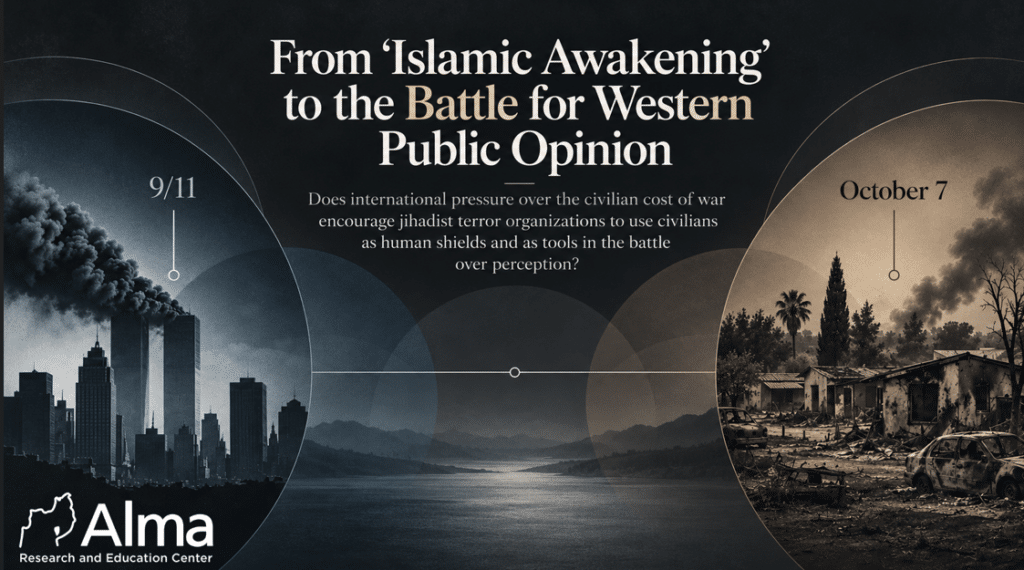
Three years have passed since October 7, 2023, a day that became one of the defining events in the history of the State of Israel. The massacre in the communities surrounding Gaza and at the Nova music festival, the acts of rape and sexual violence, the kidnappings, looting, abuse, and systematic murder of civilians left a deep national trauma and opened a war that changed Israel and the Middle East.
In retrospect, October 7 can be examined not only through the atrocities committed that day or through the war that followed. The massacre has also had a broader strategic consequence: a change in Israel’s international standing, growing identification with the Palestinian cause across significant segments of the West, and, in parts of the discourse, even challenges to the legitimacy of Israel’s very existence.
From September 11, 2001, to October 7, 2023: When the Response Becomes Part of the Attack’s Achievement
To understand how a terrorist attack can generate an achievement that goes beyond the initial blow, it is worth returning to Osama bin Laden’s strategy. September 11, 2001, was intended not only to strike the United States, but also to draw it into prolonged wars in the Muslim world, wear it down, and intensify hostility toward it.
In a model of Al-Qaeda’s strategy described after the attacks, the first stage was termed an “Islamic Awakening.” The idea was that the American response would draw the United States into war in the Muslim world, deepen the sense of confrontation between the United States and Islam, and assist in recruiting supporters and operatives to the struggle against it.
Bin Laden himself later described a policy of drawing the United States into additional fronts and wearing it down over time in human, economic, and political terms. In this sense, bin Laden viewed the attack as the opening point of a broader strategic process, rather than as an objective in itself.
The strategy succeeded only partially. The wars in Afghanistan and Iraq did not produce broad Muslim unity or support around Al-Qaeda, but they did create new arenas for recruitment and radicalization and contributed to the spread of the jihadist movement.
The response to the attack itself became part of its strategic outcome. Iraq became one of the central arenas in this process, giving rise to Al-Qaeda in Iraq, the organization from which ISIS later developed. In this way, the American response itself became part of the process bin Laden had sought to ignite.
Yahya Sinwar did not view October 7 as a stand-alone attack, but rather as an attempt to ignite a multi-front campaign against Israel. This concept fit within the Iranian-promoted principle of the “Unity of Arenas,” under which Hamas, Hezbollah, militias in Iraq and Syria, and the Houthis operate as part of a common campaign intended to exhaust Israel and ultimately bring about its collapse.
In Lebanon, Hezbollah had prepared for such a scenario for years through its Radwan Force and the “Conquer the Galilee” plan, which included breaching the border, seizing communities and military bases, killing and abducting Israelis under a broad fire umbrella. Documents attributed to Sinwar from 2022 likewise pointed to a “decisive campaign” in which Hezbollah, elements of the Iranian axis, and additional arenas would join the confrontation.
He failed in that objective. Hezbollah and other elements of the axis did join the fighting, but the simultaneous attack did not materialize, the Radwan Force did not invade the Galilee, and no broad uprising developed inside Israel. Israel did not collapse.
October 7, however, set another process in motion. If, in bin Laden’s strategy, the “Islamic Awakening” was intended to mobilize the Muslim world against the United States, then after October 7 a parallel effect emerged in the West, a “Western Awakening”: growing support for and identification with the Palestinian cause among Western publics, alongside increasing criticism of and opposition to Israel.
The phenomenon itself is not new. Previous rounds of fighting in Gaza, including Operation Cast Lead (2008–2009), Operation Protective Edge (2014), and Operation Guardian of the Walls (2021), also generated widespread protests and criticism of Israel in the West.
A similar pattern was evident during the Second Lebanon War. Following an Israeli strike in Qana in July 2006 against Hezbollah launch sites and infrastructure, the graphic images and initial casualty figures generated heavy international pressure on Israel. In the aftermath, Israel suspended aerial strikes for 48 hours, while the controversy contributed to accelerating diplomatic efforts toward a ceasefire.
After October 7, however, the scale and intensity of the phenomenon increased significantly. The protests became one of the most prominent international protest movements of recent years, spreading to university campuses, cultural and sporting institutions, and the political arena. At the same time, public attitudes toward Israel deteriorated sharply.
More seriously, in parts of anti-Zionist discourse, criticism no longer stops at the policies of the Israeli government or at the conduct of the war, but extends to questioning Zionism and the very legitimacy of Israel’s existence as a Jewish nation-state.
The Paradox of Asymmetric Warfare
As the war continued, the focus of international discourse gradually shifted from the atrocities committed by Hamas to Israel’s actions in Gaza. The massacre, rape, kidnappings, and abuse committed by Hamas did not disappear from public memory, but across significant parts of the West they ceased to serve as the central point of reference for understanding the war. In their place, images from Gaza, casualty figures, and criticism of Israel increasingly dominated the discourse.
This is a well-known pattern in the strategy of jihadist organizations: attacking a stronger state is intended not only to harm it directly, but also to provoke a broad military response. Such a response is expected to exact a civilian toll, and that toll can become an asset in the information and perception campaign, strengthening the organization’s narrative among its support base while generating international pressure and criticism against the state that was attacked and is defending itself. That pressure, in turn, can serve the interests of these organizations.
For jihadist terrorist organizations, time is a strategic resource. They generally lack the ability to defeat militarily a powerful state such as Israel. Their objective can therefore be to survive and prolong the campaign until the civilian toll, destruction, and mounting international pressure begin to restrict Israel’s freedom of action. In this way, destruction and casualty figures become leverage that can help the organization achieve in the political arena what it cannot achieve on the battlefield.
For Hamas and Hezbollah, the use of human shields, including the integration of military activity into civilian environments, amplifies precisely this advantage. The placement of infrastructure, tunnels, command centers, operatives, and weapons inside civilian areas, including residential homes, mosques, churches, schools, hospitals, and other civilian sites, is not merely an operational necessity. It deliberately makes civilians part of the strategy: if they are harmed, their deaths reinforce the victimhood narrative, generate international pressure on Israel, and increase the likelihood of restrictions on Israeli operations or of pressure to end the war. In Sinwar’s case, this approach was also reflected explicitly in messages attributed to him during the war, in which he described Palestinian deaths as “necessary sacrifices.”
In this sense, when the international community focuses only on the civilian cost of Israel’s response while ignoring the way in which the organization placed the population at risk, it reinforces the incentive to continue using the same method.
From the perspective of Islamist terrorist organizations, the message is that the price paid by their own population can become a strategic tool that provides them with leverage, legitimacy, and the ability to survive a war they cannot win militarily.
Conclusion
The international arena is an inseparable part of the campaign. Military achievements are not sufficient when, over time, the context in which Israel was compelled to act is eroded. The ability to document the threat, establish facts, and professionally explain how Hamas, Hezbollah, and the Iranian axis operate is essential to preserving international understanding of, and legitimacy for, Israel’s actions.
This is also the value of the Alma Research and Education Center’s international activity. Drawing on our focus on the northern arena, we research and document Hezbollah, Iran, and the networks built around Israel, and make our findings accessible to decision-makers, journalists, researchers, and opinion leaders worldwide. The goal is not merely to tell Israel’s story, but to provide the knowledge and context necessary to understand the threat Israel faces and its need to defend itself.


2 Responses
Dear Dana,
Great presentation to expose jihaddist warfare and strategy. I would like to add that this is an islamo-nazi 2.0 propaganda war of indoctrination, modified since the fall of hitler to invert the reality of the holocaust into a victim lie; to make terrorist jihaddists appear as “good forces of resistance” when their real motive is to exterminate all traces of the Jews and the entire State of Israel.
As there are numerous pro-Palestinian protests around the world on October 7, the Jewish community needs to remember the atrocities of Simchat Torah 5784 not on October 7 but on Simchat Torah.
Israel Independence Day is not observed on May 14, it is observed on 5 Iyar.
The Yom Kippur war is remembered on Yom Kippur, not on October 6 when it began.
Hamas chose a Jewish holiday to invade Israel, just as Egypt and Syria 50 years prior.
Yes, Simchat Torah is a joyous day, but we need to remember the events of 10/7, when they happened.