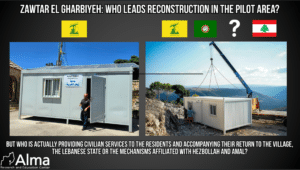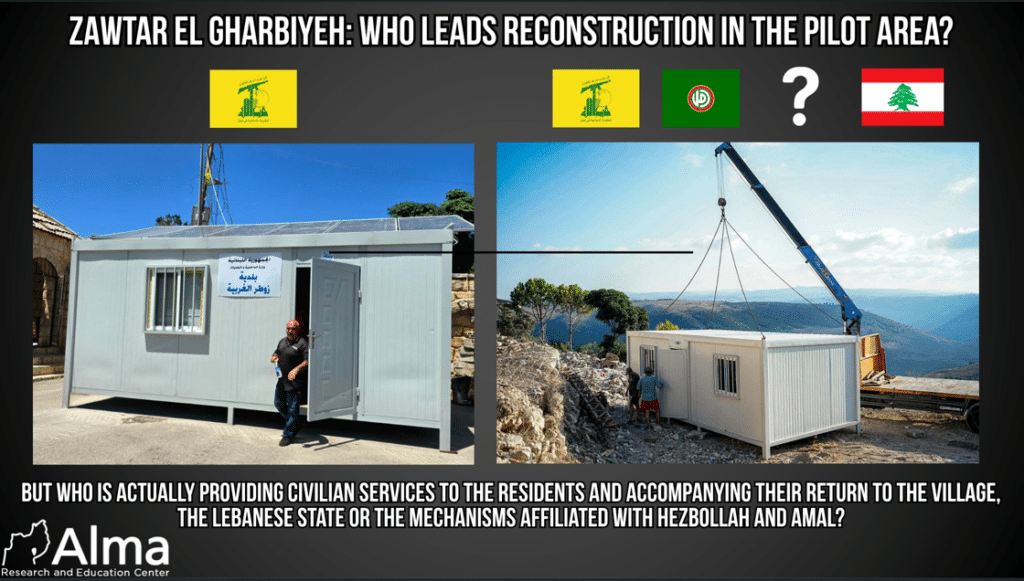
Zawtar al-Gharbiyeh is the first pilot area in southern Lebanon for testing the implementation of the arrangement. Beyond the entry of the Lebanese Army into the village and the examination of its ability to dismantle Hezbollah infrastructure and prevent its return, the goal is to reestablish the presence of the Lebanese state and civilian services.
But who is actually providing civilian services to the residents and accompanying their return to the village, the Lebanese state or the mechanisms affiliated with Hezbollah and Amal?
As early as July 27 and July 29, immediately after the Lebanese Army entered, we identified at Alma the arrival in Zawtar al-Gharbiyeh of the Islamic Health Organization and Hezbollah’s Wataawano Association. The Islamic Health Organization began providing medical services, while the association placed at least two mobile structures in the village, one serving as a temporary office for the local council, and the other as a service and food distribution center. At the same time, the association operated a kitchen that provided meals to about 150 families and mapped the residents’ needs.
At the same time, state institutions also began operating in the field of temporary housing.
At its July 9, 2026 session, the Council of Ministers authorized the South Council and the High Relief Commission to purchase prefabricated homes for families affected by the fighting through direct contracting with suppliers. However, the government decision did not include the name of any supplier, company, or association, and no purchase contract, total price, or binding timetable was published במסגרת the decision. The meaning of the decision was approval of the procurement mechanism, not the selection of the party that would actually supply the structures.
On August 8, the High Relief Commission, under the direction of Prime Minister Nawaf Salam and in cooperation with the South Council, announced the transfer of the first batch of prefabricated structures intended for Zawtar al-Gharbiyeh. About 100 prefabricated structures were assembled in Qaqaait al-Jisr, at the western entrance to the village, ahead of their installation and transfer into Zawtar al-Gharbiyeh. Some of the units were purchased by the Commission, while others arrived as donations.
On September 21, the South Council began transferring the homes to residents inside the village. Nine homes entered that day, out of 15 planned for the first stage. The transfer was carried out by the South Council, in coordination with the municipality of Zawtar al-Gharbiyeh, for families that had prepared suitable plots after the rubble had been cleared.
The South Council is indeed an official institution of the Lebanese state, but for many years it has been under the dominant influence of the Amal Movement and Nabih Berri. Hezbollah influences it more indirectly, through its alliance with Amal, the local authorities, and the influence networks of the Shiite duo in the south.
Even when the state provides budgets and resources, the body transferring part of the aid directly to residents is the South Council, ostensibly a state institution, but in practice one that serves as a mechanism of influence and control for Amal and Hezbollah in southern Lebanon.
The test in Zawtar al-Gharbiyeh is not only who finances the reconstruction, but also who is present on the ground, who distributes the aid, who accompanies the residents as they return, and who is ultimately perceived as the actor providing them with answers. It appears that Hezbollah and Amal remain at the forefront.