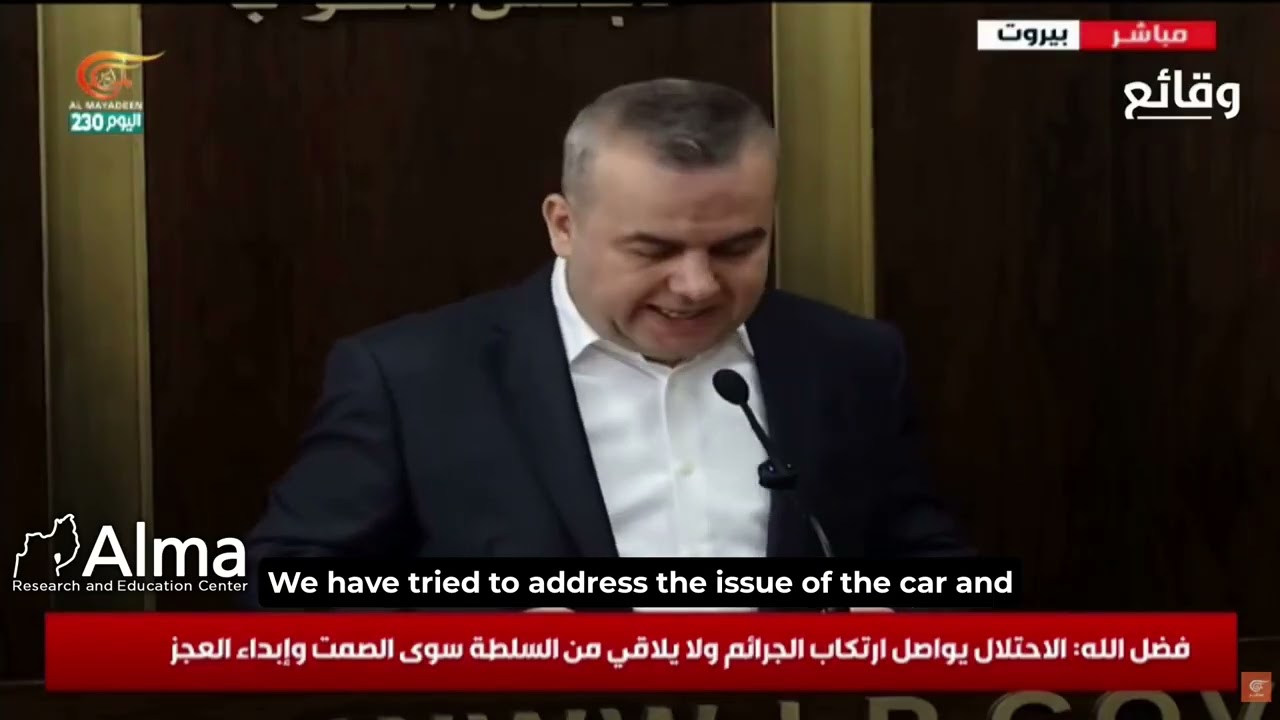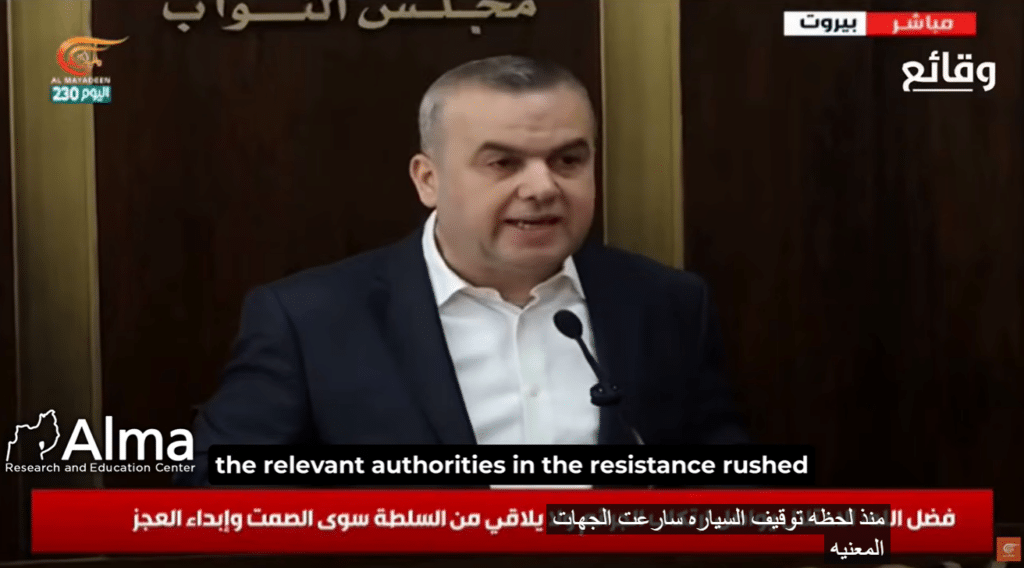
On October 15, Hezbollah MP Hassan Fadlallah confirmed that the vehicle carrying hundreds of kilograms of explosives, seized on October 5 at the Dahr al-Baidar checkpoint, belonged to Hezbollah (see the attached video). According to Fadlallah, immediately after the vehicle was seized, Hezbollah contacted the security and judicial authorities, declared its ownership, and demanded the immediate release of the detainees and the return of the vehicle and its contents. Fadlallah claimed that the explosives were intended for use against Israeli forces in southern Lebanon, rejected allegations of preparations for domestic assassinations, and warned the authorities of the consequences of measures taken against the organization. The demand for the shipment’s return illustrates Hezbollah’s position: it seeks to retain its ability to transport weapons within Lebanon and continue its independent military activities.
On October 17, Al-Akhbar reported that Lebanese President Aoun had asked Military Intelligence to expand the investigation, after which Prosecutor General Rami al-Hajj issued orders to arrest Hussein Abdullah (also known as Hajj Hussein al-Khalil), currently the head of Hezbollah’s Liaison and Coordination Unit, and his aide, Ali Ayoub, to determine their responsibility for the shipment.
However, Hezbollah MP Ibrahim al-Moussawi and judicial sources quoted by the Lebanese MTV channel denied the report concerning the arrest order. At this stage, we cannot verify the accuracy of the report that an arrest warrant was issued.
As of February 2026, Hussein Abdullah was considered a very close associate of Naim Qassem and served as a political adviser. Ali Ayoub also headed Hezbollah’s Security Committee, an unofficial security body functioning as a quasi-police force, which operates as part of the broader military and intelligence apparatus the organization has built over the years.
The test of Lebanese sovereignty lies in the authorities’ ability to pursue the investigation, uncover the chain of responsibility, and prevent similar transfers of weapons and military equipment throughout Lebanon. Meeting this test also requires tackling the widespread “revolving door” practice, whereby equipment and weapons confiscated from Hezbollah with much fanfare are returned to the organization through discreet coordination…