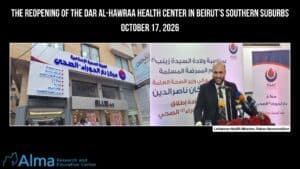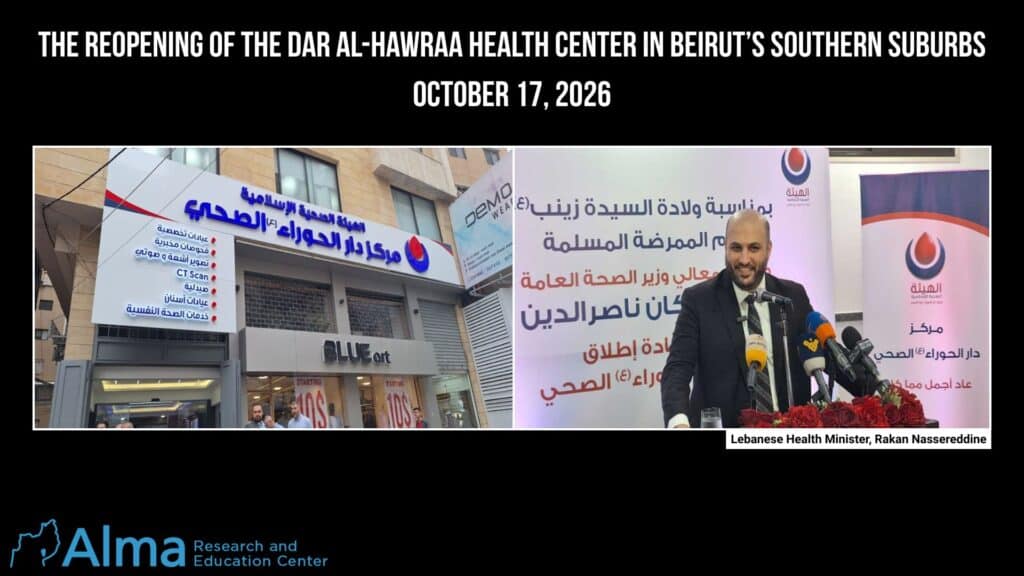
On October 17, 2026, the Dar al-Hawraa Health Center in Beirut’s southern suburbs resumed operations following repairs to war damage. The event was held under the patronage of Lebanese Health Minister Rakan Nassereddine, who represents Hezbollah in the government, and the center is operated by Hezbollah’s Islamic Health Organization. Its reopening illustrates the gap between the government’s commitment to asserting state sovereignty and one of its ministers’ involvement in rebuilding the organization’s parallel civilian system.
In its March 2 decision, the Lebanese government banned Hezbollah’s military and security activities, demanded that it surrender its weapons, and stipulated that its activities be restricted to the political sphere within the legal and constitutional framework. The decision contains no explicit directive to close all of Hezbollah’s civilian institutions. Nevertheless, rebuilding these institutions under government patronage raises a fundamental question: How does the state intend to curtail the organization’s autonomy while its representatives publicly recognize the infrastructure that enables it to maintain that autonomy?
Dar al-Hawraa provides various medical services to Hezbollah’s Shiite support base. Nassereddine even praised it as one of Lebanon’s best primary healthcare centers. Yet alongside its medical contribution, the center belongs to an organizational network with broader political and social significance. The minister’s patronage places the authority of the Health Ministry alongside a Hezbollah institution, allowing the organization to present its reconstruction as a legitimate and recognized part of the national recovery.
Hezbollah’s healthcare, welfare, education, and financial systems are central to its power. They address genuine needs while deepening dependency, maintaining daily contact with the population, and strengthening organizational and ideological loyalty. Through these systems, Hezbollah continues to function as a provider of civilian services even when its military capabilities are damaged.
Hezbollah’s civilian infrastructure is, in effect, the organization’s “game changer.”
Rebuilding a clinic within its civilian network therefore also restores its capacity to exert influence and maintain its social foothold.
In our assessment, the event’s significance also lies in the connection between two sources of authority: the state and the party. Hezbollah maintains independent institutions while simultaneously participating in the government. Its representative can thus appear as the minister responsible for the health of all Lebanese citizens while, in that same capacity, strengthening an institution belonging to Hezbollah. Official patronage does not prove that the state financed the reconstruction, but it gives it visibility and public recognition. This demonstrates Hezbollah’s ability to operate within state institutions and exploit them for its own benefit while simultaneously operating through a parallel system.
The Lebanese government therefore also faces a test in the civilian sphere. Curtailing Hezbollah’s autonomy requires expanding accessible public services, strengthening oversight and transparency, and reducing dependence on partisan intermediaries. Closing services without providing an alternative could deepen residents’ hardship and reinforce the organization’s claim that only it can assist them. Conversely, government patronage of the reconstruction of Hezbollah’s institutions allows Hezbollah to preserve that dependency with an official stamp of legitimacy.
The reopening of Dar al-Hawraa thus illustrates why any discussion of a “state within a state” must include the civilian network. As long as Hezbollah rebuilds its independent institutions and receives patronage from within the government, one of the central drivers of its continuity and recovery remains intact. The gap between declarations of sovereignty and actual conduct is evident even at the reopening ceremony of this medical center.