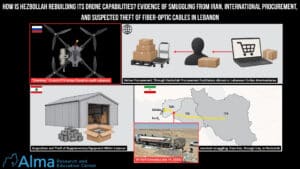
Alongside replenishing and rebuilding its arsenal of weapons, recruiting and training new operatives, Hezbollah is working to restore the organizational infrastructure necessary for the effective deployment of its weapons arsenal and military units and for regaining operational readiness. In other words, Hezbollah is rebuilding its command and control systems.
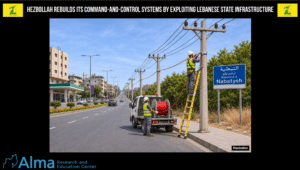
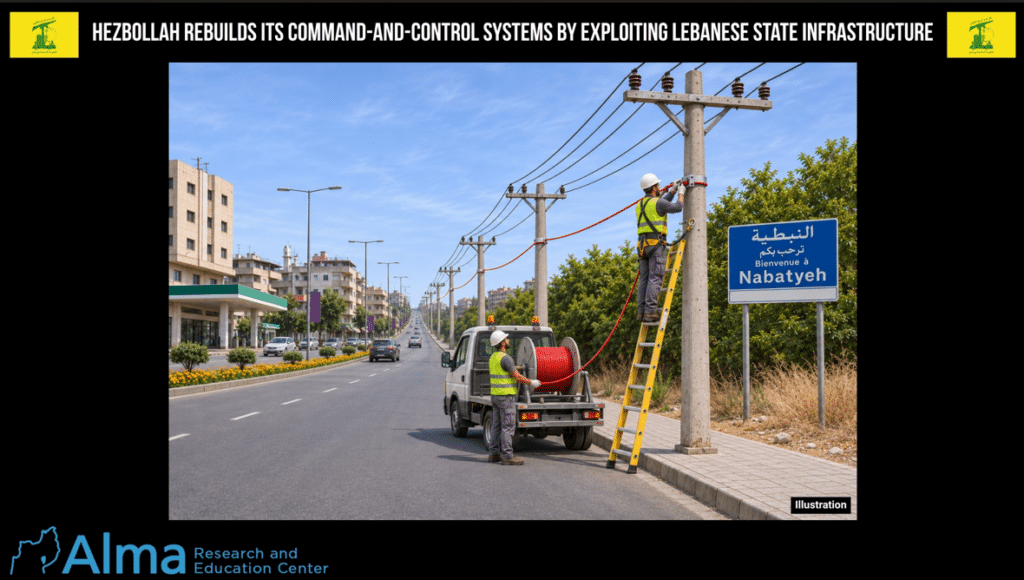
As part of this effort, Hezbollah is rebuilding its internal, independent military communications networks. According to local reports, Hezbollah operatives in the Nabatieh Governorate have been observed installing and laying communications cables on electricity poles and threading them through underground telecommunications infrastructure (and possibly sewage infrastructure) via access manholes. The installation and deployment appear to have been carried out with the acquiescence of local liaison officials (rabits) and local law enforcement personnel.
It should be recalled that the electricity, telecommunications, and sewage infrastructure through which Hezbollah’s communications cables have been routed belongs to the Lebanese state.
We assess with high probability that efforts to rebuild Hezbollah’s internal, independent military communications infrastructure are taking place not only in the Nabatieh Governorate but also throughout southern Lebanon, north of the Israeli security zone, as well as in Beirut and the Bekaa Valley.
Hezbollah’s internal, independent military communications infrastructure has been known for many years. It constitutes a strategic asset for the organization. Hezbollah deployed this infrastructure throughout its areas of operation, connecting its military assets, particularly command headquarters and intelligence collection facilities. It was designed to ensure operational independence, support command and control, and enhance the organization’s survivability during wartime.
Our March 2021 article on Hezbollah’s communications infrastructure indicated that the development of Hezbollah’s internal, independent military communications infrastructure began as early as the 1990s, combining independent infrastructure with the exploitation of the Lebanese state’s telecommunications infrastructure.
Over the years, this infrastructure evolved into a decentralized network based, among other things, on fiber-optic cables, multiple communications nodes, and the integration of additional communications technologies (including encrypted cellular communications), designed to enhance its survivability and its ability to support coordinated military operations.
As early as 2007, reports indicated Iranian involvement in financing and developing Hezbollah’s “private communications networks”. Against this background, the recent reports from Nabatieh may indicate not merely the repair of infrastructure damaged during the war, but a broader effort to restore an independent command and control capability that was developed over decades and constitutes a fundamental component of the organization’s military power.
Hezbollah’s communications infrastructure nearly triggered a civil war in May 2008. During Hassan Nasrallah’s leadership, Hezbollah repeatedly invoked the events of “May 2008” as a narrative of intimidation and threats.
On May 5, 2008, the Lebanese government, headed by Fouad Siniora, decided to dismantle Hezbollah’s internal, independent military communications infrastructure ( The government also decided to dismiss Wafiq Shuqair, the security chief at Beirut International Airport, accusing him of installing surveillance cameras along the airport’s VIP route on Hezbollah’s orders).
Hezbollah’s response to these decisions was swift and aggressive. In a speech delivered on May 8, 2008, Nasrallah declared that Hezbollah’s independent telephone network constituted one of the organization’s principal weapons and that any attempt to interfere with it would effectively amount to a declaration of war against Hezbollah.
Within hours of Nasrallah’s speech, Hezbollah operatives, assisted by members of the Amal Movement, seized control of West Beirut, surrounded Beirut International Airport, laid siege to the residences of Sunni community leaders, particularly Saad Hariri, and set fire to the offices of “Al-Mustaqbal” television, which belonged to Hariri and served as a mouthpiece for his political party.
That night, it appeared that Lebanon was descending into another civil war and that Hezbollah intended to seize control of the country. However, Hezbollah encountered unexpected resistance from Druze and Sunni militias, which responded by blocking the Al-Masnaa border crossing between Syria and Lebanon and engaging Hezbollah operatives in fighting in the Chouf Mountains and the vicinity of the port of Tripoli.
A total of 82 Lebanese were killed in the fighting, which ended without a decisive outcome following negotiations between Nasrallah and Druze leader Walid Jumblatt. The Lebanese Armed Forces subsequently deployed to the areas of confrontation and assumed responsibility for security.
On May 11, 2008, the Lebanese government decided to reverse its decisions.
The events of May 2008 in Lebanon reinforced Hezbollah’s understanding of the importance of participating in and maintaining a presence within the Lebanese government. From Hezbollah’s perspective, participation in government was necessary to protect the “resistance” and ensure that “the government of May 5, 2008, would not be repeated…” (See our October 2020 article).
Rebuilding Hezbollah’s independent military communications infrastructure is a central component of the organization’s efforts to regain operational readiness while reducing its exposure to Israeli intelligence collection and communications disruption.
The use of Lebanese state-owned public infrastructure to rebuild Hezbollah’s independent communications network once again raises fundamental questions regarding Lebanese sovereignty and governance. Hezbollah continues to establish independent military infrastructure within the state while exploiting its resources and public infrastructure.
The events of May 2008 demonstrate the extent to which Hezbollah regards its independent communications network as a strategic asset, one it is prepared to defend even at the cost of violent confrontation within Lebanon. At that time, the Siniora government’s decision to dismantle the network triggered a military response by Hezbollah and ultimately forced the government to back down and reverse its decisions.
Will Prime Minister Nawaf Salam’s government dare to confront Hezbollah’s efforts to rebuild its military communications network and take action to dismantle it?