Executive Summary
Several major developments unfolded in Iran and across the region over the past month:
- Economic, energy, and political pressure: The regime has been under a sustained U.S. naval blockade since July 2026. The blockade has prevented oil exports worth tens of billions of dollars and led to severe gas and fuel shortages, declining purchasing power, and domestic protests, alongside tensions and an open rift between the political leadership and the Islamic Revolutionary Guard Corps (IRGC).
- Nuclear developments and gaps in monitoring: Activity and construction were observed at Pickaxe Mountain as Washington and Tehran traded direct threats. The whereabouts of uranium enrichment facilities and enriched material in Isfahan remain unclear. In its quarterly report, the International Atomic Energy Agency (IAEA) confirmed significant monitoring gaps and said it could not verify that nuclear material had not been diverted from civilian activities.
- Rebuilding the ballistic missile program: Iran is working to move production and storage facilities underground, as indicated by excavation and construction at the Garmdareh and Shahroud bases. In addition to lifting its declared range limit and unveiling a new “missile city,” Iran is estimated to have restored around 20% of the production capacity that was damaged.
- Status of Iran’s proxies: Iran’s proxies are acting more in line with local interests and less as a united front. Hezbollah is focused on survival and reconstruction with Iranian funding and is, for now, refraining from initiating hostilities. The Houthis are fighting Saudi Arabia directly, while Iraqi militias are retaining their weapons and financing themselves through oil smuggling.
The Regime: Blockade, Energy Shortages, and the Risk of Unrest
The figures point to a gradual deterioration in conditions inside Iran. Household purchasing power declined further in late October. Reports of sharp disagreements at the top of the regime followed. By mid-November, shortages of gas and fuel had already triggered protests. The Iranian regime appears to be struggling to meet basic energy and subsistence needs.
Reuters reported on October 28, 2026, that Iranian households were cutting spending on food, housing, healthcare, and education as the war, blockade, and sanctions took their toll on the economy.
Reports also pointed to a rift between the regime’s political leadership and the IRGC. President Masoud Pezeshkian, Foreign Minister Abbas Araghchi, and Parliament Speaker Mohammad Bagher Ghalibaf lead the political camp. Supreme National Security Council Secretary Mohsen Rezaei and IRGC Commander Ahmad Vahidi represent the IRGC’s position. According to several reports, Rezaei and Vahidi are directing the regime’s wartime decisions on behalf of Supreme Leader Mojtaba Khamenei.
On November 10, government spokesperson Fatemeh Mohajerani said the daily natural gas shortfall was expected to reach 430 million cubic meters this winter, compared with 300 million in previous winters. National Iranian Gas Company CEO Saeed Tavakoli said four major gas processing facilities were damaged in the opening stages of the war. U.S. Central Command (CENTCOM) reportedly released figures showing that the blockade had prevented $30 billion in oil exports since July 2026 and that 150 vessels had been diverted after attempting to export Iranian oil.
Iran International reported a five-kilometer queue at gas stations in the Kerman area. Fuel shortages also reportedly sparked protests and roadblocks in Bandar Abbas.
The Nuclear Program: Pickaxe Mountain, Isfahan (ENTC), and Monitoring Gaps
The focus of the nuclear discussion has recently shifted from access to the sites to the whereabouts of the uranium. In October, reports focused on the sealing of Pickaxe Mountain and U.S. threats to strike it. In November, attention shifted to enriched uranium outside the scope of monitoring and to an IAEA report saying the agency did not even know where the enrichment facility in Isfahan was located.
Pickaxe Mountain:
Reports on Pickaxe Mountain (Kuh-e Kolang Gaz La) describe a site that appears sealed from the outside, yet where activity and construction continue. The site has also become a focus of direct threats between Washington and Tehran. It is a deeply buried facility south of the Natanz complex.
Reuters reported on October 16, 2026, that Trump warned that the United States might have to strike the site. The following day, the Institute for Science and International Security (ISIS), headed by David Albright, published satellite images dated October 7. The images showed that the eastern tunnel entrances remained sealed with earth and that earthen barriers on the roads to the western entrances were still in place. The institute said this reinforced its assessment that access to the complex had been blocked for more than two months.
Nevertheless, IAEA Director General Rafael Grossi said construction had been observed at the site. In late October, ISIS published an elevation profile showing differences in elevation between the eastern and western tunnel entrances and the ventilation shafts. The institute said these differences could indicate several levels, two separate tunnels, or a descending western tunnel.
In early November, Trump told Fox News: “We eliminated their nuclear program. We have one or two facilities left to deal with. We might have to strike Pickaxe Mountain, but it’s not a big deal. We can do it in ten minutes or in an hour.” On November 11, Rezaei, who was appointed secretary of the Supreme National Security Council in August 2026, responded in an interview with Al Mayadeen. He said that if the site were attacked, Iran would strike distant U.S. bases, including bases in Europe. He added: “We will not allow a single grain of enriched material to leave Iran,” and said Iran needed the material to design nuclear-powered ships and submarines.
According to a November 14, 2026, report in Gulf Daily News, the IAEA confirmed activity at Pickaxe Mountain but said it had no information about what was taking place inside.
Isfahan (ENTC):
In November, attention shifted to Isfahan. The central question was where Iran’s enriched uranium was and why the IAEA could not verify its whereabouts. An agency report confirmed the extent of the monitoring gap.
Estimates differed as to the location of 440 kg of enriched uranium, with Pickaxe Mountain and the underground facility at the Isfahan Nuclear Technology Center (ENTC) among the possibilities. The IAEA assessed that at least half of the material remained buried in Isfahan after the first war with Iran, while other assessments suggested that some had been moved to Pickaxe Mountain.
The Isfahan facility is about 150 meters underground and has four entrances. The entrances were hit by U.S. Navy cruise missiles at the end of Operation Rising Lion, which began on June 13, 2025. They were not hit during Operation Roaring Lion, which began on February 28, 2026.
On November 9, Iranian Foreign Ministry spokesperson Esmaeil Baghaei said IAEA inspectors had recently visited the Bushehr nuclear power plant, but that the visit did not signal broader access to nuclear sites. Iran submitted a ten-page document to the IAEA arguing that it was not obliged to allow full inspections while it remained under threat of attack.
In its November quarterly report, the IAEA said it did not know the location or status of the Isfahan Fuel Enrichment Plant (IFEP), or whether it contained nuclear material. International media reported on November 13, 2026, that Iran had declared the facility in June 2025 but had never allowed inspectors to visit it. The agency assessed that it was located deep inside an Isfahan tunnel complex bombed in June 2025. The reporting also noted that in March 2026 Grossi had assessed that a significant share of Iran’s uranium enriched to near weapons grade was stored in that complex.
Other Sites and the Enrichment Target
Beyond Pickaxe Mountain and Isfahan, satellite images documented reconstruction at other sites damaged in strikes, including sites ISIS links to the nuclear program. In November, a public statement from Tehran also called for the ability to enrich uranium to a higher level.
In October, ISIS documented repairs to what it assessed was probably a water tank, construction of a new support building, and increased vehicle activity at the Minzadehi nuclear site on the outskirts of Tehran, following Israeli strikes there in March 2026. The institute also published images of a second phase of reconstruction at Taleghan 2 in the Parchin complex. The Israeli Air Force struck the site in October 2024. According to the institute, it had previously been linked to explosives tests for nuclear weapon initiation mechanisms.
In early November, the BBC reported that new construction and excavation had been identified near tunnel entrances outside Qom, close to the Fordow enrichment facility. On November 8, Mohammad Javad Larijani, head of Iran’s Institute for Research in Fundamental Sciences and an adviser to the supreme leader, said Iran needed the capability to enrich uranium to 80%.
Missiles: Garmdareh, Shahroud, and the Recovery of Production
Iran is no longer just repairing damaged buildings; it is excavating new underground facilities near major bases. Estimates have also been published for the rate of production, the size of the stockpile, and the share of capacity restored. Each measures something different.
Garmdareh:
The Garmdareh base, in Karaj near Tehran, is the clearest recent example of new construction. The work may be an entrance to a new underground facility, but the facility’s purpose remains unclear.
A November 2026 BBC Verify investigation reported that analysts from the British intelligence firm MAIAR had identified excavation and construction at the base. The images showed numerous vehicles and improvements at the nearby air base. The investigation identified a new entrance to an underground facility in an area suspected of housing a missile base.
Janes also identified a facility under construction, including tunnel entrances, but left open the possibility that it was intended to expand missile bases, provide storage, or serve another purpose.
Shahroud:
In Shahroud, northern Iran, reports pointed to a possible effort to move missile production into a protected facility after the nearby base was struck several times.
Several reports documented substantial excavation at Shahroud. Jim Lamson, a former CIA analyst, assessed that the work could be linked to missile production and that the IRGC might be trying to move production facilities underground.
Ballistic Missiles – Production and Deterrence Assessments
Several estimates concerning ballistic missiles appeared in November. Monthly production, stockpile size, and the share of production capacity restored are three separate measures. Iran also broadened its threats by announcing the lifting of its range limit and threatening bases in Europe.
On November 7, the IRGC spokesperson announced that Iran had lifted its self-imposed 2,000-kilometer range limit. Days later, Iran unveiled a new underground “missile city” belonging to the IRGC Aerospace Force in a ceremony broadcast by Tasnim. Iranian armed forces chief of staff Maj. Gen. Ali Abdollahi and IRGC Aerospace Force commander Brig. Gen. Majid Mousavi attended. Reports also cited Western intelligence estimates that Iran was producing 50 ballistic missiles per month.
On November 10, 2026, Bloomberg reported an estimated Iranian stockpile of about 1,700 ballistic missiles. According to Israeli media reports, the Israeli defense establishment assesses that Iran has restored about 20% of the ballistic missile production capacity that was damaged. Iran also claimed it had improved the warheads of its liquid-fueled Khorramshahr missile, which it said would enable it to strike U.S. bases in Europe.
Iran’s Proxies: Selective Rebuilding and Local Priorities
Iran’s proxies appear to be responding to conditions in their respective arenas and operating less as a unified axis for now. Hezbollah is focused on survival, rebuilding, and strengthening its capabilities with Iranian funding. The Houthis are fighting Saudi Arabia directly. Iraqi militias are retaining their weapons and independent sources of revenue.
Hezbollah
In early October, Hezbollah representatives said the organization was not prepared to initiate a new war with Israel if fighting resumed between Iran and the United States and Israel. Although joining such a war would run counter to Hezbollah’s immediate interests because it needs time to recover, the assessment is that the organization would join the fighting if Iran directed and pressured it to do so.
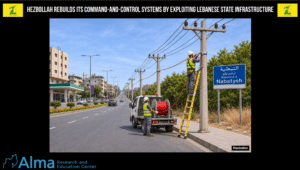
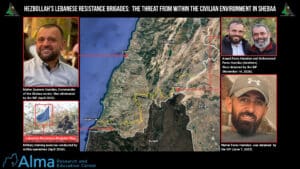
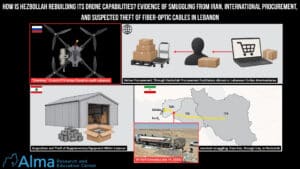
Hezbollah is currently focused on rebuilding and expanding its weapons arsenal, recruiting and training personnel, and physically restoring its military infrastructure.
The Houthis
The Houthis have been fighting Saudi Arabia directly, focusing their attacks on oil infrastructure and cities deep inside the kingdom. Saudi Arabia responded with strikes in Yemen and diplomatic pressure.
Houthi targets included an Aramco facility in Riyadh and Riyadh’s international airport. In response, Saudi Arabia carried out strikes in Yemen aimed at destroying Houthi infrastructure and killing Houthi leaders, reportedly drawing on real-time Israeli intelligence.
Iraq
Iran-backed Shiite militias in Iraq are retaining their weapons and independent funding sources, using the prospect of renewed regional fighting to delay disarmament.
In November, a leaked Iraqi Interior Ministry report revealed that Kataib Hezbollah, led by Ahmad al-Hamidawi, had stolen millions of dollars’ worth of crude oil over five years in the Jurf al-Sakhar area south of Baghdad by illegally tapping state pipelines. The disclosure sparked an open confrontation between the Iraqi state and the Iran-backed Shiite militia.
Conclusion
Iran’s regime faces a sustained U.S. naval blockade, severe energy and fuel shortages, declining purchasing power, and divisions at the top. Activity continues at Pickaxe Mountain, while serious gaps in IAEA monitoring leave the whereabouts of enriched uranium and enrichment facilities in Isfahan uncertain. Iran is working to move ballistic missile production and storage underground, as at Garmdareh and Shahroud, and has restored about 20% of its production capacity. Meanwhile, its proxies are operating in a decentralized manner and according to local priorities. Hezbollah is focused on survival and rebuilding with Iranian funding while refraining from initiating hostilities. The Houthis are fighting Saudi Arabia directly, and Iraqi Shiite militias are retaining their weapons and funding themselves independently. At the same time, CENTCOM has reached peak operational readiness for a possible resumption of the military campaign.
Sources
- https://www.reuters.com/world/trump-says-us-may-need-strike-irans-pickaxe-mountain-2026-10-16/[reuters]
- https://www.reuters.com/world/middle-east/hezbollah-readies-new-regional-war-with-funds-iran-sources-say-2026-10-26/[reuters]
- https://www.reuters.com/world/middle-east/iranians-cut-essentials-put-dreams-hold-as-war-hit-economy-bites-2026-10-28/[reuters]
- https://www.aljazeera.com/news/2026/10/1/syria-denies-officials-held-secret-talks-with-hezbollah-in-turkiye
- https://www.jpost.com/middle-east/article-910651
- https://www.timesofisrael.com/un-nuclear-watchdog-chief-says-construction-observed-at-irans-pickaxe-mountain[timesofisrael]
- https://www.timesofisrael.com/un-agency-cant-confirm-iran-hasnt-diverted-nuclear-material-from-peaceful-activity/[timesofisrael]
- https://www.gdnonline.com/Details/1406038/UN-nuclear-watchdog-confirms-activity-at-Tehran%E2%80%99s-Pickaxe-Mountain[gdnonline]
- https://www.bbc.co.uk/news/articles/ckjrwx1r2d5ro[bbc.co]
- https://www.bbc.com/hausa/articles/c68jzzp1grr9o[bbc]
- https://www.criticalthreats.org/analysis/iran-update-november-10-2026[criticalthreats]
- https://israel-alma.org/irans-missile-arsenal-erosion-rebuilding-renewed-erosion-and-a-further-attempt-to-rebuild/