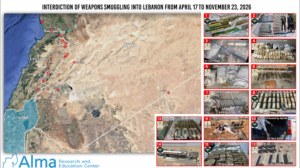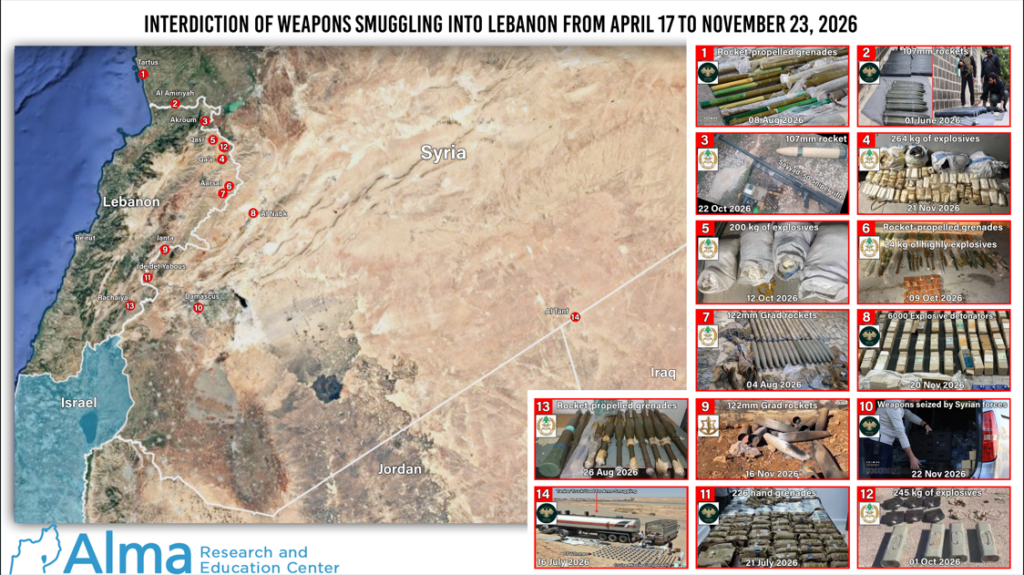
Between April 17, 2026, following the conclusion of Operation “Roaring Lion,” and November 23, we documented 14 incidents in open sources involving the interdiction of weapons shipments destined for Lebanon, most of them intended for Hezbollah as part of the organization’s military buildup efforts. Seven were intercepted by the Lebanese Armed Forces (LAF), six by Syrian security forces, and one was targeted in an IDF strike.
The intercepted shipments included a variety of weapons, among them long-range missiles, anti-tank guided missiles (ATGMs), 122 mm Grad rockets, at least 100 FPV drones and fiber-optic guidance components, RPG warheads, hand grenades, automatic rifles, and ammunition. In addition, approximately 733 kg of explosives, including TNT and C4, were seized in four separate incidents.
In two significant incidents, the shipments were explicitly linked to Hezbollah: On July 16, the Syrian Ministry of Interior announced the seizure of a shipment of missiles and UAVs along the Iraq–Syria border, which it claimed was destined for Hezbollah. On November 16, the IDF struck a weapons shipment being transferred from Syria to Lebanon in the Janta area of the Beqaa Valley, en route to Hezbollah (based on an analysis of images published from the strike site, the shipment contained Grad rockets with Iranian components).
The series of interdictions does not necessarily indicate successful enforcement or the disruption of smuggling operations. Rather, it reveals the continued activity of weapons supply routes into Lebanon. The 14 documented incidents reflect only the smuggling attempts that were uncovered. The volume of shipments that successfully reached their destination remains unknown.
We assess that the relatively high number of interdictions may also reflect an increase in the frequency and intensity of smuggling attempts, against the backdrop of Hezbollah’s efforts to restore its military capabilities and replenish its weapons stockpiles following the war. However, this cannot be established with certainty based solely on the number of interdictions.
Hezbollah’s military buildup efforts may serve several scenarios: preparations for a renewed military confrontation with Israel, as well as preparations for a potential internal confrontation in Lebanon should pressure to disarm Hezbollah translate into concrete enforcement measures.
Hezbollah is restoring its military capabilities, replenishing its stockpiles, and reestablishing its military infrastructure. Therefore, the interdiction of individual weapons shipments is no substitute for a consistent strike policy targeting Hezbollah’s rehabilitation efforts throughout Lebanon.