
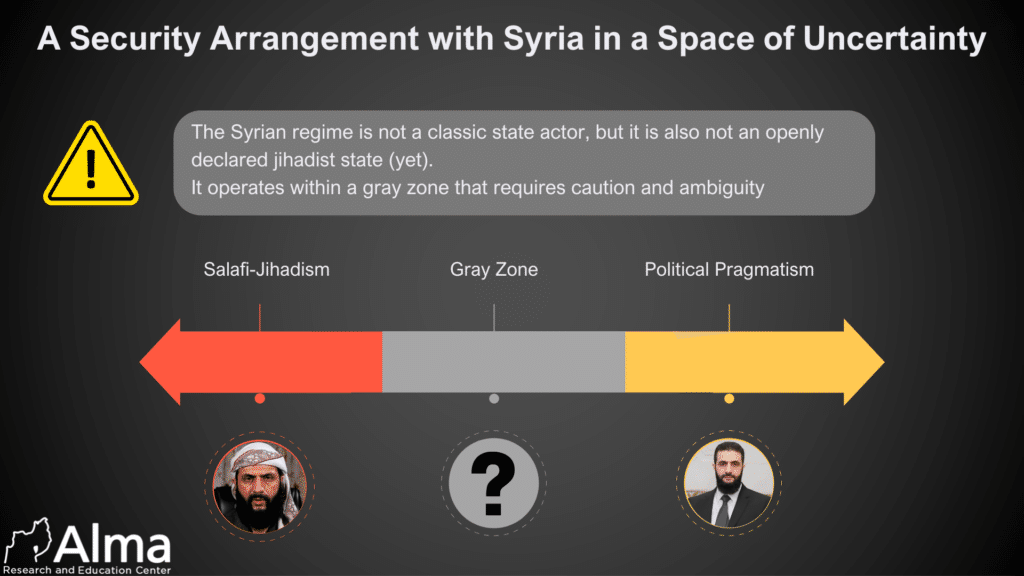
Israel’s northern arena has undergone significant changes over the past two years, reshaping the regional balance of power. From the weakening of Hezbollah in Lebanon, through the collapse of the Assad regime in Syria, to the rise of rebel forces led by Ahmad al-Shara (Abu Muhammad al-Julani) – the security reality along Israel’s northern border is in the midst of profound transformation.
The Shiite axis, which for many years constituted the primary threat to Israel in this arena, has weakened. However, the weakening of one axis does not eliminate Israel’s security challenges. On the contrary – it sharpens the need for a renewed assessment of the nature of emerging threats.
Israel must ensure that it is not replacing one threat with another: moving from a threat based on the Shiite axis and Iranian proxies to a new threat in the form of a radical Sunni axis, with jihadist roots and a different worldview – but no less hostile.
The change in the Syrian arena creates tactical opportunities alongside strategic risks. An unstable central regime, together with the rise of armed actors with an extremist jihadist ideological past, requires Israel to act cautiously: to exploit the weakening of its enemies – but to avoid illusions of stability.
Israel’s Interest in a Security Arrangement with Syria
Shortly after the rebel forces rose to power in Syria in December 2024, IDF forces deployed in the buffer zone along the Syria–Israel border (an area meant to be demilitarized and free of Syrian military presence), with the aim of protecting Israel’s border and preventing the outbreak of terrorist activity and the entrenchment of hostile elements.
On the one hand, this presence provides Israel with security depth and freedom of action against immediate threats. On the other hand, as time passes and the presence is perceived as permanent, growing local resistance begins to emerge, and the continuation of the existing situation may turn escalation into a matter of time.
The opposition does not come only from radical elements, but also from public discourse within Syria, where calls against Israel are increasing. These calls and hostility toward Israel were expressed prominently during events marking the anniversary of the fall of the Assad regime (December 8).[1]
At the same time, President Ahmad al-Shara continues to consistently emphasize his demand for Israeli withdrawal from Syrian territory, portraying the Israeli presence as a violation of sovereignty and presenting Israel as the sole obstacle to regional stability and to an agreement.
Is it possible – and if so, how – to reach an arrangement that prevents escalation without harming Israel’s security?
The Nature of the Current Syrian Regime
Examining the possibility of a security arrangement with Syria requires a sober assessment of the identity and character of the regime with which Israel might sign an agreement. This is a leadership that emerged from an Islamist rebel movement, a significant portion of whose senior figures carry a clear jihadist past.
At the head of the regime stands Ahmad al-Shara (Abu Muhammad al-Julani), a figure who emerged from the worlds of al-Qaeda and Salafi jihad. Although in recent years – and especially over the past year – al-Shara has undergone a process of rebranding, attempting to portray himself as a pragmatic leader who has abandoned jihadist ideology, this does not erase the ideological infrastructure from which he emerged.
Moreover, over the past year, additional indicators have strengthened the assessment that the “moderation” processes presented by the Syrian regime are not necessarily evidence of ideological renunciation but may reflect tactical adaptation to a complex regional and international reality. In the jihadist sphere, political pragmatism does not contradict adherence to long-term goals; rather, it often serves as a means to achieve them.
Alongside this, the current Syrian regime operates in a fragile domestic arena. Its leadership must establish legitimacy vis-à-vis a public exhausted by many years of war and vis-à-vis various armed groups. In this reality, Israel may, when needed, serve as a convenient political tool for strengthening the regime’s internal cohesion – as a foreign factor threatening Syrian sovereignty and one against which unity is required.
However, at this stage it appears that the Syrian leadership prefers to focus on the domestic arena: consolidating rule, strengthening public legitimacy, and building functioning military, security, and governance institutions. A direct confrontation with Israel does not currently serve these interests and could divert resources and undermine stabilization processes that are still far from complete.
This gap – between the potential use of Israel as a unifying enemy and the desire to avoid premature escalation – defines the Syrian regime’s current room for maneuver but does not eliminate the risk of future conflagration.
Therefore, Israel, and of course the international community as well, must understand that even if the Syrian regime currently operates based on considerations of stability and reconstruction, this does not mean adoption of a Western state-centric conception of agreements, sovereignty, or borders. This is an actor likely driven by a combination of pragmatic constraints and jihadist ideology – a combination that requires heightened caution, structural suspicion, and a deep understanding of the decision-making culture on the other side.
Perceptions of Agreements in the Jihadist World versus the West
To properly assess any possible arrangement with Syria, Israel must consider a deep conceptual gap between how agreements are perceived in the Western world and how they are perceived in the jihadist-Islamist world.
In the Western conception, a political or security agreement is viewed as a binding tool intended to regulate relations over time, reduce friction, and prevent a return to conflict. The basic assumption is that the agreement reflects a genuine intention to change reality, recognize sovereignty and legitimacy of the parties, and to uphold the agreement over the long term.
By contrast, in the jihadist conception, an agreement is not necessarily an expression of reconciliation or ideological concession, but first and foremost a tactical instrument. Agreements are signed based on considerations of power, weakness, temporary interest, or the need to regroup, and their validity is perceived as contingent on circumstances. A change in the balance of power may justify, ideologically and religiously, the cancellation or violation of the agreement.
In this context, the Treaty of Hudaybiyyah constitutes a formative model in jihadist perception. The agreement, signed by Muhammad with the Quraysh tribe in 628 CE when he was in a position of relative weakness, is perceived as proof of the legitimacy of temporary agreements with an enemy – as long as they serve a strategic interest. The subsequent violation of the agreement, after the balance of power shifted, is not perceived as a moral failure but as a legitimate and even desirable move.
Over time, the Treaty of Hudaybiyyah became an expression used to describe “temporary peace” – one intended to serve a tactical need rather than a goal of permanent reconciliation. In this sense, the agreement is perceived as a tool to “lull” the enemy rather than as a renunciation of the struggle itself. Thus, for example, Yasser Arafat publicly compared the Oslo Accords on several occasions to the Treaty of Hudaybiyyah – a comparison intended to send a clear message to the Palestinian public: this is a tactical move, not a principled concession regarding the continuation of the struggle.
Beyond its historical significance, the Treaty of Hudaybiyyah also serves as a religious reference that grants legitimacy to forming alliances with actors perceived as infidels, based on the understanding that it is permissible – and even appropriate – to violate such alliances when doing so serves broader Islamic interests. This interpretation has become deeply embedded in the political consciousness of various Islamist movements and continues to serve as a source of ideological inspiration for the use of agreements as a temporary phase in struggle.
Another central concept is taqiyya (التقيّة) – a jurisprudential-religious principle in Islam that permits a believer to conceal his true faith or distort his declarations through outward behaviour when his life, body, or freedom are under real threat. In the jihadist conception, taqiyya has become an operational tactic, meaning the “right” to conceal intentions, ideology, or military activity when this serves strategic and survival needs. The Syrian regime is in a state of political and security survival; state and security institutions have not yet fully consolidated, and armed groups and regime opponents continue to threaten stability.
This concept is also reflected in instructional manuals of ISIS and al-Qaeda, in which believers are instructed to conceal their faith to protect the objective, with the aim of integrating into Western society. Conversely, taqiyya has also historically been used by Shiites to conceal their religion due to persecution and discrimination. In the political context, this means that a gap between moderate public rhetoric and a hostile underlying worldview is not necessarily a contradiction, but rather a familiar and accepted pattern of behaviour.
Implications for Israel
As long as the clear ideology of al-Shara and his regime is unknown, in the event of a security agreement with Syria, Israel must avoid the Western foundational assumption that signing an agreement means the end of a conflict. Such an agreement may reduce the risk of escalation and prevent confrontations in the short term, but it does not eliminate the need for constant vigilance, military superiority, and preparedness for future escalation.
Israel must act to secure an agreement that safeguards Israel’s strategic interests and the communities along the Syrian border, even if this includes maintaining a presence at outposts and positions within Syrian territory.
The Israeli presence in Syria has clear security importance. During its activity, large quantities of weapons were located, and terrorist infrastructures and hostile elements operating near the border were thwarted. This presence enables Israel to proactively defend its borders, prevent the entrenchment of new threats, serve as a buffer between hostile actors and Israeli communities adjacent to the border, and block the development of a dangerous security reality before it becomes a tangible threat. In this sense, Israeli activity is not intended for occupation, but for threat prevention and reduction of future escalation risks.
Al-Shara is careful to repeatedly emphasize that this is not a peace agreement or normalization, but a security arrangement. Israel must act without illusions and without naïve expectations of civilian normalization or genuine reconciliation; security preparedness and risk awareness must remain even in an era of arrangement – especially as long as uncertainty remains regarding the nature and stability of the new Syrian regime. In our assessment, this uncertainty will persist for a prolonged period.
Summary
The emerging reality in the northern arena requires Israel to combine sober security realism with calculated diplomatic flexibility. An arrangement with Syria may serve clear Israeli interests: reducing friction, preventing unplanned escalation, preserving relative stability along the border, and strengthening legitimacy vis-à-vis the international community. However, such an arrangement cannot rest on Western assumptions of reconciliation, ideological change, or peace.
First and foremost, Israel must safeguard its security interests. Even if Israel reaches a security arrangement with Syria, it must remember that Syria is not a “classic” state actor in the Western sense. The roots of Syria’s president and his senior associates lie in Salafi-jihadist ideology, this fact requires Israel to examine any agreement not only through the conventional political-security prism, but also through the Islamic-jihadist conceptual world from which decision-makers in Damascus emerge.
[1] https://x.com/Israel_Alma_org/status/2000882265853694454




One Response
Dear Dana,
Historically we know AlSharra was a terrorist, jihaddist snake. He may have crawled into a tree to speak nicely, but he cannot be trusted! Tree snakes can also change color to deceive and prepare for when to strike next. When dealing with a deadly venomous snake it is better to crush or remove the head to restore a safe environment. Otherwise death lurks overhead, and can strike at the next opportunity.