The Iranian Arena
Day 14 of the war. Over the past 24 hours, the IDF completed several waves of strikes against regime infrastructure in Iran at three main locations simultaneously. In Shiraz, the IDF struck an underground site used for the production and storage of ballistic missiles, as well as an air force base and the control tower at the local airport. In Tehran, sites and a central base of the regime’s air defense array were targeted, along with facilities used for the production of weapons, defense systems, and components for ballistic missiles. In addition, the Air Force struck checkpoints and forces of the Basij unit that had recently been established in the city. In the city of Ahvaz, headquarters belonging to the regime were attacked, including headquarters of the IRGC Ground Forces and a central headquarters of the internal security forces.
In addition to the reports of strikes at the main locations, strikes were also reported at several other sites across Iran, including the air force base in Bandar Abbas, a missile base in Khomein, as well as facilities in Bushehr, Karaj, Qom, and Arak.
In total, more than 200 targets across Iran were struck over the past 24 hours, including missile launchers, defense systems, and weapons production sites.
According to American sources, between 160 and 190 ballistic missile launchers of the Iranian regime have been destroyed since the beginning of the campaign, and about 200 additional launchers have been blocked or disabled. According to estimates, the regime still has about 150 active launchers. It was also reported that since the start of the fighting about 10,000 members of the regime’s security and internal forces have been killed or wounded.
According to a report by the U.S. Central Command (CENTCOM), on March 12 an aerial accident occurred between two American refueling aircraft over western Iraq during operational activity related to the strikes in Iran. One aircraft crashed while the other managed to land safely. Four members of the crew of the crashed aircraft were killed, and the search for two additional crew members is ongoing in Iraq.
According to U.S. Central Command data, since the beginning of the campaign about 6,000 targets across Iran have been struck, and more than 90 Iranian vessels have been destroyed or damaged during the operations.
At the same time, Iran is holding marches and events today marking International Quds Day. The regime’s propaganda machine is doing everything it can to demonstrate the regime’s strength and survivability. Alongside the strikes, the regime brought its supporters into the streets today. Many senior regime officials who are still alive (from the president downward) went out into the streets and moved among the demonstrators in the various marches while displaying (apparently) self-confidence.
As is customary, U.S. and Israeli flags were burned, and the usual chants of “Death to America” and “Death to Israel” were heard.
Iran Attacks Targets Across the Middle East
Iran continues to carry out attacks against various targets across the Middle East.
In Turkey, missiles were intercepted above Incirlik Air Base, which hosts U.S. nuclear weapons. This marks the third time since the beginning of the campaign that Iran has launched missiles toward Turkish territory. The missiles were intercepted by NATO forces.
In the United Arab Emirates, an Iranian UAV struck a building this morning in the Dubai International Financial Centre (DIFC).
In Saudi Arabia, more than 50 Iranian UAVs entered the country’s airspace overnight.
In Oman, two additional people were killed in Iranian UAV attacks in the Sohar area in the north of the country, near the Strait of Hormuz.
Additional attacks were also reported in Jordan and Kuwait.
Iraq
A French soldier was killed and several French soldiers were wounded in an Iranian UAV attack on a French base near Erbil Airport in the Iraqi Kurdistan region.
The Israeli Arena
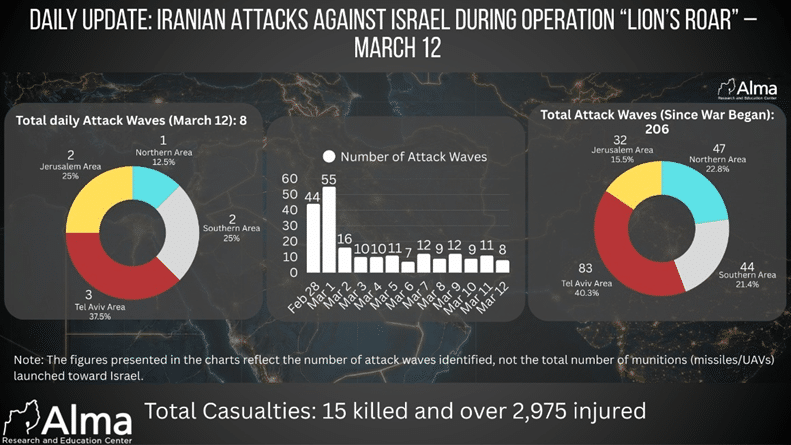
On March 12, eight Iranian waves of attacks against Israel were identified. Geographically, most of the attacks were directed toward the Tel Aviv area, which experienced three waves of attacks (37.5%). In addition, two waves of attacks were recorded in the south (25%), two waves in the Jerusalem area (25%), and one wave of attacks in the north (12.5%).
Since the beginning of the campaign, a total of 206 Iranian waves of attacks against Israel have been identified. In the cumulative geographical distribution of all attacks, the central region—particularly the Tel Aviv metropolitan area—continues to be the main target, with 83 waves of attacks (40.3%). This is followed by the northern region with 47 waves (22.8%), the southern region with 44 waves (21.4%), and the Jerusalem area with 32 waves (15.5%).
An examination of the daily trend indicates that after the peak recorded in the first days of the campaign (44 waves of attacks on February 28 and 55 waves on March 1), there has been a decline in the scope of attacks and relative stabilization in the daily rate of attacks. Since the beginning of March, the number of waves of attacks has averaged around 10 waves per day.
Since the beginning of the war, 15 civilians have been killed in Israel, and more than 2,975 people have been injured to varying degrees as a result of direct hits, falling interceptor debris, and secondary damage. During the past 24 hours, 213 injured individuals were evacuated to hospitals.
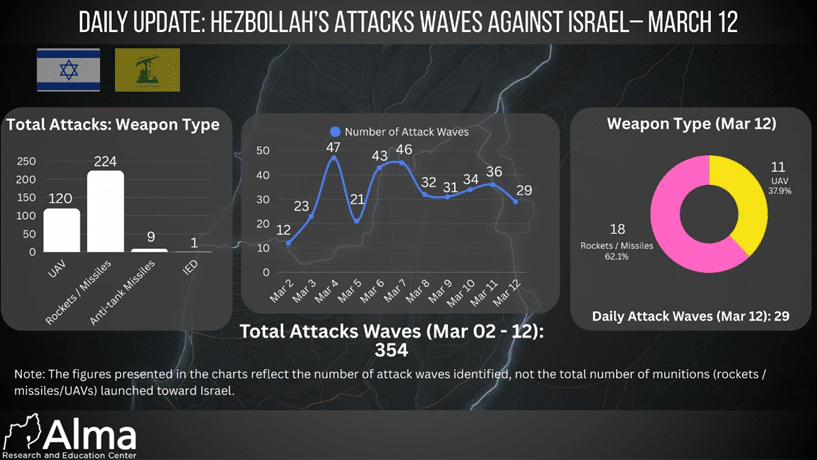
On March 12, 29 Hezbollah waves of attacks against Israel were identified. In terms of the types of weapons used, 18 waves of attacks (62.1%) were carried out using rockets and missiles, while 11 waves of attacks (37.9%) were carried out using UAVs.
Most of the launches were directed toward the northern region, mainly toward border communities and the Galilee area up to Haifa. Several attacks were also carried out within Lebanon toward IDF forces, and in one attack several launches were directed toward the Tel Aviv area. In the attack toward the Tel Aviv area, a missile struck residential buildings in one of the communities in central Israel and caused extensive damage.
Since Hezbollah joined the fighting on March 2, a total of 354 waves of attacks against Israel have been identified. An examination of the types of weapons used by the organization so far indicates that rockets and missiles continue to constitute the main means of attack, with 224 waves of attacks. Alongside this, the use of UAVs has become a central component of the organization’s operational activity, with 120 waves of attacks carried out using UAVs. In addition, 9 attacks using anti-tank missiles and one explosive device attack were documented.
An examination of the daily trend indicates fluctuations in the scope of attacks throughout the days of the campaign. After a sharp increase at the beginning of the fighting and a peak of activity recorded on March 4 (47 waves of attacks), a temporary decline was recorded followed by a return to a high level of activity on March 6–7. In recent days, relative stabilization has been observed at an average range of about 33 waves of attacks per day.
Lebanon and Hezbollah
Lebanese President Joseph Aoun is working to promote a temporary ceasefire for one month. According to reports, Aoun asked the U.S. ambassador in Beirut to exert pressure on Israel to reach a ceasefire that would allow Lebanon to begin implementing a plan to establish state control over all weapons in the country, including Hezbollah’s weapons.
At the same time, discussions are taking place regarding the formation of a Lebanese delegation that would conduct political negotiations in the future. Among the names mentioned as possible members of the delegation are Paul Salem, president of the Middle East Institute in Washington and a prominent figure in the Lebanese diplomatic arena; Simon Karam, a former diplomat and former Lebanese ambassador to the United States; Abd al-Sattar Issa, secretary-general of the Lebanese Ministry of Foreign Affairs; and Shukri Abu Nassar, a Druze political figure and former diplomat. So far, no Shiite representative has been agreed upon for the delegation, which is delaying the completion of its composition. Speaker of Parliament Nabih Berri expressed principled support for the initiative but emphasized that he opposes holding negotiations while the fighting continues.
According to political sources in Lebanon, the country received a message stating that there is no willingness to open negotiations before a change in the situation on the ground.
The publication of a document titled “The Declaration of the National Officers” sparked political controversy in Lebanon. The document was presented in the media as the position of a group of officers in the Lebanese army who expressed reservations about political developments and the pressures being placed on the army. Following the publication, the leadership of the Lebanese army denied any connection to the document. The army emphasized that no such group exists within the army and that all soldiers are committed solely to the chain of command. Prime Minister Nawaf Salam described the document as “suspicious” and argued that it is a publication that could harm the unity of the army. According to political sources in Lebanon, the publication comes amid the dispute surrounding the issue of disarming Hezbollah and the pressures being placed on the army on this matter.
According to a report by the Iran International channel (which we cannot verify), sources inside Iran claimed that Lebanese Parliament Speaker Nabih Berri receives more than $500,000 per month from Iran. According to the report, the funds are transferred in order to maintain unity in the Shiite position between Hezbollah and the Amal movement. The support is intended to ensure coordination between the Shiite leadership in Lebanon and Iran’s interests. Berri refused to respond to the report.
Organizations and bodies affiliated with Hezbollah are operating in the civilian and social sphere in order to assist the population displaced from their homes. These activities include search and rescue operations, medical assistance, and humanitarian and logistical support for civilians affected by the fighting.
The Lebanese government has opened 592 reception centers for displaced persons across the country.
The organization “Al-Wafaa li-Naqabat al-Ummal wal-Mustakhdimin,” which is affiliated with Hezbollah, published a statement marking International Quds (Jerusalem) Day. In the statement, the organization called on workers in Lebanon to join volunteer activities, participate in search and rescue operations, and assist medical and humanitarian teams. The statement emphasized the need to strengthen the “spirit of social resistance” and to assist the population affected by the war. It also noted that Jerusalem Day is an opportunity to strengthen support for the resistance organizations.
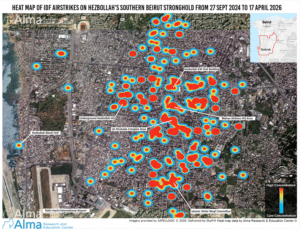
Over the past 24 hours, the IDF completed dozens of waves of strikes against Hezbollah infrastructure in Beirut, the Beqaa, Sidon, and southern Lebanon. The IDF struck about 400 targets, including missile launchers, observation systems, weapons storage facilities, and headquarters.
The Air Force struck the al-Zrariyeh–Tir Falsay bridge over the Litani River in Lebanon (between Sidon and Tyre). This is not the first time this bridge has been attacked. The bridge is known as a crossing used by Hezbollah operatives moving from the north to the south of the country. Both the Lebanese Army and UNIFIL have been deployed in the area of the bridge in recent times, but aside from demonstrating presence they did not actually prevent the movement of Hezbollah operatives.
In addition, assets of the Al-Qard al-Hasan institution and economic assets of Hezbollah were attacked. In the Beqaa and southern Lebanon, about 10 Hezbollah weapons storage facilities were struck. Some of the warehouses were located in the area between the Litani River and the Zahrani River, the area of Hezbollah’s Badr Unit, from which many rockets are launched toward Israel.
In addition, several Hezbollah operatives were eliminated, including Murtada Hussein Srour, an operative (a professional knowledge focal point) in Hezbollah’s aerial unit (127), who also worked as a lecturer and held a PhD in chemistry at the Lebanese University. Murtada was the brother of the commander of Unit 127, who was eliminated during 2024. Along with Srour, Dr. Hussein Bazi was also eliminated, who served as the dean of the Faculty of Sciences at the university and was a Hezbollah operative.
Syria
Shiite militias in Iraq warned Syrian President Ahmad al-Sharaa not to carry out any military action against Hezbollah in Lebanon. In a statement issued by the militias, it was written that such a move would be considered a declaration of war against the entire “Axis of Resistance.” The statement further noted that any aggressive action toward Lebanese territory, in coordination with the Israeli and American enemy, would be considered a declaration of a comprehensive war and that the region would shift to a state of “open war.”
The International Arena
French President Emmanuel Macron confirmed that a French soldier was killed in an attack on the French base overnight in Erbil in the Iraqi Kurdistan region.
According to a report in the Wall Street Journal, the Saudi oil company Aramco is in negotiations with security companies from Ukraine to purchase interceptor UAVs for defense against Iranian attacks.
The United States is temporarily easing sanctions on Russia. The Trump administration approved a temporary 30-day waiver allowing countries to purchase Russian oil that is already in transit at sea. The aim is to lower oil and fuel prices, which have risen rapidly in recent times. French President Emmanuel Macron stated that the crisis in the Strait of Hormuz does not justify lifting sanctions on Russia.
Note: The next daily report will be published on Sunday, March 15.