The Iranian Arena
Over the past 24 hours, extensive strikes were carried out across several key locations in Iran, including Tehran, Kashan, Isfahan, and Shiraz.
These strikes targeted a range of sites directly linked to the regime’s security apparatus and military production, including facilities associated with the Basij and the Islamic Revolutionary Guard Corps, as well as industrial sites used for the development and production of weapons.
Among the targets were a facility for producing the regime’s defense systems, a plant for casting and filling warheads with explosives, a site for mixing and casting engines used in the development of ballistic missiles, and facilities producing critical components for ballistic missile development based on solid-fuel engines.
In addition, sites for the production and development of key ballistic missile components were struck, along with facilities manufacturing batteries for weapons systems and a weapons production site belonging to the Revolutionary Guards. Reports also indicated power outages in several areas of Tehran.
At the same time, strikes were carried out in Kermanshah, Karaj, and Dezful, targeting sites used for the storage and launch of ballistic missiles as well as air defense systems.
The President of the United States announced that he is postponing the planned strike on Iran’s energy facilities until Monday, April 6.
Eliminations
It was reported that Mohammadali Khodabakhsh, an air defense expert in the Islamic Revolutionary Guard Corps, was eliminated in strikes in Isfahan.
Iranian Activity in the Region:
Saudi Arabia – The Saudi Ministry of Defense reported that seven UAVs were intercepted in the eastern part of the country over the past 24 hours.
Kuwait – The Kuwaiti Ministry of Defense reported that one UAV and six ballistic missiles launched toward the emirate were intercepted the previous day. Alongside the interceptions, impacts on the ground were reported, including damage to Shuwaikh Port as a result of a UAV attack, as well as a strike on the fuel storage area at Mubarak Port, which caused a fire.
United Arab Emirates – The Ministry of Defense announced that fifteen ballistic missiles and eleven attack UAVs were launched toward the country the previous day. According to the ministry, since the beginning of the war, the UAE has been targeted by 375 ballistic missiles, 1,826 UAVs, and 15 cruise missiles.
Bahrain – Over the past 24 hours, 12 UAVs were intercepted, bringing the total since the start of the campaign to 154 missiles and 362 UAVs intercepted.
Qatar– For the first time in over a week, missile attack alerts were activated.
According to the Iranian news agency Fars, Iran issued targeted warnings to hotels in the United Arab Emirates and Bahrain, stating that hosting American forces would make them legitimate targets for attack.
Syria– The Four Seasons hotel in Damascus was mentioned as a potential Iranian target due to the presence of American military experts.
The Islamic Revolutionary Guard Corps prevented the passage of three container ships from different countries through the Strait of Hormuz.
Iraq
The Lebanese channel Al-Mayadeen reported strikes against a Popular Mobilization Forces base in Dur al-Sharikah, adjacent to an Iraqi army base. In response, the Iraqi Ministry of Foreign Affairs expressed absolute opposition to any attacks against Gulf states and Jordan, emphasizing Iraq’s commitment to a policy of balance, mutual respect, and regional cooperation. The ministry stated that the government is determined to take the necessary steps to address security challenges and is fully prepared to receive any information regarding attacks carried out from its territory, while clarifying that it opposes the use of Iraqi soil to attack other countries.
Judge Faiq Zaidan, head of Iraq’s Supreme Judicial Council, sharply criticized the conduct of the militias over the past month, arguing that they had taken the decision to initiate a military confrontation without government authority. According to him, this constitutes a violation of the rule of law and state institutions, dragging Iraq into internal and regional conflicts without national consensus. Zaidan warned that the continuation of this trend could lead to international isolation and sanctions, and described the militias’ refusal to submit to state authority as a serious threat to the stability of the state and society.
The Israeli Arena
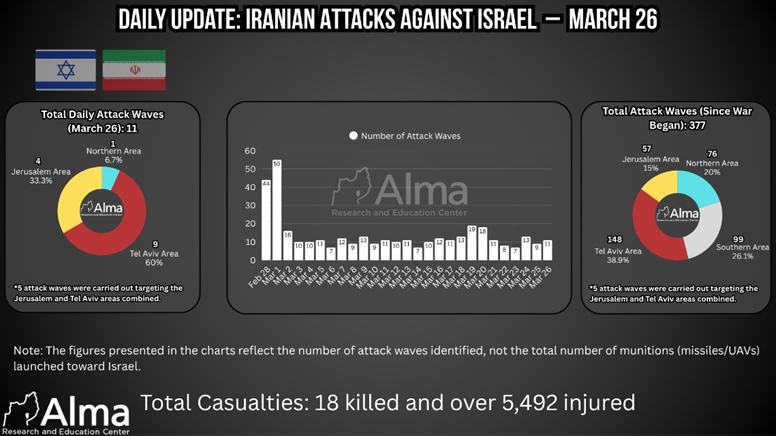
On March 26, 11 Iranian attack waves targeting Israel were identified, carried out using ballistic missiles. This reflects the continuation of a consistent operational pattern, maintaining a sustained pace of attacks as part of Iran’s attrition strategy.
Geographically, the attacks were distributed across several key regions:
Nine attack waves (approximately 60%) were directed at the Tel Aviv area.
Four additional waves (approximately 33.3%) targeted the Jerusalem area.
One wave (approximately 6.7%) was aimed at the northern region.
It should also be noted that five attack waves targeted both the Tel Aviv and Jerusalem areas simultaneously.
During the attacks, direct hits were recorded in civilian areas, including a strike on a residential neighborhood in the Arab town of Kafr Qasim. Additional impacts were reported in the cities of Modiin and Jerusalem, as well as in the north, including a shopping center in the Haifa area and in the Arab city of Shefa-Amr.
Since the beginning of the campaign, a total of 377 Iranian attack waves against Israel have been identified. In cumulative distribution, the central region—particularly the Tel Aviv metropolitan area—remains the primary target, alongside a broad geographic spread that also includes the south, the north, and the Jerusalem area.
Since the start of the war, 18 civilians in Israel have been killed, and more than 5,492 people have been injured to varying degrees as a result of direct impacts, falling interception debris, and secondary damage. In addition, thousands of civilians have been evacuated from their homes due to missile strikes, and the ongoing fire continues to disrupt daily life.
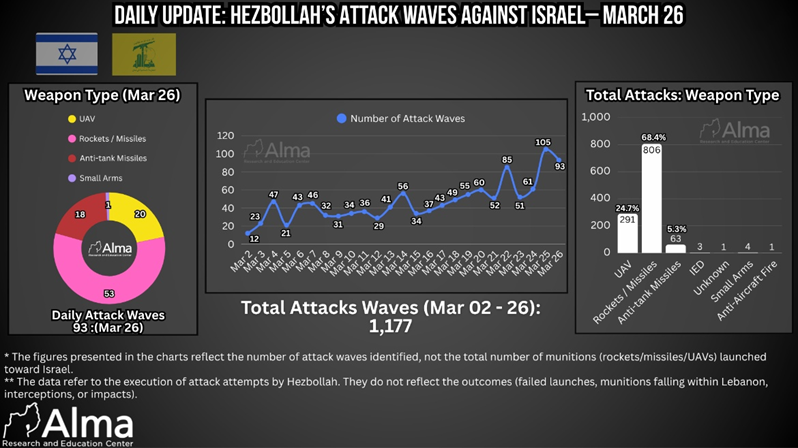
On March 26, 93 Hezbollah attack waves against Israel were identified, indicating continued intense activity while maintaining a particularly high volume of attacks.
During the day, in one of Hezbollah’s rocket barrages toward the city of Nahariya, one civilian was killed after a rocket struck the entrance of a residential building. Another civilian was seriously injured.
An IDF soldier was killed by an anti-tank missile, and additional soldiers were injured in several incidents. So far, four IDF soldiers and two civilians have been killed as a result of Hezbollah attacks.
Hezbollah is deliberately targeting civilian areas, resulting in direct hits on communities, cities, and civilian infrastructure in northern Israel. During the day, several impacts were also recorded in the city of Kiryat Shmona.
In terms of weapons used, most attacks were carried out using rockets and missiles (53 waves), alongside 20 UAV attack waves, 18 anti-tank missile attacks, and one incident involving small arms fire. This pattern indicates the continued dominance of rocket fire, alongside the integration of multiple types of weaponry.
Geographic distribution of the attacks:
- 31 attack waves (approximately 33.3%) targeted border communities (0–5 km).
- Six attack waves (approximately 6.5%) were directed at a range of 5–10 km, toward the Nahariya and Upper Galilee area.
- Fifty-two attack waves (approximately 55.9%) targeted a range of 10–30 km, including Safed, Acre, and the Golan Heights.
- Three attack waves (approximately 3.2%) were directed at a range of 30–50 km, toward Tiberias, the Lower Galilee, the Krayot, Haifa, Yokneam, and the Jezreel Valley.
- One attack wave (approximately 1.1%) targeted a range of over 100 km, toward central Israel.
Hezbollah claimed responsibility for 48 attack waves carried out against IDF forces operating in southern Lebanon, which included the use of indirect fire (rockets), suicide UAVs, anti-tank missiles, and small arms.
Since Hezbollah joined the fighting on March 2, a total of 1,177 attack waves against Israel have been identified. The overall trend indicates continued intensive offensive activity, combining large-scale fire directed at the civilian rear with attacks against IDF forces maneuvering in southern Lebanon.
Lebanon and Hezbollah
According to a report in the Lebanese newspaper Al-Akhbar, a central mouthpiece of Hezbollah, Egypt is holding contacts with Israel, the United States, and France in an effort to halt the IDF’s ground advance in southern Lebanon.
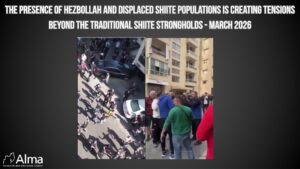
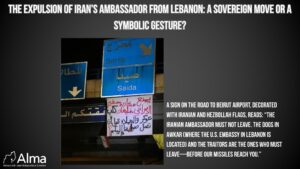
Internal tensions in Lebanon are intensifying regarding the issue of expelling the Iranian ambassador. According to a report in Al-Joumhouria, the Shiite duo—Hezbollah and the Amal Movement—opposes the planned departure of the ambassador and intends to treat the Lebanese foreign minister’s decision as if it had not been made.
According to a report by the Lebanese network MTV, Shiite ministers are not expected to resign from the government despite the dispute, and are likely to participate in the upcoming cabinet meeting after boycotting the previous session led by Prime Minister Nawaf Salam. The boycott was presented as a calculated move aimed at sending a political message to the government and President Joseph Aoun, emphasizing that the status of the “Shiite duo” cannot be ignored in sensitive decision-making, particularly during wartime.
Speaker of Parliament Nabih Berri expressed strong opposition to the decision to expel the ambassador, called for its full cancellation, and warned of political consequences. In practice, it appears that the “duo” does not intend to allow the implementation of the decision.
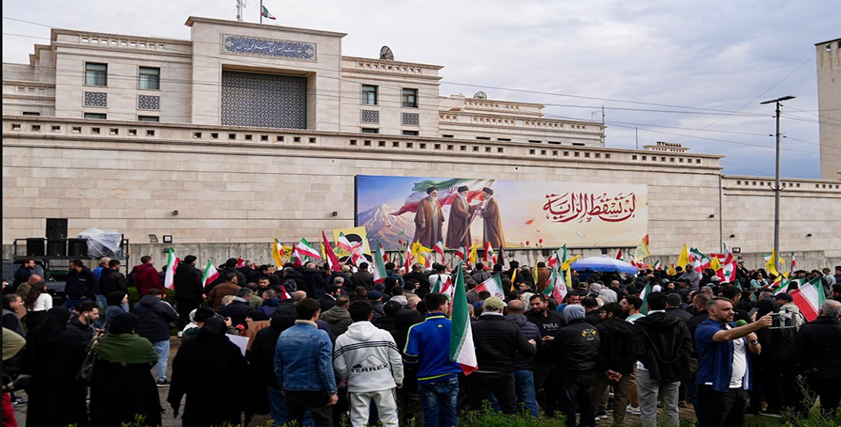
In this context, a protest was held outside the Iranian embassy in Beirut, attended by political and ideological actors affiliated with Hezbollah and other organizations. During the demonstration, participants voiced opposition to the Lebanese decision, expressed support for Iran, and stressed that the Iranian ambassador would not leave Lebanon, reflecting the depth of public and political backing for this position within this camp.
Lebanese Prime Minister Nawaf Salam condemned during a cabinet meeting the operation of a Hezbollah terror cell in Kuwait, noting that he had spoken with the Kuwaiti prime minister and conveyed Lebanon’s official condemnation. Hezbollah, for its part, denied the Kuwaiti reports regarding the presence of its cells operating in Gulf states.
The IDF continues intensive operations in southern Lebanon and Beirut. According to the IDF Spokesperson, the Israeli Air Force has struck more than 100 targets in Beirut since the beginning of the campaign, including high-rise buildings used as headquarters for the “Radwan Force” and for Hezbollah.
The IDF also eliminated Hassan Mohammad Bashir in the village of Hajir, a senior commander in Hezbollah’s anti-tank array.
The International Arena
According to a report in the Financial Times, the United Arab Emirates has expressed to the United States its willingness to take part in an international force that would work to reopen the Strait of Hormuz. At the same time, the UAE, together with Bahrain, is working to advance a UN Security Council resolution that would provide a mandate for a future task force, although it is estimated that this initiative will face opposition from China and Russia.
Ukrainian President Volodymyr Zelensky, currently visiting Saudi Arabia, announced the signing of a military cooperation agreement between the defense ministries of the two countries.
Director General of the International Atomic Energy Agency, Rafael Grossi, warned of the risks associated with strikes near the Bushehr nuclear reactor. According to him, this is an active facility containing a significant amount of nuclear material, and any damage to it could lead to a severe radiological event with broad consequences both within Iran and beyond.
Note: The next report will be published on Sunday, March 29.