The Iranian Arena
Over the past 24 hours, the IDF carried out a wave of strikes against sites producing aerial and naval weapons in the Tehran area, alongside strikes on defense systems and a launch position for anti-aircraft missiles.
An additional extensive wave of strikes was carried out in Isfahan, during which the city’s industrial university was targeted. Additional strikes were reported in the area of Mashhad airport, as well as in the cities of Shiraz and Bandar Abbas.
According to U.S. Central Command, more than two-thirds of Iran’s ballistic missile production facilities, UAV production sites, and shipyards have been destroyed so far.
Eliminations
The commander of the IRGC Navy, Ali Reza Tangsiri, was eliminated along with the head of the Navy’s intelligence branch, Behnam Rezaei, in a strike in Bandar Abbas.
In addition, according to reports in Iranian media, General Masib Bakhtiari, commander of Iran’s First Fleet, was also eliminated in the strikes in the city.
Iran continues to target locations across the Middle East
United Arab Emirates – Two people were reported killed and three others injured as a result of shrapnel falling in Abu Dhabi.
Kuwait – An Iranian strike targeted fuel storage facilities at Kuwait Airport.
At the same time, Kuwait’s Ministry of Interior announced that it had foiled a terrorist network directed by Hezbollah that planned to carry out assassinations targeting the country’s leadership and symbols. According to the statement, six suspects were arrested, including five Kuwaiti citizens and one individual whose citizenship had previously been revoked, and the involvement of 14 additional individuals who fled the country was uncovered. These included Kuwaiti citizens, individuals stripped of citizenship, two Iranians, and two Lebanese linked to Hezbollah. According to the investigation, the suspects admitted to ties with Hezbollah, joining the organization, and undergoing military training outside Kuwait, which included the use of weapons and explosives, surveillance methods, and assassination techniques.
Iraq
Pro-Iranian militias launched attacks against targets linked to the United States. The Iraqi government reported that seven soldiers were killed and 13 others injured in an American strike on a clinic at a military base.
The Israeli Arena
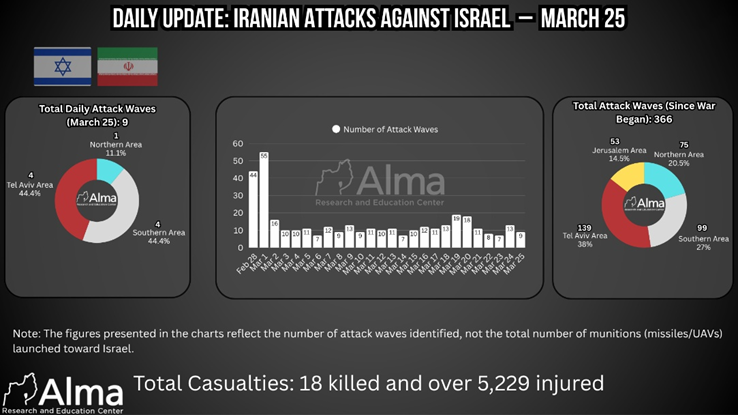
On March 25, nine Iranian attack waves against Israel were identified, carried out using ballistic missiles. This reflects a continuation of a consistent pattern of activity, maintaining a relatively moderate pace of attacks compared to the more intense days recorded over the past week. During one of the attack waves, impacts were identified in the Hadera area.
Geographically, the attacks were distributed across several key regions:
Four attack waves (44.4%) targeted the Tel Aviv area,
Four additional attack waves (44.4%) targeted southern Israel,
And one attack wave (11.1%) targeted the northern region.
This distribution indicates continued combined targeting of the center and the south, alongside complementary geographic dispersion toward the north.
Since the beginning of the campaign, a total of 366 Iranian attack waves against Israel have been identified. In cumulative distribution, the central region—particularly the Tel Aviv metropolitan area—continues to be the primary target, alongside an ongoing expansion of efforts toward southern and northern Israel.
Trend analysis indicates that despite daily fluctuations in the scope of attacks, a consistent operational pattern is maintained as part of a strategy of sustained pressure on the Israeli home front, combining a focus on densely populated areas with dispersed attacks across other parts of the country.
Since the start of the war, 18 civilians in Israel have been killed, and more than 5,229 people have been injured to varying degrees as a result of direct strikes, falling interceptor debris, and secondary damage. In addition, extensive damage has been caused to residential buildings and civilian infrastructure, approximately 5,000 Israelis have been evacuated from their homes due to the attacks, and the ongoing fire continues to disrupt daily life.
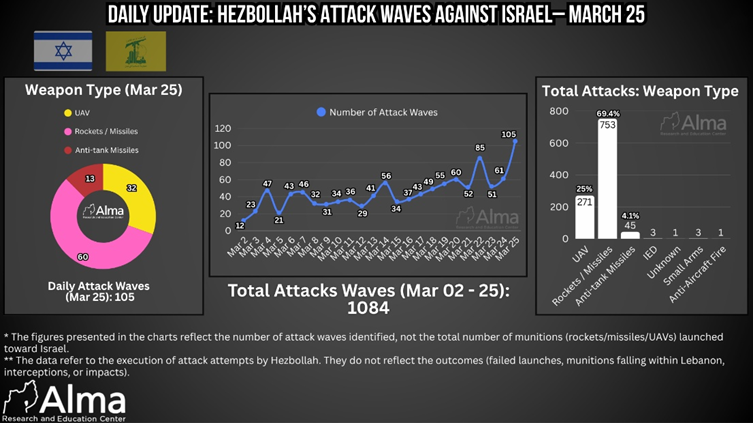
On March 25, 105 Hezbollah attack waves against Israel were identified—the most intense day of fighting since the beginning of the campaign.
An IDF soldier was killed in southern Lebanon, and additional soldiers were injured. In addition, two civilians were injured in one of Hezbollah’s rocket barrages toward the city of Karmiel. So far, three IDF soldiers and one civilian have been killed in the northern arena.
In terms of weapon types, most of the attacks were carried out using rockets and missiles (60 waves – approximately 57%), alongside 32 attack waves using UAVs (approximately 30%) and 13 attacks using anti-tank missiles (approximately 12%). The high use of anti-tank missiles is also unusual compared to previous days, and was used by Hezbollah to target IDF forces in southern Lebanon.
Geographically, the attacks were spread across various ranges in northern Israel:
• 34 attack waves targeted communities near the border (0–5 km).
• 9 attacks targeted the 5–10 km range – toward the cities of Safed, Karmiel, and Nahariya and nearby communities.
• 10 attack waves targeted the 10–40 km range – the areas of the Krayot, Haifa, the Golan Heights, and the Lower Galilee.
It also emerges that 55 attack waves were carried out within Lebanon against IDF forces operating against Hezbollah, for which the organization claimed responsibility. These attacks were carried out using indirect fire, anti-tank missiles, and loitering UAVs. As IDF activity in southern Lebanon deepens, Hezbollah’s effort to target IDF forces increases accordingly.
However, it should be emphasized that even when Hezbollah presents its attacks as directed at military targets, in practice they often involve the use of statistical weapons (primarily rockets) that are not precise, and therefore also impact civilian communities near the border in Israel.
Since Hezbollah joined the fighting on March 2, a total of 1,084 attack waves against Israel have been identified. Trend analysis indicates a continued escalation in the scope of attacks, with a transition to particularly high levels of activity and increased pressure on both the home front and forces on the ground.
On March 26, a Hezbollah rocket made a direct hit on a residential building in the city of Nahariya, killing one civilian and seriously injuring another. A Hezbollah UAV strike in a community near the border resulted in three people lightly injured.
Lebanon and Hezbollah
The Lebanese newspaper Nidaa Al-Watan reports that Egypt’s Foreign Minister, Badr Abdelatty, is expected to arrive in Beirut and meet with Lebanese President Joseph Aoun and other senior officials as part of efforts to advance an initiative to halt the war.
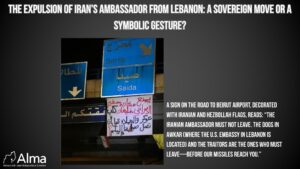
According to reports, contacts are ongoing between President Aoun and Speaker of Parliament Nabih Berri in an attempt to find a solution to the issue of expelling Iran’s ambassador, Mohammad Reza Shibani.
Hezbollah Deputy Head of the Political Council, Mahmoud Qamati, called for participation in a solidarity event in front of the Iranian embassy in Beirut, stating that calls to expel the Iranian ambassador harm Lebanon’s sovereignty and deviate from diplomatic norms.
Naim Qassem stated that, from Hezbollah’s perspective, the current situation presents a choice between surrender and confrontation and “resistance,” and that Hezbollah will continue its “resistance,” emphasizing the need for national unity against Israel and the United States.
Israeli military activity in southern Lebanon continues, including exchanges of fire, airstrikes, and ground operations. During the night, Egoz unit forces detained and captured a cell commander from Hezbollah’s proxy organization, the “Lebanese Brigades for Resistance Against the Israeli Occupation,” in the Mount Dov sector.
The International Arena
The Iranian news agency Tasnim reported that the Houthis in Yemen are prepared to enter the fighting and even take control of the Bab al-Mandab Strait.
The UAE Ambassador to the United States, Yousef Al Otaiba, stated that Iran’s nuclear capabilities have been damaged and its proxies have weakened, but emphasized that further action is needed to remove the missile and UAV threat. According to him, the UAE is prepared to join an international initiative to reopen the Strait of Hormuz. In addition, the senior advisor to the UAE President, Anwar Gargash, warned that harm to civilians, infrastructure, and energy and maritime security will not go unanswered.
In a joint statement, Kuwait, the United Arab Emirates, Bahrain, Saudi Arabia, Qatar, and Jordan strongly condemned the Iranian attacks, describing them as a blatant violation of their sovereignty and territorial integrity, whether directly or through proxies and armed organizations supported by Iran. The countries also condemned attacks by pro-Iranian militias from Iraqi territory and called on the Iraqi government to take immediate measures to stop them. They further reaffirmed their right to self-defense and to take all necessary measures to preserve their sovereignty, security, and stability.
The head of the Ugandan People’s Defence Forces expressed support for Israel on X, stating that although there is a desire for the war to end, any call for the destruction of Israel will lead Uganda to join the fighting alongside it.