
The month of December 2025 was marked by a relative decrease in the scope of strikes compared to previous months; however, this does not indicate a reduction in Hezbollah’s presence or in its military rehabilitation activities in Lebanon. This article presents a quantitative and geographic analysis of IDF strikes carried out during December 2025, in the context of all strikes conducted during the ceasefire period since 27 November 2024.
In December 2025, the IDF carried out 40 airstrikes in Lebanon (Each strike may include attacks on a single target or multiple targets within the same area, and the data refer to the number of rounds of strike rather than the number of individual targets). Most of the strikes were conducted in southern Lebanon: 19 strikes north of the Litani River, 16 strikes south of the Litani River, and an additional five strikes in the Beqaa region.
Eleven Hezbollah operatives were eliminated, the majority of them (eight) in the area south of the Litani River, indicating the continued presence and intensive activity of Hezbollah in this area. In addition, one Amal operative and one Lebanese operative from the Quds Force Operations Unit (Unit 840) were eliminated.
The targets struck included weapons storage facilities (in some cases, when an operational need arose, evacuation warnings were issued in order to protect the civilian population), two training and instruction compounds of the Radwan Unit, military structures, terrorist infrastructure, rockets launching sites, and a military camp. Hezbollah continues to pursue military rehabilitation, with the Radwan Unit being a high priority for rebuilding its offensive capabilities.
Beyond the airstrikes, the IDF conducted ground activity, with 11 reported incidents of offensive operations in villages adjacent to the border with Israel. In these areas, the IDF acts to prevent Hezbollah activity in close proximity to Israeli territory, which is characterized, among other things, by attempts to collect weapons, intelligence-gathering activity, and more.
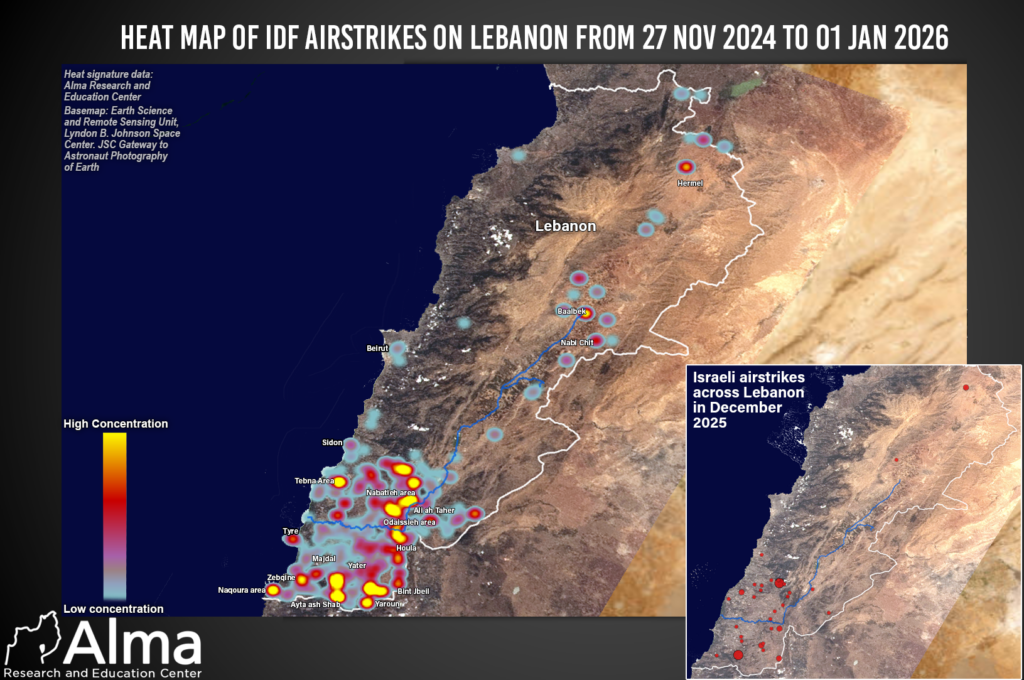
Heat map of IDF airstrikes in Lebanon (from 27 November 2024 to 1 January 2026): the map illustrates the concentrations of IDF airstrikes across Lebanon (including operatives eliminations).
The heat map indicates a high and sustained concentration of rounds of strike in southern Lebanon, primarily in areas south and north of the Litani River. Secondary strike clusters are evident in the Beqaa Valley, while the rest of the country shows more limited and dispersed activity.
The distribution of strike locations corresponds to Hezbollah’s well-known deployment patterns in southern Lebanon, both north and south of the Litani, and in the Beqaa region. The absence of a significant concentration of strikes in Beirut does not necessarily reflect the scope of Hezbollah activity there, but is largely due to IDF operational constraints related to dense civilian population and international legitimacy. In the few cases in which strikes were carried out in the city, advance evacuation warnings were issued, with the exception of three operatives’ eliminations.
The map’s data point to the continued rehabilitation and re-entrenchment of Hezbollah infrastructure, as well as prominent and ongoing activity by its operatives throughout southern Lebanon. The repeated concentration of strikes in the same geographic areas suggests that Hezbollah infrastructure in these areas has not been fully neutralized and may indicate the organization’s ability to recover, adapt, and sustain its operations in the area.
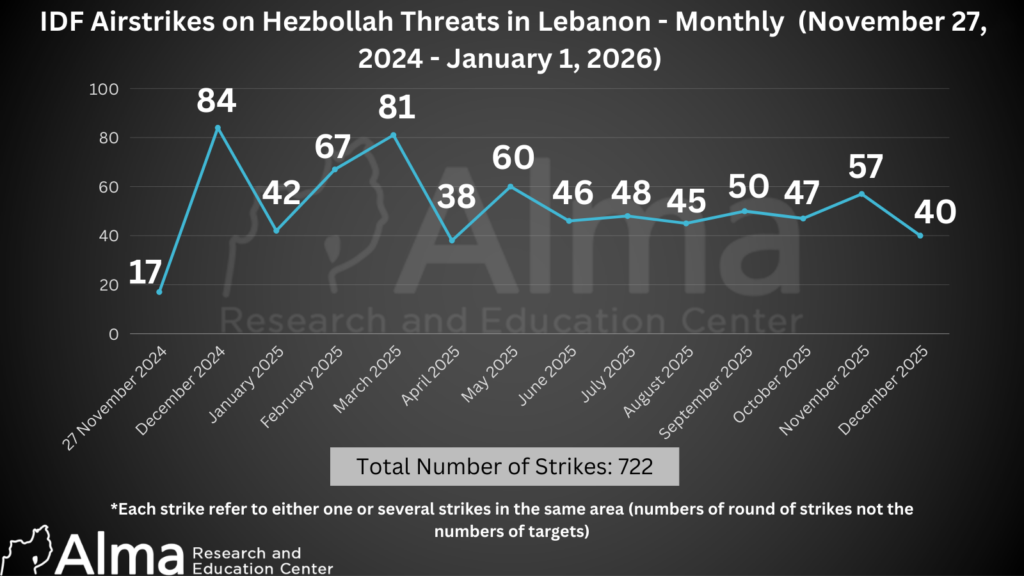
IDF airstrikes against Hezbollah threats in Lebanon – by month (27 November 2024 – 1 January 2026): the graph presents the monthly number of IDF airstrikes carried out against Hezbollah targets in Lebanon since the ceasefire came into effect. In total, 722 rounds of strikes were conducted.
An analysis of the scope of the strikes indicates a relatively gradual decline since mid-2025. In the first half of 2025, the average stood at 62 monthly strikes (from December 2024 through May 2025). In contrast, during the second half of the year (June–December 2025), the average monthly number of strikes was 47 rounds of strikes.
December 2025 was the month with the lowest number of strikes in the past six months, with 40 rounds of strikes.
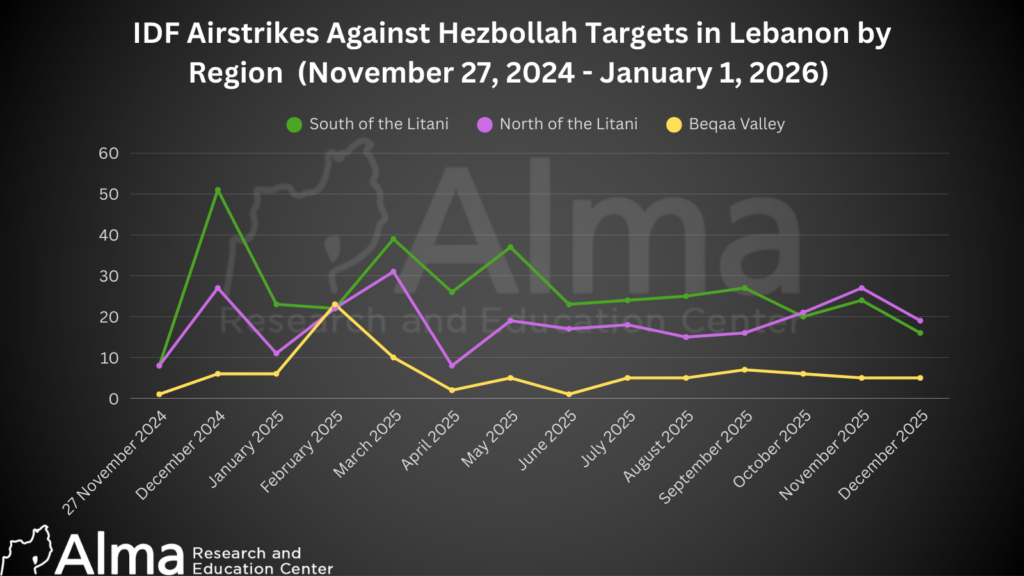
IDF airstrikes against Hezbollah targets in Lebanon by geographic area (27 November 2024 – 1 January 2026): the data in the graph present the monthly number of strikes south of the Litani River, north of the Litani River, and in the Beqaa region.
The graph shows that most strikes were carried out south of the Litani; however, a different trend has emerged in the past two months. In November and December 2025, most of the strikes were in areas north of the Litani. This trend indicates a shift in Hezbollah’s operational center of gravity from southern Lebanon to areas north of the Litani. At the same time, the continued strikes south of the Litani and along the contact line indicate that Hezbollah continues to maintain a presence and activity south of the Litani and is even attempting to rehabilitate infrastructure in this area. Hezbollah has not fully withdrawn from the southern Litani area.
In addition, the data show a general decline in the overall scope of strikes in recent months, particularly in December 2025.



2 Responses
Dear Dr Zoe,
Syria is comparable to a large fragmentation bomb. There would seem to be several burning fuses of possible different lengths. Jihaddist rule is incompatible with minority Liberty and Justice. Unless jihaddist sharia law is confronted and defused the bomb will eventually explode. A peaceful plan to provide minority independence with political boundaries seems preferable to prevent jihaddist oppression, violence and domination over time.
Dear Dana,
Hezbollah forces must be TOTALLY ERADICATED. There can be no compromise with lying genocidal jihaddists who are ideologically devoted to the annihilation of the State of Israel..