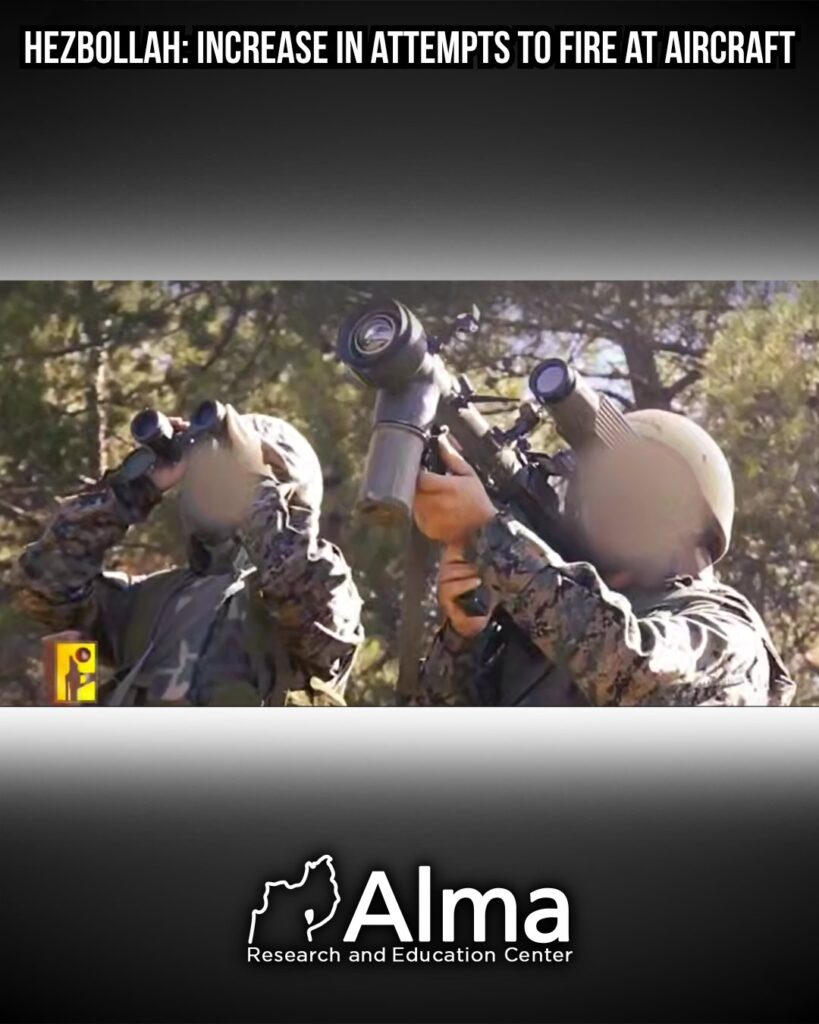
It appears that Hezbollah is increasing its efforts to attempt to harm the IDF’s freedom of aerial operation over Lebanese airspace. In recent days, we have identified a rise in Hezbollah’s claims of responsibility for several incidents involving attempts to hit, and in some cases allegedly successfully hitting, IDF aircraft. These statements are accompanied by a Hezbollah influence campaign, reflected in an increase in the publication of videos showing such firing activity. On April 1, the IDF formally updated that on March 31, a surface-to-air missile was launched at an IDF UAV, a hit was indeed identified, and the aircraft crashed. Hezbollah currently operates in southern Lebanon with a low signature, mainly through small cells using shoulder-fired anti-aircraft missiles (MANPADS), which are primarily effective against UAVs and low-flying helicopters. The advantage of these cells lies in their mobility and survivability. Hezbollah possesses at least five types of shoulder-fired missile systems (both very old and more advanced), of Russian origin (Strela, Igla), Iranian (Misagh), North Korean (HT-16PGJ), and possibly even American-made (Stinger).