The targeted elimination campaign is a key component of Israel’s efforts to thwart and disrupt the organization’s military recovery processes, accounting for roughly one-third of all strikes conducted in Lebanon during the ceasefire period.
The quantitative analysis shows that the main targeted elimination effort focused on the low-level ranks (73.6 %), while the share of mid-level ranks (22.8%) and senior leadership ranks (3.5%) remained significantly low. In our assessment, this distribution creates a limited effect on rehabilitation processes.
Impairing the low-level ranks does not substantially affect the organization’s ability to rehabilitate itself. The senior and mid-level ranks constitute the organizational center of gravity—directing rehabilitation, force buildup, and its activation—yet these ranks have so far been hit on an insufficient scale.
The qualitative analysis indicates the need to focus the targeted elimination effort on position holders, units, and frameworks that directly influence Hezbollah’s force buildup and activation processes.
In order to tilt the equation of rehabilitation pace versus the effectiveness of interdiction activity in Israel’s favor, a substantial change is required both in the quantity and in the quality of the targeted elimination effort: significantly, systematically, and continuously increasing strikes against the senior leadership and mid-level ranks, with emphasis on position holders and units that serve as critical rehabilitation engines for Hezbollah.
General:
According to the data we have, since the signing of the ceasefire agreement in Lebanon on 27 November 2024, and up to the time of writing, 254 targeted eliminations of Hezbollah operatives have been conducted. (operatives whose details were published and verified from open sources only).
Does the organizational standing of those eliminated have a meaningful operational effect on Hezbollah and its rehabilitation efforts? What should be the most effective quantitative and qualitative focus of targeted elimination operations?
Analysis of Targeted Eliminations – Quantitative Perspective:
Below is a quantitative breakdown of those eliminated according to their status:
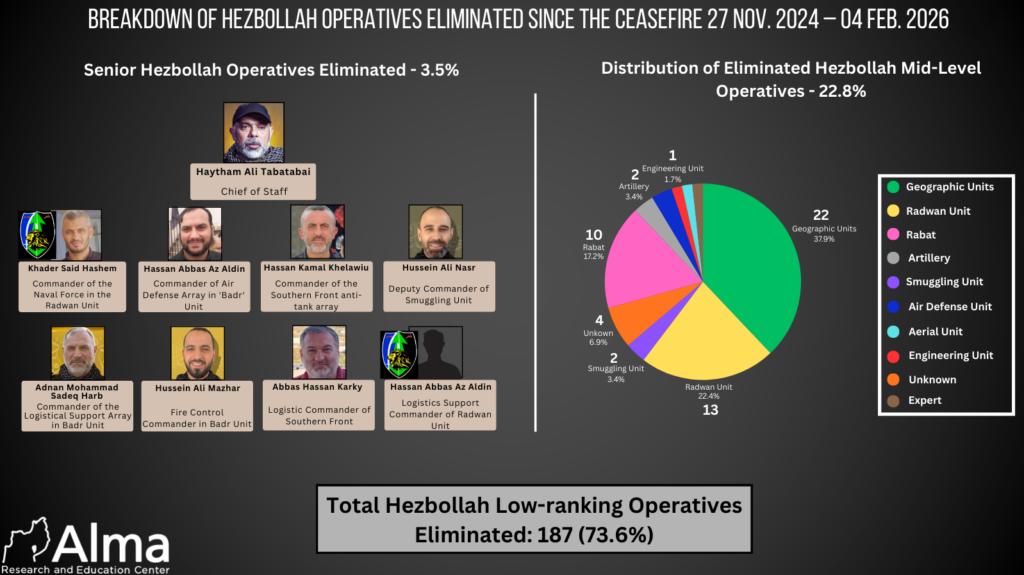
187 were defined by us as low-level ranks (“operative”) – 73.6 % of those eliminated.
58 were defined by us as “mid-level rank” (referring to operatives defined as commanders at the equivalent level up to battalion commander, “key operative,” “knowledge hub,” and “rabat”) – 22.8% of those eliminated.
9 were defined by us as “senior – leadership” (referring to commanders equivalent to brigade commander and above) – 3.5% of those eliminated.
The targeted elimination effort constitutes an important and central component of Israel’s overall effort to thwart and disrupt Hezbollah’s rehabilitation efforts. The targeted elimination effort makes up about one-third of all strikes in Lebanon during the ceasefire so far.
As we noted in the report on the main points of Hezbollah’s updated military status – January 2026 , at this time we assess that Hezbollah’s military rehabilitation pace exceeds the scope of interdiction activity conducted by the IDF.
In our assessment, to more effectively harm Hezbollah’s rehabilitation activity and tilt the “rehabilitation pace versus interdiction effectiveness equation” in Israel’s favor, it is necessary to work toward a significant change in the ratio and share of eliminated operatives from the different Hezbollah operative populations.
Subject to operational capabilities and intelligence accessibility, it is necessary to significantly increase the number of Hezbollah eliminations from the senior leadership population (which directs rehabilitation) and the mid-level population (the center of gravity driving rehabilitation processes). As of now, the number of eliminations among the low-level ranks is three times greater than among the mid-level ranks and twenty times greater than among the senior leadership population.
Low-Level Rank Population (73.6 % of those eliminated):
As of today, most eliminations during the ceasefire (187 operatives) are from the low-level Rank population. In our assessment, eliminating lower ranks can disrupt routine activity to some extent but cannot significantly harm Hezbollah’s activity in general and Hezbollah’s rehabilitation activity in particular.
The share of eliminations among the low-level rank population is significantly greater than the share among the mid-level population (three times greater) and among the senior population (twenty times greater).
Mid-Level Population (22.8% of those eliminated):
So far, 58 mid-level operatives have been eliminated during the ceasefire. Of these, 44 were commanders at various ranks up to the equivalent level of battalion commander: 22 from the geographic units, 13 from the Radwan Unit, 2 from artillery, 1from smuggling, 1 from air defense, 1 from the engineering unit.
Additionally, 10 “rabats” (village liaison operatives) were eliminated, 3 “key operatives” (air unit, air defense, and smuggling) and one “knowledge hub” in the field of weapons production.
Senior Leadership Population (3.5% of those eliminated):
So far, 9 senior figures have been eliminated during the ceasefire period. The most senior figure eliminated so far is Haytham Ali Tabatabai, Hezbollah’s military commander (“Chief of Staff”). He was eliminated in an airstrike in Beirut on 23 November 2025.
There is no doubt that Tabatabai’s elimination was a very significant escalation in the context of activity against Hezbollah’s rehabilitation processes. However, if it remains a one-time escalation against the military leadership level, it is not enough to thwart and disrupt rehabilitation.
In addition, 8 position holders from the senior population were hit:
Commander of the naval forces in the Radwan Unit, commander of logistics in the Radwan Unit, commander of logistics of the Southern Front Headquarters, commander of the anti-tank array in the Southern Front, deputy commander of Unit 4400, commander of logistics in the Badr Unit, fire management officer in the Zahrani sector (Badr Unit), air defense array commander in the Badr Unit.
Analysis of Targeted Eliminations – Qualitative Perspective:
In terms of quality, the targeted elimination effort should focus on position holders and units that most influence Hezbollah’s rehabilitation in aspects of force buildup and activation.
Leadership – if we use the names known to us from open sources within the leadership group directly linked to rehabilitation activity, we can mention Muhammad Haidar (current role unknown. Potential replacement for Tabatabai), Talal Hamiyah (known as commander of Unit 910. Current role unknown. Potential replacement for Tabatabai), Haj Khalil Harb (known as commander of Units 1800, 133, 3800. Current role unknown. Potential replacement for Tabatabai), Wafiq Safa (head of the Coordination and Liaison Unit), Ali Daamoush (head of the Executive Council), Khodr Yusuf Nader (commander of the Security Unit).
There is a possibility that some of the individuals mentioned above have assumed the roles of eliminated members of the Jihad Council and are now serving in positions such as operations commander, Southern Front commander, commander of the strategic arrays, commander of the logistics array, and similar posts.

Senior figures – focus should be placed on the senior directing command population: commanders of geographic units, commanders of professional units, commanders of staff units, brigade commanders and their equivalents.
Mid-level rank – focus should be placed on battalion (“fauj”) commanders and their equivalents in the various units and arrays, and on professional operatives defined as “knowledge hubs.”
The Air Unit -As part of the reconstruction process, Hezbollah is promoting a buildup in its drone and UAV arsenal as a central effort for a future conflict. The Air Unit (127) is responsible for the development, production, and assembly of UAVs in general and suicide UAVs in particular for the UAV arrays in the organization’s various units. The goal is to turn the UAV array into a real strategic threat in the next confrontation by increasing quantity, quality, and operational methods.
Interdiction efforts against the Air Unit should focus on the unit’s command level, position holders directly responsible for building and operating UAV production lines, and professional knowledge hubs related to UAV development, production, and assembly.
The Radwan Unit – Although the unit was severely damaged during the war (commanders, operatives, and infrastructure) And its forces are currently deployed north of the Litani, the Radwan Unit is Hezbollah’s central elite offensive unit and significant rehabilitation efforts are invested in its force buildup. Today, in our assessment, the Radwan Unit has returned to a similar manpower scope as before the war (about 5,000 operatives) and to operational readiness with potential for Focused and limited offensive activity against Israel in various frameworks, Although the distance from the line of contact makes it difficult.
It is evident that the IDF is concentrating interdiction effort against the Radwan Unit and its infrastructure. About 18 percent of all eliminated operatives are Radwan operatives at various levels. As mentioned above, two senior figures from the unit were eliminated, and an additional 13 from the mid-level population: Naval force commander, battalion (“fauj”) commander, 4 commanders, 2 intelligence officers in the areas from Mahruna and Adloun, battalion operations officer, battalion staff officer, platoon commander in the Ein Qana area, commander in the anti-tank array, commander in the special force in the Al-Qal’iya area.
Interdiction efforts against the Radwan Unit should focus on the following position holders:
Unit commander, brigade commanders, battalion commanders, commander of the UAV array in the unit, commander of the training array, operations officer, commander of the anti-tank array in the unit, the new commander of the naval array in the unit.
The Logistics Array – A Hezbollah logistical headquarters unit responsible for all matters related to budgeting and the organization of its various operational arrays. This framework oversees the storage and movement of weapons inside Lebanon, plays a role in weapons smuggling, and manages the distribution of smuggled arms among Hezbollah’s different units, both in terms of transportation and the allocation of resources.
The array commanders deal with budgeting and logistical management of the organization’s most sensitive projects, including the operational war plan and additional special plans, including launching attacks toward the State of Israel from Lebanese and Syrian territory.
The Production Directorate (operating under the Logistics Array) – The directorate managing research, development, and weapons production in Hezbollah is also responsible for expanding Hezbollah’s supply capabilities (storage and transport of weapons within Lebanon). One of the most significant rehabilitation components is Hezbollah’s ability to produce weapons independently on Lebanese soil. The current challenging reality of weapons smuggling into Lebanon has turned independent weapons production from a complementary capability into a vital existential strategic need for continued force buildup: moving from reliance on vulnerable external logistics to a new situation of “bringing the factory home” to Lebanon as a guarantee for the future of Hezbollah’s military power.
Just as a systematic elimination campaign targeted Iranian nuclear scientists who formed the core of the nuclear project’s research and development, interdiction efforts against the Production Directorate should likewise concentrate on a sustained campaign against engineers who function as key professional knowledge hubs in the directorate’s research, development, and production activities.
The Missile and Rocket Array – The array is responsible for Hezbollah’s various missile units. The missile and rocket array, which before the war included about 75,000 items of all types and ranges, suffered severe damage during the war. The assessment is that today Hezbollah holds an arsenal of up to about one-third of what it possessed before the war.
The arsenal today can still allow Hezbollah (at least “on paper,” and depending on the number of launchers) to carry out the firing of dozens of munitions every day for at least a full consecutive year. As part of its rehabilitation efforts, Hezbollah is concentrating on redeploying the array, salvaging capabilities, ensuring survivability, renewing stocks, and expanding the arsenal.
Interdiction efforts against the missile and rocket array should focus on the array’s commanders, the commanders of the missile units within the array, the regional commanders within those units, and the sector commanders operating under the regional commanders.
Smuggling and Financing Array (Weapons / Money) – The framework charged with smuggling and transferring weapons, pertinent equipment, and financial resources to Hezbollah in Lebanon, while also building funding streams and financial networks both domestically and internationally. Interdiction efforts should focus on arms procurement agents, currency exchangers, and key “businessmen” (some of whom operate beyond Lebanon as well).
Summary:
The targeted elimination campaign has shown, both in wartime and throughout the ceasefire, that the notion that “everyone can be replaced” is not always accurate. Hezbollah at times finds it difficult to appoint substitutes, particularly within the senior leadership and, in some cases, the mid-level command ranks.
The sense of intelligence penetration within Hezbollah caused by eliminations at all ranks is deep and widespread, and can cause loss of organizational self-confidence, which has some potential (though not comprehensive) to disrupt operational activity.
In our assessment, this feeling continues due to the ongoing eliminations carried out almost daily by Israel. According to local reports, Hezbollah is conducting secret internal procedures against operatives suspected of cooperating with Israel, and in recent months at least 21 suspects have been arrested, who according to suspicions against them, passed information to Israel that enabled the elimination of dozens of operatives at various ranks.
Israel’s efforts to thwart and disrupt Hezbollah’s rehabilitation naturally hinge on operational capacity and access to reliable intelligence, both of which are especially critical in the context of targeted eliminations.
As we mentioned in our November 2025 article (“Abu Ali Tabatabai Eliminated; Israel’s Strategic Challenge Is Only Beginning”), Israel’s strategy of weakening Hezbollah must be pursued “across the entire field” in Lebanon, i.e., every geographic area and any target or individual directly or indirectly tied to Hezbollah (military, semi-military, or “civilian”) remains a legitimate strike objective at any time going forward.
To shift the balance in which Hezbollah’s military reconstruction pace outstrips the IDF’s interdiction efforts, a quantitative adjustment is required in the proportion of eliminations across the three populations outlined in this document (senior leadership, mid-level ranks, and low-level operatives). On the qualitative level, efforts should concentrate on those operatives and units that exert the greatest influence over Hezbollah’s force rebuilding and operational activation processes.