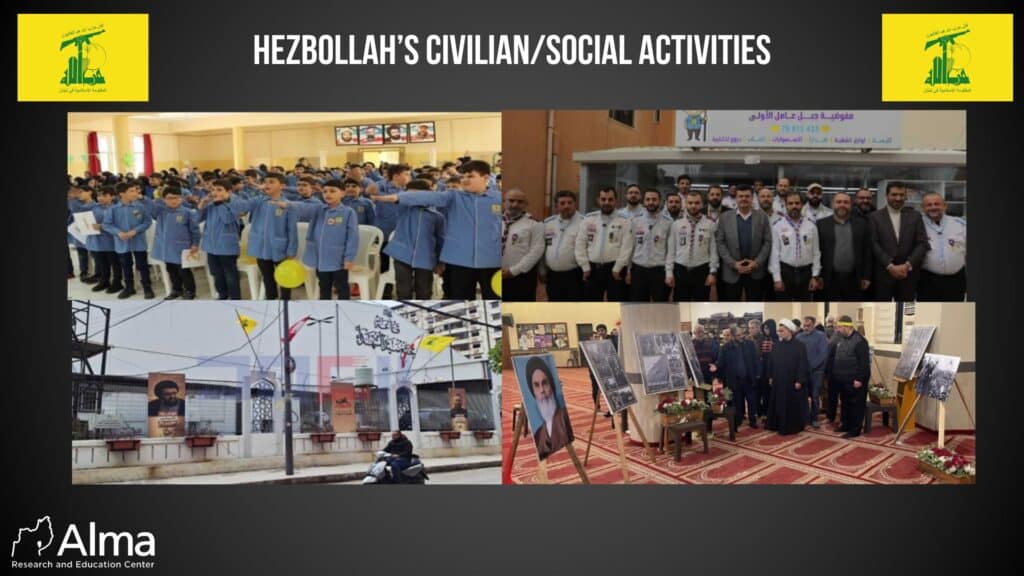
Hezbollah’s civil-social activity is not a secondary component of its military and political operations, but rather a central strategic element in its overall operational concept. Despite the many difficulties and challenges (financial, social, and others) that have arisen due to the war, Hezbollah continues to cultivate the narrative in which it serves as a functioning alternative to the failing Lebanese state – establishing dependency, fostering long-term loyalty, and shaping public consciousness in line with its ideology.
Below are several examples from the past week:
Ramadan as an Arena for Consolidating Loyalty: Between Humanitarian Aid and Building an Infrastructure of Influence
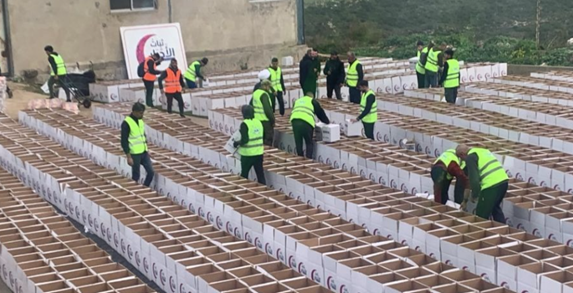
The launch of the Ramadan campaign by the “Wataawanou” (“And Help One Another”) association (February 12), under the title “The Resilience of the Free,” illustrates how the organization combines welfare provision with a political-value message. The campaign is intended for approximately 60,000 families across Lebanon and for 36 villages in southern Lebanon near the border, an area affected by the fighting and considered a core stronghold for Hezbollah.
The assistance includes food packages, hot iftar meals (the meal that breaks the daily fast), meat and dairy products, and basic supplies. It is carried out in cooperation with donors, educational institutions, and community initiatives. Beyond its impressive logistical scope, this is a move with significant consciousness-related implications: Ramadan, as a month of solidarity and charity, serves as a platform for presenting Hezbollah as the protector and provider of the community, in contrast to a state perceived as lacking either the capacity or the will to provide a response.
The implicit message is clear: the economic and social security of the Shiite community is tied to Hezbollah’s presence and activity.
Free Medical Care as a Tool of Political-Ideological Influence
The free health days held in the Palestinian camps (February 14), in cooperation with Hezbollah’s “Islamic Health Organization,” indicate an expansion of influence beyond the Shiite base. Providing medical treatment to 1,530 patients, including medication at no cost, positions Hezbollah as an essential service provider also for the Palestinian population in Lebanon.
However, the context in which the activity took place, the marking of 47 years since the Islamic Revolution in Iran and expressions of identification with the “leader martyrs” – emphasizes that this was not a neutral humanitarian initiative. The assistance is intertwined with an ideological message that deepens affiliation with the Iranian axis and links the Palestinian struggle to the concept of “resistance” led by Hezbollah. In this way, a connection is created between welfare, politics, and regional identity.
Memorial Ceremonies and Cultural Events: Shaping Collective Memory
Preparations to mark the memorial day for the “commander martyrs” in the southern suburb of Beirut (Dahiyeh), through posters, banners, and extensive logistical arrangements, reflect the importance of public space in shaping consciousness. Commemorating the organization’s leading figures is not merely a historical tribute, but a political act that produces a continuous narrative of sacrifice, heroism, and legitimacy for armed struggle.
The opening of the photo exhibition marking the victory of the Islamic Revolution in Iran (February 13) also forms part of this effort. By presenting the stages of the revolution and screening documentary films, the organization reinforces its ideological and emotional connection to Iran as a source of inspiration and an ideological foundation. Historical memory thus becomes an educational-political tool shaping a loyal collective consciousness.
Education and Youth Movements: Investing in the Next Generation
Activity in schools and youth movements underscores the concept of the “next generation” as a strategic objective. The marking of the birth of Imam al-Mahdi at the al-Mahdi School in Machgharah (February 14) included religious singing and discussions about “positive anticipation” and adherence to values, but in practice it constitutes the embedding of a religious-national identity aligned with Hezbollah’s worldview.
Similarly, the inauguration of the equipment cooperative of the al-Mahdi Scouts in al- Bazouriye, north of the city of Tyre, is not merely a technical organizational step. It represents an investment in social infrastructure that ensures the availability, visibility, and continuity of the movement’s activities in an area affected by the fighting. The scout movement serves as a framework for ideological socialization, combining community activity with education in the values of “resistance,” and as a mechanism for identifying and recruiting new operatives for Hezbollah’s military units.
Between State and Organization: Hezbollah as an Alternative Governance Model
The multiplicity of civilian initiatives within a short period demonstrates that Hezbollah operates as a hybrid entity, military, political, and civilian alike. In a reality of ongoing economic collapse and governmental weakness in Lebanon, through civilian reconstruction, welfare, health, food distribution, education, and public ceremonies, Hezbollah blurs the line between a non-state organization and a de facto sovereign in areas where the Lebanese state struggles to function.
The significance extends beyond immediate assistance: the civilian activity generates a mechanism of dependency, shapes collective identity, and grants the organization sustained public legitimacy, primarily among the Shiite population, but also among additional audiences in need of assistance. In this way, it constitutes a strategic infrastructure that enables it to preserve political and military power over time.
In conclusion, Hezbollah’s civilian activity is not merely a series of isolated initiatives of charity or culture, but a structured system of building influence, creating dependency, recruiting organizational and ideological loyalty, and shaping consciousness, a deep mechanism that ensures the organization’s stability and standing in Lebanon and in the regional arena.