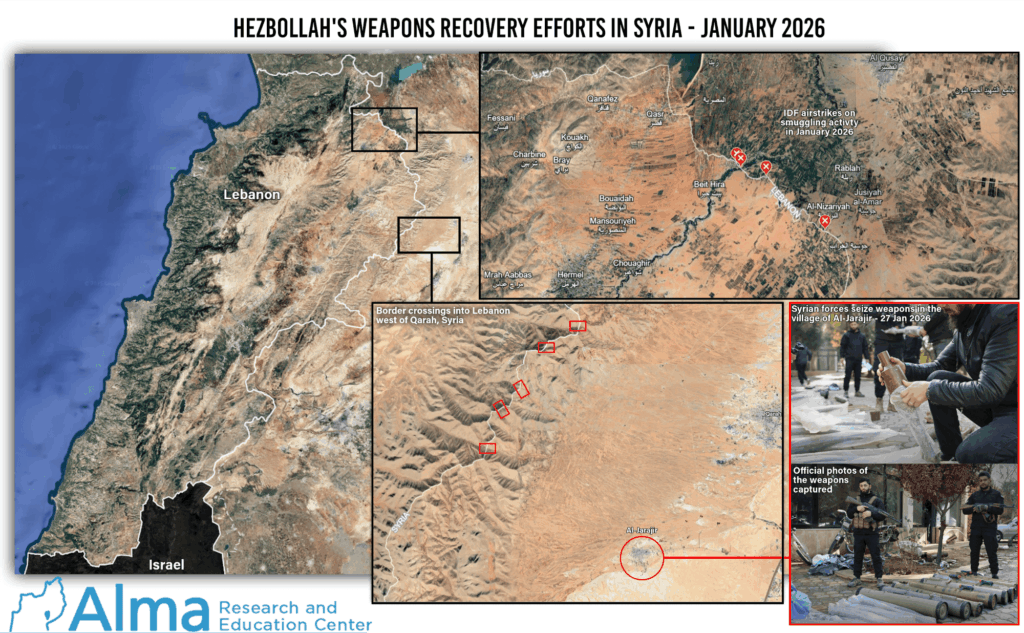
On 21 January, the IDF struck four crossings along the Syrian–Lebanese border that had been used by Hezbollah for weapons smuggling. The targeted crossings were located in a well-known smuggling sector in the Housh al-Sayyid Ali area, which is considered a central anchor in Hezbollah’s overland weapons-smuggling network. Even under the current Syrian regime, the Syrian–Lebanese border remains a key component of Hezbollah’s weapons corridor, enabling the rehabilitation of its military capabilities and the continuation of its force-build-up process.
In this context, activity by Syrian security forces to thwart the smuggling of weapons from Syria into Lebanon has also been observed. On 26 January, Syrian security forces announced the foiling of a shipment of combat means in the Al-Jarajir area, which included 9M113 Konkurs anti-tank missiles, RPG-7 rounds, Fajr rockets, Tandem HEAT rockets, and other light weapons.
At the same time, it is important to emphasize the limitations of the effectiveness of such strikes over the medium and long term. Along the roughly 400-kilometer border between Syria and Lebanon, there is, on average, an illegal crossing every 3–4 kilometers. Moreover, the topographical characteristics of the area and the limited level of control allow for the rapid opening of alternative crossing routes using relatively simple engineering means. Thus, the use of basic engineering equipment, including tractors, enables the paving or renewal of smuggling routes within a very short time frame.