Tal Beeri and Dana Polak
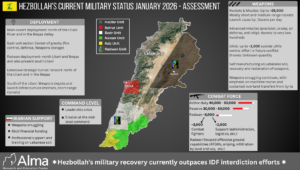
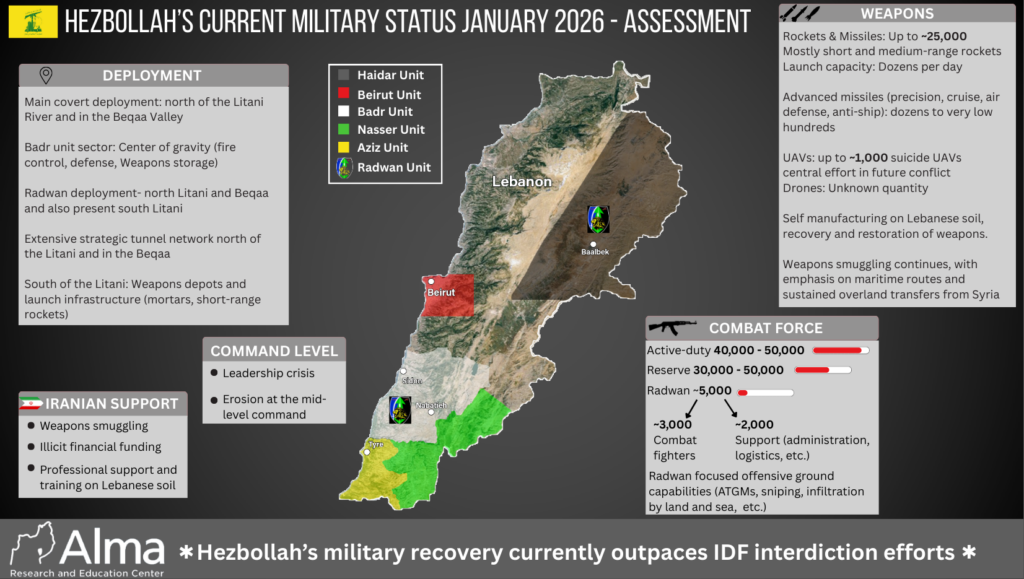
Below is an updated assessment of the key aspects of Hezbollah’s military status as of February 2026, in light of the impact of the recent war, the IDF’s ongoing thwarting operations during the ceasefire, and Hezbollah’s efforts to rebuild and strengthen its forces.
The analysis focuses on the core components of the organization’s military power – the weapons arsenal, combat force, geographic deployment, command level, and Iranian support.
This assessment is based, among other things, on a quantitative analysis of the scope of IDF activity in the Lebanese arena during the ceasefire period (since November 27, 2024). This analysis was compared to indications regarding the pace of Hezbollah’s rehabilitation, reorganization, and force buildup, with the aim of assessing the relationship between the IDF’s thwarting efforts and the organization’s military recovery capability.
Within this framework, it can be assessed that at this time, Hezbollah’s pace of military rehabilitation exceeds the scope of thwarting activity carried out by the IDF.
Weapons Arsenal
Hezbollah currently possesses a rocket and missile arsenal estimated at up to approximately 25,000 items, based mostly on short- and medium-range rockets, with a launch capability of dozens of rockets and missiles per day. Alongside this, the organization has a more limited array of advanced missiles, including precision missiles, cruise missiles, air defense systems, and shore-to-sea missiles, numbering from dozens to at most a few hundred of each.
The UAV domain constitutes a central layer in future force buildup. Hezbollah possesses approximately 1,000 suicide UAVs, while the scope of drones is not fully known.
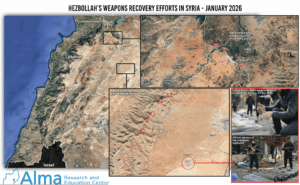
The organization is concentrating efforts on domestic production of weapons on Lebanese soil, alongside rehabilitation and repair of weaponry. At the same time, weapons smuggling continues, with an emphasis on the maritime route, alongside continued land smuggling through Syria, despite the rise of the al-Shara regime and its own anti-smuggling thwarting operations.
Combat Force
Hezbollah fields a substantial combat force, estimated at around 40,000–50,000 active combatants and an additional 30,000–50,000 reservists. Central to its offensive structure is the Radwan Unit, which Hezbollah is making major efforts to rebuild and restore. The unit currently includes roughly 5,000 members, with about 3,000 fighters and approximately 2,000 support personnel responsible for administration, logistics, and related functions. Radwan represents Hezbollah’s primary elite offensive capability, maintaining the training and capacity to carry out targeted offensive missions, including anti-tank attacks, sniper operations, and infiltration by land, sea, and other means.
Deployment
Hezbollah’s primary covert force posture is concentrated north of the Litani River and in the Beqaa Valley, areas that provide strategic depth for the organization’s operations. The Badr Unit sector north of the Litani has emerged as the key operational hub for firepower deployment, defensive activity, and weapons storage.
The Radwan Unit is likewise positioned mainly north of the Litani and in the Beqaa, though its operatives remain present and active south of the Litani as well.
Hezbollah also sustains and operates a strategic tunnel network north of the Litani and the Beqaa. South of the Litani, current deployments focus primarily on weapons depots and launch infrastructure, especially for mortars and short-range rockets.
Command Level
At the command level, Hezbollah is facing serious structural difficulties, most notably a prolonged leadership crisis alongside significant weakening of its mid-level command ranks.
In the wake of the eliminations the organization sustained during the war, affecting both its political and military leadership, a leadership vacuum has emerged, fuelling internal disagreements and heightened tensions among the remaining senior figures. The elimination of Abu Ali Tabatabai in November 2025 further deepened these command challenges.
These eliminations, both during the war and throughout the ceasefire period, have also likely accelerated the erosion of the mid-level command structure. This decline results from the loss of experienced commanders and key hubs of expertise, the growing strain placed on those still in position, and disruptions to command and operational continuity.
At the same time, mid-level commanders must continue managing routine military and security responsibilities. Due to their daily physical proximity to the Shiite population, they are also heavily engaged in supporting and assisting the families of Hezbollah operatives affected during the war and ceasefire, while contending with the everyday hardships (and mounting frustration) within the organization’s base community.
Iranian Support
Iranian support remains a key pillar of Hezbollah’s military reconstruction and operational capacity. Tehran’s strategic commitment to restoring Hezbollah and maintaining its strength is reflected in continued weapons smuggling, illicit funding channels, and sustained technical and professional support. In this context, Iranian personnel, particularly from the Islamic Revolutionary Guard Corps and the Quds Force, are active on Lebanese territory, offering supervision, training, and expertise across multiple domains. This support enhances Hezbollah’s military capabilities and acts as a significant force multiplier in rebuilding and sustaining the organization’s damaged military infrastructure.
Summary
Despite the substantial and accumulating damage Hezbollah has suffered to its military capabilities and command structure during the fighting, and notwithstanding the serious challenges it faces on both the military and civilian fronts, the organization continues to demonstrate notable resilience and recovery. An examination of its key force components suggests that, at present, Hezbollah’s pace of military reconstruction is outstripping the scope of IDF countermeasures.
In its current condition, Hezbollah retains the ability to engage in a direct confrontation with Israel, meaning; it could operationally join a potential conflict should the United States strike Iran. However, in our assessment, such involvement would depend on authorization from the “Vilayat-e Faqih” (“rule of the Islamic jurists”), and Hezbollah would only enter the conflict if the Supreme Leader, or his successor, were to issue such a decision.
Several reports indicate that during the 12-day war against Iran in June 2025, despite the desire of the IRGC and Quds Force military leadership for Hezbollah to participate, the organization ultimately refrained. In our view, this was due to the absence of an order from the Supreme Leader, and therefore Hezbollah did not join the war.
(Note – attention should be paid to the fact that we are not addressing Israeli capabilities and the extent of damage to Hezbollah following the use of those capabilities in such a confrontation. Our reference is to Hezbollah’s capability in its current given state.)