
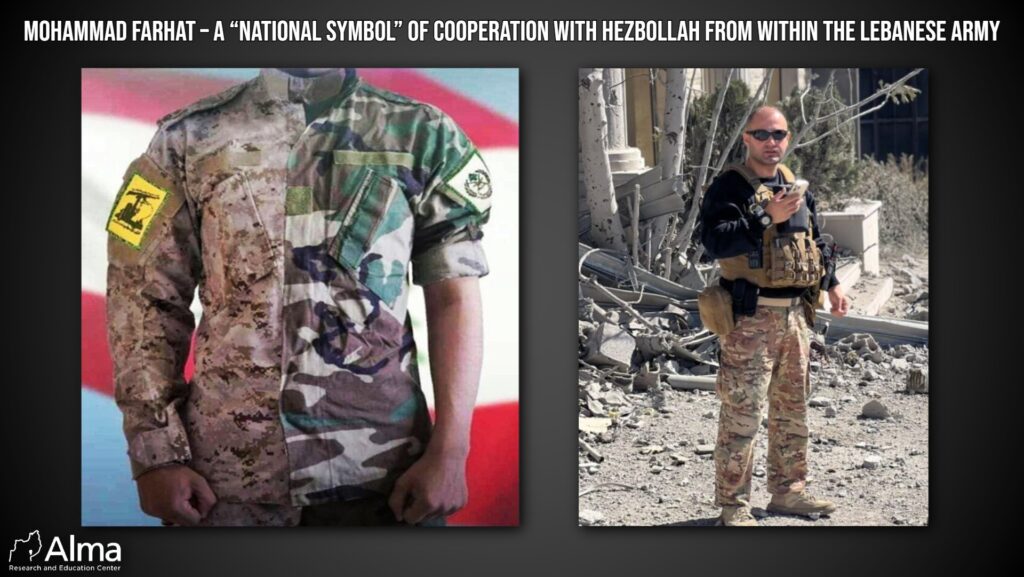
The story of Major (Ra’ed) Mohammad Sami Farhat, a Shiite officer in the Fifth Intervention Regiment of the Lebanese Army, sheds further light on the ties, coordination, and cooperation between Hezbollah and Shiite officers and soldiers within the Lebanese Army.
The Fifth Intervention Regiment has been deployed in southern Lebanon since 2017, within UNIFIL’s area of operations. As part of its mandate, it is meant to work in coordination and cooperation with UNIFIL to support the implementation of UN Security Council Resolution 1701. It currently holds responsibility for the Bint Jbeil district in southern Lebanon.
On March 5, 2023, an unusual incident[1] took place near the border line in the vicinity of Aita al-Shaab–Shtula involving Lebanese Army soldiers and IDF troops. Major Farhat was documented placing himself in the way of IDF soldiers as they attempted to install a barbed-wire fence near the Blue Line. While the Israeli soldiers stood just a few meters away from him, with UNIFIL soldiers in between, Farhat addressed the IDF soldiers in English and clarified: “We are defending our land. This is the last time I speak this way; from now on we will have other ways to confront [you],” before ordering his soldiers to ready their weapons. The video was published on social media and went viral, mainly among Hezbollah-supporting users, who crowned Farhat a “national hero.”
Major Farhat, a Shiite, was born on September 14, 1988, in the town of Deir Qanoun Ras al-Ain in southern Lebanon, in the Tyre area. Farhat enlisted in the Lebanese Army on November 6, 2006, advanced through the ranks to the rank of Major, which he received on January 1, 2022. During his service he received several decorations and commendations from the Commander of the Lebanese Army (currently, the President of Lebanon – Joseph Aoun).
During the war, which began on the Lebanese front on October 8, 2023, Farhat continued to serve in southern Lebanon as part of his regiment. The relative freedom of movement enjoyed by the Lebanese Army allowed Farhat to move around in the area. According to his brother Ali, in an article published in the newspaper Al-Ahed, considered one of Hezbollah’s mouthpieces, “Mohammad (Farhat) entered frontline villages dozens of times, on missions to evacuate wounded, and saved dozens of them”[2] … “He risked his life and, on many occasions, narrowly escaped shelling and attacks” …
These statements by the brother raise several questions. With the start of the fighting on the Lebanese front, the civilian population of the frontline villages left the villages and, as of the writing of these lines, the overwhelming majority has not yet returned. Why did Major Farhat, an officer in the Lebanese Army, enter those villages emptied of civilian population in order to evacuate wounded? If the civilian population left, then who were those “dozens” of wounded? Did Farhat use his relative freedom of movement to assist Hezbollah, for example by evacuating wounded Hezbollah operatives and transporting Hezbollah operatives in Lebanese Army vehicles from one place to another?
According to local reports, on October 23, 2024, in the afternoon hours, Israeli air force aircraft struck two buildings in the western neighbourhood of the village of Yater (a frontline area, about 3.5 kilometres from the border with Israel), where Hezbollah operatives were present. As a result of the strikes, some of the operatives were wounded and others attempted to call for assistance. When news of the strike and the request for help reached Major Farhat, he decided to carry out the evacuation mission himself.
At around 22:30, Farhat arrived in a military jeep accompanied by two soldiers, Corporal Mohammad Hussein Nazal and Corporal Mousa Youssef Mohanna, at the buildings used by Hezbollah. A few minutes after he arrived, the IDF carried out a second strike, after identifying movement of people in the two buildings.
The IDF was unaware of the presence of Major Farhat and his two soldiers at the site, and they were killed as a result of the second strike.
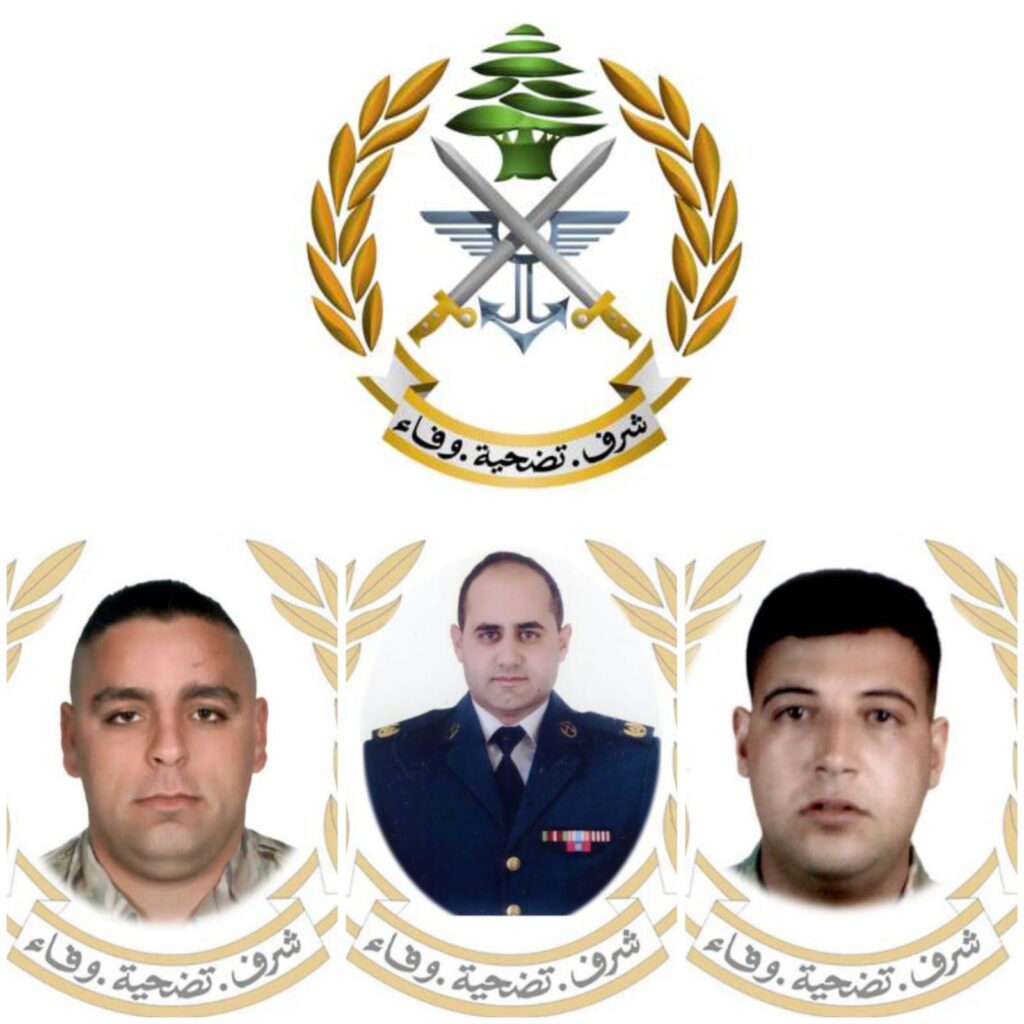
Unlike other similar cases during the war, in which the Lebanese Army updated the IDF in advance about its movements through UNIFIL mediation, this time the update did not reach the IDF in time. In fact, the update / coordination message was related by the Lebanese Army only after Farhat and his two soldiers were already dead.
Is it possible that even within the Lebanese Army it was known that the mission on which Farhat set out—apparently on his own initiative—was not approved and not legitimate, and therefore they did not rush to update and coordinate his movement and location?
During the war, the Lebanese Army did not actively participate in the fighting and was never designated as a target by the IDF. Even so, the question remains: why were more than 40 Lebanese Army soldiers killed[3] during the war?
In wartime, errors are inevitable. Some Lebanese Army soldiers were apparently killed unintentionally. Others, however, lost their lives because Hezbollah used the Lebanese Army as a human shield, while another group—such as Major Farhat and his two soldiers—were killed because, by their own initiative and choice, they found themselves in the wrong place at the wrong time.
The circumstances surrounding their presence at the location of their deaths, alongside Hezbollah operatives who were subject to attack, strongly indicate that they were collaborating with Hezbollah from within the Lebanese Army.
Farhat’s military funeral turned into a national event. Despite the circumstances of his death against the background of cooperation with Hezbollah, a military ceremony was held in his honour, attended by the then Commander of the Army and current President of Lebanon, Joseph Aoun. Due to the fighting that continued in southern Lebanon, it was decided to bury Farhat temporarily in the Christian town of Rachaine in the Zgharta district in the north of the country. The funeral procession departed from the plaza of the Frangieh family palace.[4] At that time, Suleiman Frangieh, backed by Hezbollah, was running for the presidency of Lebanon.
The two main presidential contenders—Joseph Aoun and Suleiman Frangieh—attended the funeral ceremony. Both were acutely aware of the audience they needed to appeal to and recognized the necessity of aligning themselves with the public “Festival” that elevated Farhat into a national symbol.
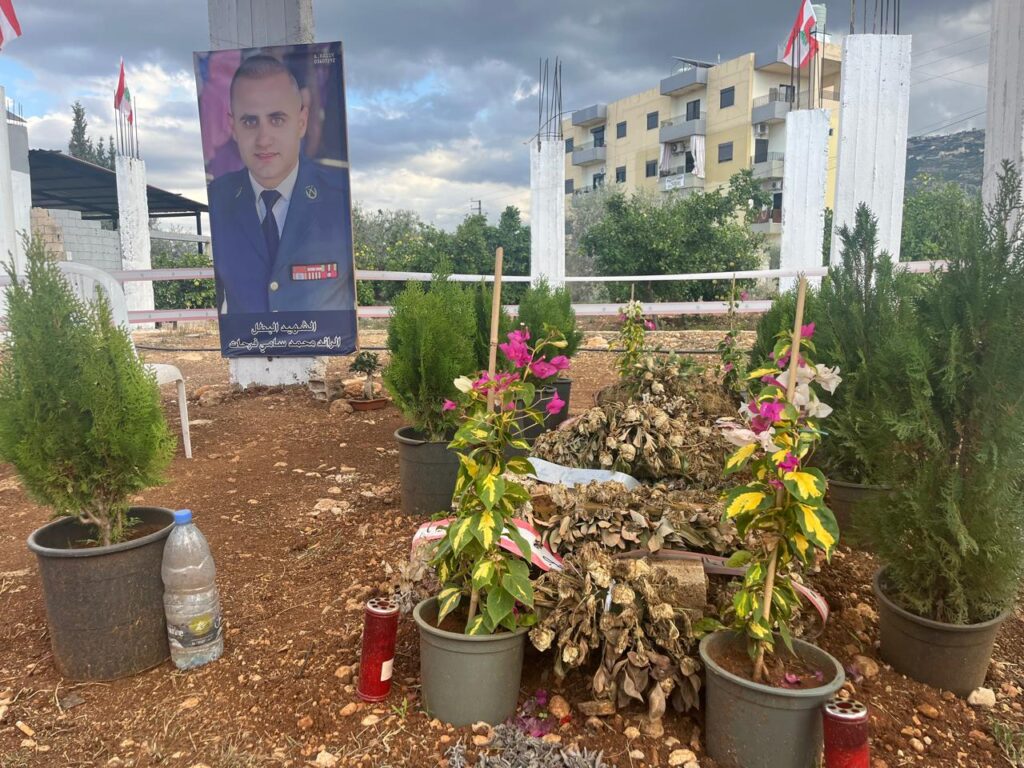
The “Farhat Festival” continued until recently. In October 2025, on the first anniversary of Farhat’s death, the current Commander of the Army, General Rudolph Haikal, together with the UNIFIL commander, inaugurated a new military base for the Fifth Intervention Regiment in the village of Dounine, and named it after Farhat, who was posthumously promoted to the rank of Lieutenant Colonel (Muqadam). The ceremony was presented as a tribute to the officer’s heroism and as a symbol of national unity, but in practice it marked a state commemoration of an officer who acted in the service of Hezbollah.
In an army in which about 50 percent are Shiites, Hezbollah collaborators can be found at all ranks and in all units. The many Shiite officers (senior and junior) and soldiers within the Lebanese Army who cooperate with Hezbollah cause the Lebanese Army to be unable to operate independently. The existence of cooperation, based on sectarian / ideological / familial / social identification, directly affects the “disarmament” of Hezbollah. In practice, the Lebanese Army cannot and does not want to disarm Hezbollah.
Major Farhat is a “national symbol” of cooperation from within the Lebanese Army with Hezbollah. He represents a large group of officers and soldiers operating in the gray area of cooperation between the Lebanese Army and Hezbollah—a group that army commanders struggle, and at times are not interested, to set clear boundaries for.
In March 2025, after General Rudolph Haikal assumed the position of Commander of the Army (replacing Joseph Aoun, who was appointed President of Lebanon), Brigadier General Nicolas Thabet was appointed Commander of the South Litani sector in the Lebanese Army and head of the Lebanese delegation to the ceasefire monitoring mechanism.
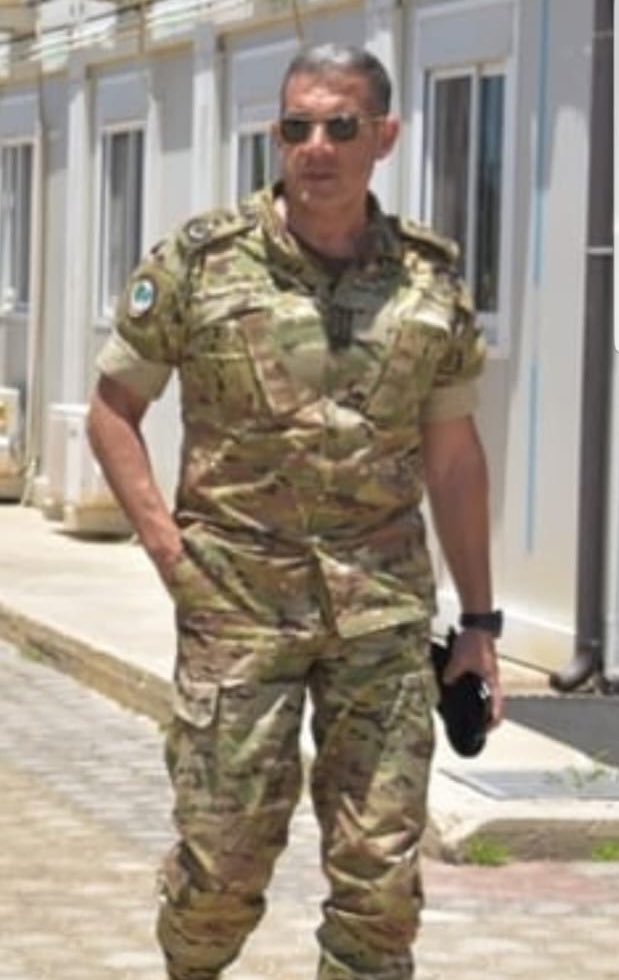
Thabet, a Maronite Christian, started his career in the Presidential Guard during the tenure of Emile Lahoud—often referred to as “the President of the Resistance” and regarded as closely aligned with Hezbollah. He later served in the Military Intelligence Directorate (See article), an institution widely known for the extent of Hezbollah’s penetration within it.
It appears that Thabet ’s appointment was perceived as a compromise by the Army Commander, in order not to provoke opposition from Hezbollah. Indeed, Thabet presents a hard line against Israel in his statements[5] and appears to align himself with the “spirit of Hezbollah” and act accordingly.[6]
The Army Commander, Haikal, is not identified as an ally of Hezbollah. However, he too has ambitions. Chief among them is to be appointed President of Lebanon in the future. Considering this, he prefers not to confront Hezbollah in practice. Even if it appears that the Lebanese Army is acting to “disarm weapons,” this is only an appearance intended to lower the level of pressure coming from the international community, led by the U.S., and from parts of the Lebanese government. As noted above, the lack of desire is compounded by a lack of ability stemming primarily from the deep cooperation from within the Lebanese Army with Hezbollah.
Below are further examples, previously published by us, of Lebanese Army officers, particularly intelligence officers, and soldiers who cooperate with Hezbollah:
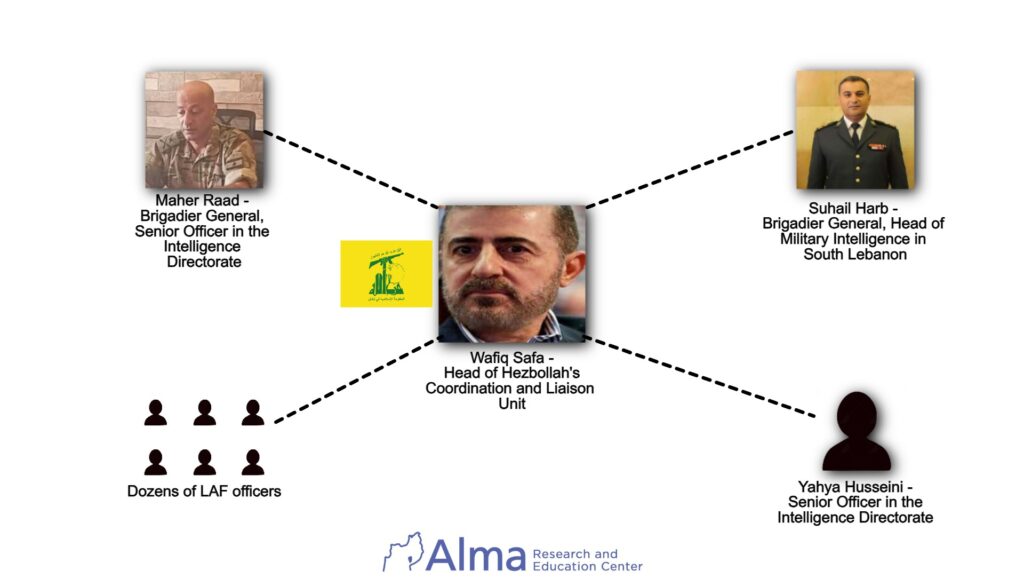
Suhail Gharb – On August 22, 2025, the IDF Spokesperson disclosed that Suhail Gharb, the head of military intelligence in southern Lebanon, had played a role in obstructing the investigation into the killing of an Irish UNIFIL soldier. The soldier was shot in the head in the al-Aqibiya area, between Tyre and Sidon, on December 14, 2022, by Hezbollah operatives. According to the disclosure, Gharb helped Hezbollah conceal key details of the incident and interfere with evidence and assisted efforts to prevent those responsible from being prosecuted.
Brigadier General (Amid) Gharb, a Shiite, is widely recognized for his collaboration with Hezbollah and for his close ties to Wafiq Safa, the organization’s head of coordination and liaison. At Safa’s insistence,[7] Gharb was appointed by the then commander of the Lebanese Army, Joseph Aoun, to the monitoring committee of the joint operations room of the ceasefire mechanism (“the Mechanism”), effectively presenting Aoun with a fait accompli.
On January 27, 2025, it was revealed that Gharb transferred information from the joint operations room to Hezbollah. Among other things, he transferred advance information to Hezbollah about Lebanese Army intentions to carry out raids and patrols that could harm Hezbollah activity and assets. In addition, it was claimed that Gharb sabotaged initiatives intended to distance Hezbollah from security institutions and ensured the integration of officers loyal to the organization into key positions in the army. On the same day, the Lebanese Army issued[8] a sweeping denial, claiming that this was a “malicious fabrication intended to undermine the stability of the army and that all accusations attributed to its officers are untrue, and are part of Israel’s attempts to evade implementation of agreements and carry out aggression.”
Despite the sweeping denial, in March 2025 it was reported that Gharb participated[9] in an official Hezbollah condolence ceremony in Nabatiyeh, held in memory of Hassan Nasrallah and Hashem Safi al-Din, Hezbollah leaders who were eliminated by Israel in September / October 2024.
Alongside Gharb, Brigadier General Ali Ismail, the intelligence officer of the Nabatiyeh sector in the Lebanese Army, also participated in the condolence visit.
Yahya Husseini – In August 2017, another Shiite officer from the Military Intelligence Directorate named Yahya Husseini was exposed. Husseini served in southern Lebanon and acted on behalf of Hezbollah. In 2017, Husseini was a Major (Ra’ed) and served as the intelligence officer in the Hasbaya sector in southern Lebanon. Husseini, who continues to serve today in military intelligence in southern Lebanon and has since been promoted to the rank of Brigadier General, was linked, among other things, to the August 2010 shooting incident by the Lebanese Army against the IDF in the Adaisseh area. As a result of the shooting, IDF soldiers were killed and wounded. According to various publications, Husseini (under Hezbollah guidance) convinced Lebanese soldiers to open fire. At the end of 2017, Lebanon’s ambassador to the UN denied that Husseini cooperated with Hezbollah. The ambassador – Nawaf Salam- is currently the Prime Minister of Lebanon.
Maher Raad – Brigadier General Maher Raad, head of the office of the Military Intelligence Directorate in the Dahieh (who has since been transferred to another position at the Directorate headquarters), manages cooperation, against the background of smuggling, with senior Hezbollah figures, foremost among them Wafiq Safa.
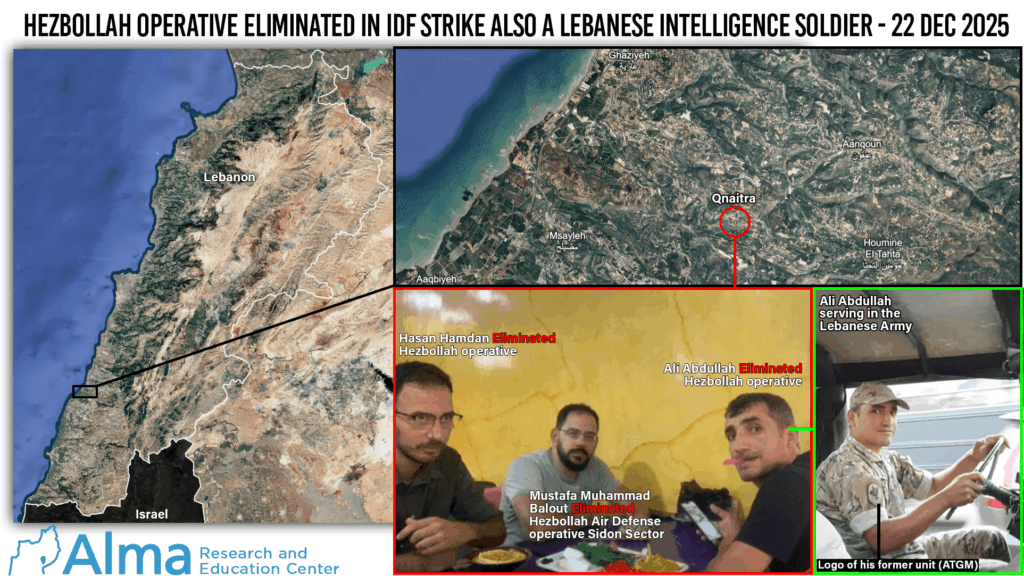
On December 22, 2025, three people were eliminated in an airstrike on a vehicle near the village of al-Quneitra:
Mustafa Mohammad Boulat, an operative in Hezbollah’s Air Defence Array in the Sidon sector; Hassan Hamdan, a Hezbollah operative who also worked as a correspondent for the Hezbollah-affiliated newspaper Al-Ahed; and Staff Sergeant Ali Abdallah, serving in the anti-tank regiment in the support brigade of the Lebanese Army.
According to the IDF Spokesperson’s statement, Abdallah was a Hezbollah collaborator. The Lebanese Army denied the IDF Spokesperson’s statement but confirmed that Ali Abdallah was a soldier in the support brigade’s anti-tank regiment.
The release of a photograph and video depicting the three individuals who were eliminated singing a song in praise of Nasrallah together indicates a close personal bond between them.
On December 24, a funeral for the three was held in the village of Houmine al-Tahta, north of the Litani in southern Lebanon. The most prominent image from the funeral is a picture of their three coffins together:
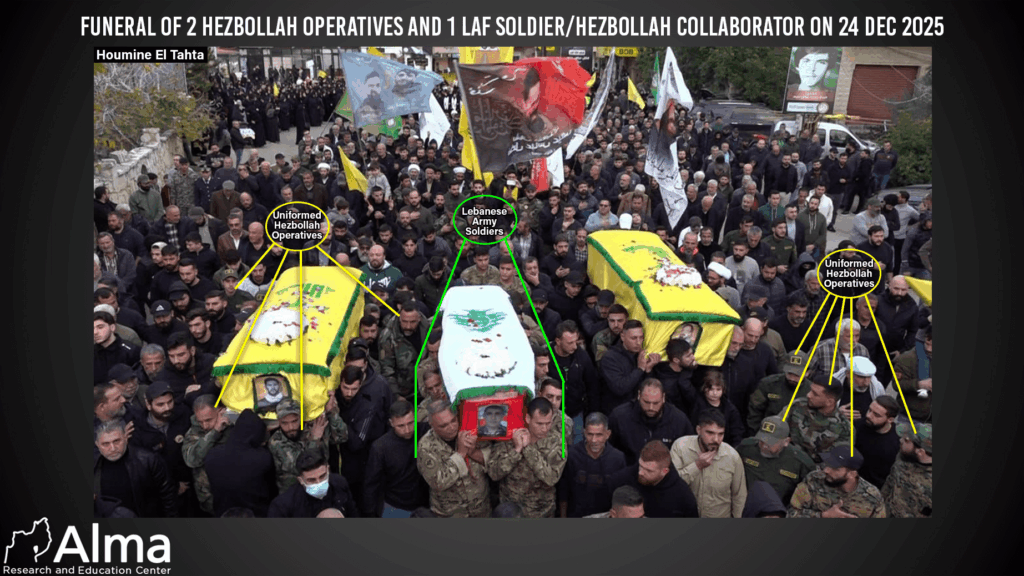
The image is a symbolic one presenting the connection between the Lebanese Army and Hezbollah. Three coffins, side by side, wrapped in Hezbollah and Lebanese flags, carried by Hezbollah operatives in uniform and civilian clothing alongside Lebanese Army soldiers.
Hezbollah’s central narrative, the equation of “people, army, resistance,” which conveys the message that they cannot be separated and that cooperation between them cannot be stopped, is clearly expressed in the image: residents of the Shiite village (“the people”), officers and soldiers of the Lebanese Army (“the army”), and Hezbollah operatives in civilian clothing and military uniforms (“the resistance”).
[1] https://www.annahar.com/lebanon/politics/163791/بالفيديو–الشهيد-الرائد-محمد-فرحات-مواجها-الجيش-الإسرائيلي-نحن-نحمي-أرضنا
[2] https://alahednews.news/post/88936/المقدّم-محمد-فرحات..-شهيدٌ-مقاوم-شجاع-بحجم-بطولات-الوطن
[3] https://www.reuters.com/world/middle-east/who-is-joseph-aoun-lebanese-army-commander-elected-president-2025-01-09/
[4] https://legal-agenda.com/عاش-بطلًا-واستشهد-بطلًا-ويعود-بطلًا-ز/
[5] https://www.lebanondebate.com/article/767389-إسرائيل-عاجزة-عن-تقديم-إثباتات-قائد-جنوبجنوب-الليطاني-اليونيفيل-تقلص-انتشارها-في
[6] https://www.lebanonfiles.com/2025/articles/%D8%A3%D8%AE%D8%A8%D8%A7%D8%B1-%D9%85%D8%AD%D9%84%D9%8A%D9%91%D8%A9/%D8%B3%D8%AE%D9%88%D9%86%D8%A9-%D9%81%D9%8A-%D8%A7%D9%84%D9%85%D9%8A%D9%83%D8%A7%D9%86%D9%8A%D8%B2%D9%85-%D9%82%D8%A7%D8%A6%D8%AF-%D9%82%D8%B7%D8%A7%D8%B9-%D8%AC%D9%86%D9%88%D8%A8-%D8%A7%D9%84%D9%84/
[7] https://www.nidaalwatan.com/article/295554
[8] https://www.lebarmy.gov.lb/en/content/denial-information-about-alleged-security-leaks-carried-out-army-officers
[9] https://www.lebanon24.com/news/lebanon/1327990/حزب-الله-تقبل-التعازي-باستشهاد-نصرالله-وصفي-الدين-في-النبطية



One Response
Dear Tal,
The entire jihaddist proxy cancerous burocratic structure from the ayatollah to UNIFIL to the infiltrated LAF (a military laugh) to the corrupted NGO’S down to the last teenage jihaddist: ALL ARE FORCES OF EVIL!
They must be eliminated to secure peace. By their own proclamations they are genocidal in their definitive jihaddist ideology. “Resistance” is a disguise for genocidal extermination. Therefore they must reap what they have sewn.