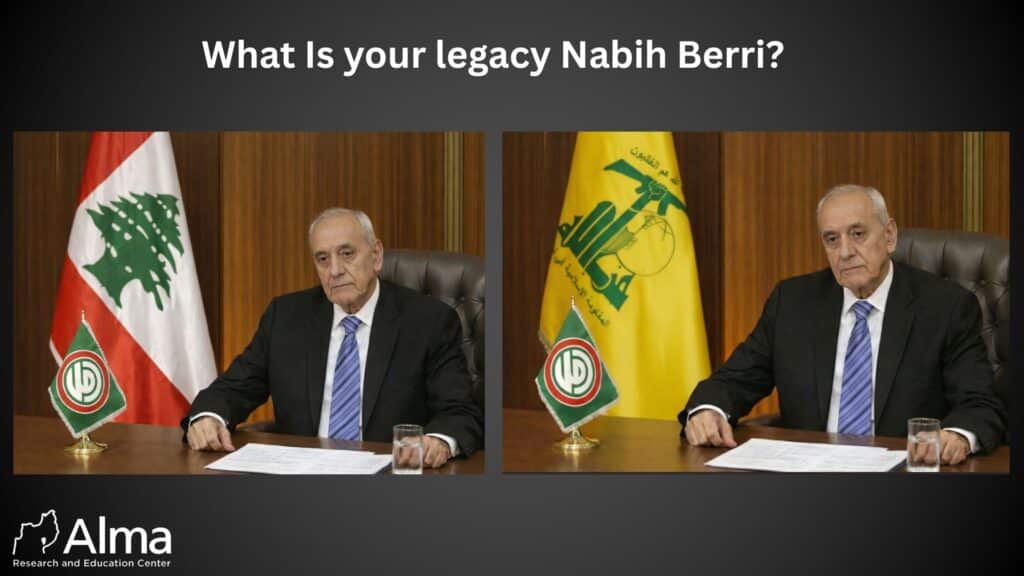
On January 28 (the publication date of this article) the Speaker of the Lebanese Parliament and longtime leader of the Shiite Amal Movement, Nabih Berri, turns 88. This milestone draws attention to a pivotal question: what will Lebanon face in the post–Berri era? Will his legacy contribute to the country’s recovery and stability, or will it deepen the path toward further collapse and destruction?
According to reports in Lebanon,[1] within political circles in the country, perhaps also in Berri’s own surroundings, discussions have been taking place for months behind closed doors about the possibility of postponing the parliamentary elections scheduled to be held in May 2026 and extending the parliament’s term by an additional two years — an extension that would allow Berri a dignified exit from the arena, and serve as a bridge for transferring the leadership of the Shiite community without a sharp political upheaval.[2] This stems from concerns within the “Shiite duo” that Hezbollah’s military setback is being leveraged politically, as rivals seek to secure gains in Shiite parliamentary seats. In Lebanon, it has also been argued that, despite the proposal’s public sensitivity, many within the elite political establishment view it as the “lesser evil” compared to other alternatives.
Alongside the postponement idea, a discussion is taking place within the Shiite public on a no less sensitive issue — who will inherit Berri, if and when he steps down. It seems that as of today, there is no agreed-upon and clear candidate. Inevitably, the absence of a natural successor strengthens Berri’s own standing and deepens the assessment that in the West they would prefer change “from within” — the emergence of a moderate figure from within the Amal Movement who could preserve an open channel to the West, without dismantling the existing structure. A preference that could lead to external support for postponing the elections.
Within this fabric, another thesis arises — Berri appears to be entering a phase focused on shaping his legacy, aiming to be seen as a figure guiding Lebanon toward recovery and stability rather than as someone complicit in the devastation brought about by regional conflicts and alignment with the axis of resistance.[3] From this perspective, it is possible that Nabih Berri may choose not to stand in the way of the Lebanese Army’s gradual efforts to reassert state sovereignty, including measures related to Hezbollah’s disarmament, in return for unlocking American and broader international support, particularly Saudi assistance, to finance the reconstruction of the south.
An Israeli Signal and Message?
Not only is Nabih Berri facing mounting internal and international pressure, but it is also possible that Israel conveyed a signal or message to him, given his status as a pivotal figure with the capacity to play an important role in shaping Lebanon’s future. Over the past year, two separate incidents involved strikes on assets linked to his family or situated in areas closely associated with him.
The first incident took place in October 2024 in Tebnine, a town in southern Lebanon and the hometown of Nabih Berri. An airstrike struck the residence of Abdullah Berri,[4] Nabih’s son. The attack attracted uncommon attention in Lebanese media, largely because of the political sensitivity surrounding the identity of the property’s owner.
The second, broader incident occurred on October 11, 2025, in the al-Msayleh area of the Zahrani district, very near Nabih Berri’s estate. In a major Israeli Air Force strike, multiple lots were hit and destroyed, where dozens of bulldozers, excavators, and other heavy engineering vehicles belonging to Tabaja Machines Ltd. had been parked. Lebanese officials stated that the equipment was being used for rubble removal and preparations to rebuild towns damaged during the war. The IDF, however, claimed the machinery was intended for Hezbollah’s reconstruction of its military infrastructure.
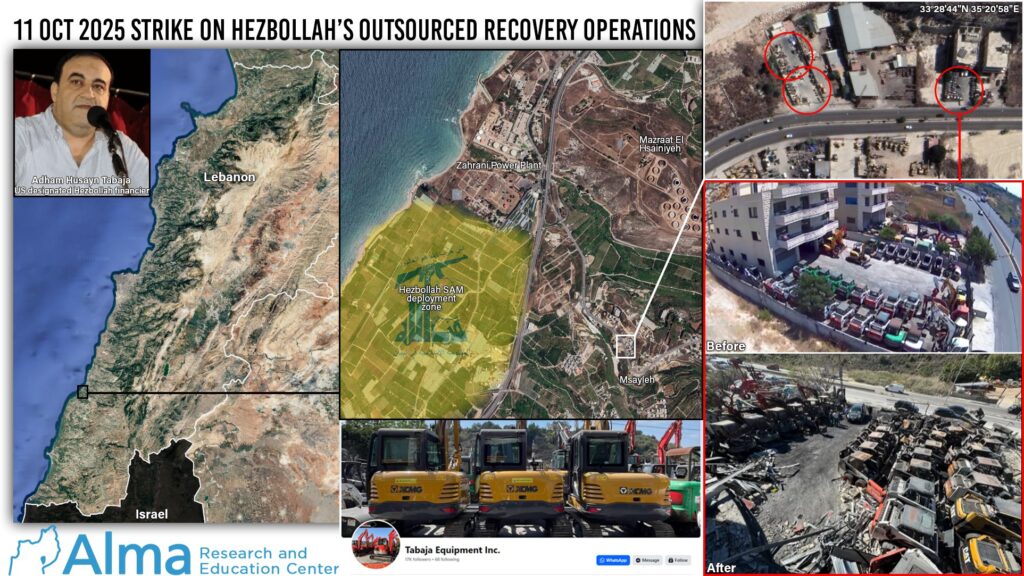
The consensus among political actors in Lebanon was that the strike in al- Msayleh carried a sharp message, directed personally at Nabih Berri.[5] He himself claimed it was carried out less than 24 hours after he pressured the Lebanese government to allocate a special clause in the 2026 budget for rebuilding the south and clashed with the Lebanese prime minister on this issue. “Israel chose the opportune moment to escalate the dispute” between him and Prime Minister Nawaf Salam regarding “the exclusion of the reconstruction of the South from the budget proposal”, Berri told Asharq al-Awsat.[6]
Berri chose to ignore the fact that even in his “backyard,” near his home in al-Msayleh, Hezbollah operates civilian infrastructure that assists it in southern Lebanon, and that this is part of Hezbollah’s economic-logistical network that greatly supports its military reconstruction process.
It is possible that the IDF strikes were intended to convey a message and personal signal to Berri — as someone holding a central political key in any future process of settlement, disarmament, or reconstruction — in order to push him toward a more flexible compromise position in the face of international demands. On the other hand, another possibility exists in which Israel seeks to prevent the impression that Nabih Berri remains outside the circle of the price paid by Hezbollah, thus allowing him to preserve his internal standing as part of the “resistance” public without being perceived as someone receiving special treatment or immunity.
Will Nabih Berri, as he grows older, ultimately distance himself from the alliance with Hezbollah? Is this partnership rooted in genuine ideological alignment, or has it mainly been a pragmatic arrangement of shared interests—interests that may now be eroded as Hezbollah’s military strength declines?
A rare and candid insight into Berri’s stance emerged from a classified U.S. diplomatic cable dated July 17, 2006, later released through WikiLeaks.[7] The document, which detailed a meeting between Nabih Berri and the American ambassador in Beirut during the Second Lebanon War, revealed a considerably more complexposition than the one Berri expressed publicly.
According to the report, Berri arrived at the meeting held on the fifth day of the war in 2006 in a good and even cheerful mood, despite the heavy bombardments and the severe harm to the Shiite population in the south. His condemnation of “Israeli aggression” was described by the embassy document as merely ceremonial, while in practice Berri analysed the campaign in utilitarian and cold terms.
Berri determined that Hezbollah made a grave mistake when it kidnapped the Israeli soldiers and added that Hezbollah leader Hassan Nasrallah misled the Lebanese leadership when he promised stability on the eve of the operation. He said explicitly that he felt betrayed and even declared that “it is no longer possible to sit with Nasrallah around the same table.”
In an especially unusual manner, Berri hinted that a limited Israeli action might be a positive development, since it could weaken Hezbollah both militarily and politically. However, he warned against a prolonged campaign, which he said would reverse Lebanese public opinion in favor of the organization. He estimated that Israel had only a window of four to five days, after which continued military pressure would become ineffective and even harmful. Berri illustrated this claim with an image etched into diplomatic history: “It’s like honey — a little is good, but if you eat the whole jar, you get sick,” he said, and laughed out loud…
The meeting also featured Berri’s clear and unprecedented endorsement of the full implementation of UN Security Council Resolution 1559, including the disarmament of militias in Lebanon. He stressed that any ceasefire must be structured to prevent Hezbollah from using it as an opportunity to regroup and deepen its entrenchment. Berri further argued that the Lebanese Army could only deploy effectively in the south once Hezbollah has been substantially weakened, as the army in its current condition lacks the strength to confront it.
Alongside this, Berri expressed criticism, somewhat cynical, of Israel’s performance in the war, claiming that the scope of damage to Hezbollah was limited: “only three operatives were killed in the last week,” he said. He believed Israel would need to improve its intelligence or launch a broad ground maneuver — but warned that such a move would cause Israeli casualties and undermine public opinion within Israel itself.
In its concluding assessment, the American embassy evaluates in the document that Berri is not a softened version of Hezbollah, nor a proxy controlled by Syria and Iran. On the contrary, he is perceived as a political rival of Hezbollah within the Shiite arena, and as someone who sees the organization as a threat to his own power base. According to the report, if Hezbollah is militarily weakened, Berri would be ready — and perhaps even interested — in weakening it politically.
It also emerges that Berri sees himself first and foremost as a pillar of the Lebanese establishment. Someone capable of speaking with everyone, but who does not “decide for them.”
Perhaps It Is Time to Make Decisions and Not Only Be a Mediator?
This perception of Berri of himself, as a mediator and not a decisive actor, reappeared also in his positions in the decade that followed, and it provides early context for understanding his role in the ceasefire agreement of November 2024.
On November 27, 2024, a ceasefire agreement was signed between Israel and Lebanon, under American-French mediation. Although formally it was an agreement between the two states, within Lebanon itself it was clear that Berri was the central figure who conducted the contacts, also (and perhaps mainly) on behalf of Hezbollah. Lebanese and international sources described him as someone who received “political power of attorney” from the organization to manage the negotiations, with the understanding that he was the only one capable of doing so without undermining Shiite cohesion.
In his statements after the agreement, Berri consistently emphasized that Lebanon is committed to the ceasefire and to implementing Resolution 1701, including — preventing the presence of armed militias south of the Litani River. In addition, Berri stated that responsibility for enforcing the agreement lies with the state and the international community. His words reflected a dual line: on the one hand, defending Hezbollah against claims of violations. On the other, stressing that Hezbollah does not operate outside a national framework, and that the state is sovereign.
What Legacy Does Nabih Berri Want to Leave Behind?
It seems that after the elimination of Hassan Nasrallah in September 2024, tensions and mutual suspicion within the “Shiite duo” resurfaced. In November 2025, Hezbollah published an open letter[8] to three senior figures in Lebanon — President Joseph Aoun, Prime Minister Nawaf Salam, and Speaker Berri. In the letter, Hezbollah presented its positions regarding negotiations with Israel and the weapons issue. According to reports in the Lebanese press, the letter was published without prior coordination with Berri — a step considered unusual in relations between the sides. Political sources said that Berry’s office was discontent with how the letter was presented, though not with its actual content.
In early December 2025, the gap between the sides sharpened also around the appointment of former ambassador Simon Karam as the civilian representative who would head the Lebanese delegation to the “Mechanism” committee. Despite Hezbollah’s declared reservation toward any move that could be interpreted as an opening to political negotiations with Israel, according to reports, Berri was fully involved behind the scenes in the appointment,[9] even though publicly he was careful to define Karam’s role as “only technical” and to deny any political dimension to the talks.[10]
A few days later, an unusual report was published in Lebanon according to which Berri approached[11] the Iranian leadership with a request to examine receiving a fatwa from Supreme Leader Khamenei that would allow Hezbollah to hand over the strategic weapons in its possession. According to the publication, Berri presented the move as part of a comprehensive arrangement to end the war and claimed that he could obtain American consent for it. At the same time, he demanded to ensure Lebanon’s detachment from any future conflict between Iran and Israel and requested urgent financial assistance to rehabilitate tens of thousands of Shiites affected by the fighting. The Iranian response, it was claimed, was partial: Tehran agreed to economic assistance but refrained from giving a clear answer regarding the fatwa or the demand to detach the arenas.
Over Berri’s actions in the past year looms the bloody legacy of the “Shiite duo” — the “brothers’ war” of the 1980s between Amal and Hezbollah, which left heavy casualties on both sides. After the conflict ended, an informal division of roles took shape: Hezbollah retained military dominance, while the Amal Movement, led by Nabih Berri, secured political and institutional influence. This balance helped maintain relative stability and avert renewed internal clashes, but it has depended largely on Berri’s personal authority as an aging leader and on his relationship with Nasrallah, who is now gone.
At this stage, it is evident that Nabih Berri is approaching the end of his political career, and as Lebanon enters a decisive and fateful moment, the question of his legacy becomes even more profound. The devastation in the south, the displaced left without shelter, and the country’s economic collapse —rests heavily on his shoulders.
Will Nabih Berri be remembered as the one who saved Lebanon and led it toward a better future, or as a figure complicit in its collapse? It seems that the moment is approaching (and perhaps has already arrived) in which the veteran and aging leader will have to decide, between loyalty to his state and his ethnicity, or loyalty to a utilitarian, interest-based political alliance with Hezbollah.
[1] https://www.nidaalwatan.com/article/357902-%D8%A8%D8%B1%D9%8A-%D8%B1%D8%AC%D9%84-%D8%A7%D9%84%D8%B9%D8%A7%D9%85%D8%A7%D9%84%D8%A3%D8%AE%D9%8A%D8%B1
[2] https://today.lorientlejour.com/article/1485139/berris-pivotal-moment-under-pressure-and-holding-the-keys.html
[3] https://www.lebanonfiles.com/2025/articles/خاص/الثنائي-قلق-من-المتغيرات-وبري-يريد-قطف/
[4] https://www.youm7.com/story/2024/10/29/غارة-للاحتلال-أمام-منزل-رئيس-مجلس-النواب-اللبنانى-نبيه-برى/6758123
[5] https://www.alarabiya.net/politics/2025/10/12/%D8%A7%D8%B3%D8%B1%D8%A7%D8%A6%D9%8A%D9%84-%D8%AA%D8%B3%D8%AA%D9%87%D8%AF%D9%81-%D8%A8%D8%B1%D9%8A-
[6] https://aawsat.com/العالم-العربي/المشرق-العربي/5196479-بري-الرسالة-الإسرائيلية-وصلت-لكن-أين-صدقية-الراعي-الأميركي
[7] https://wikileaks.org/plusd/cables/06BEIRUT2407_a.html
[8] https://today.lorientlejour.com/article/1483953/hezbollah-sends-open-letter-to-aoun-berri-and-salam-no-to-political-negotiations-with-israel.html?utm_source=chatgpt.com
[9] https://english.aawsat.com/arab-world/5216460-lebanon%E2%80%99s-leaders-unite-technical-security-track-talks-israel
[10] https://asasmedia.com/101050/
[11] https://www.mtv.com.lb/news/محليات/1635038/بري-يطلب-فتوى-من-خامنئي-بشأن–الحزب-