
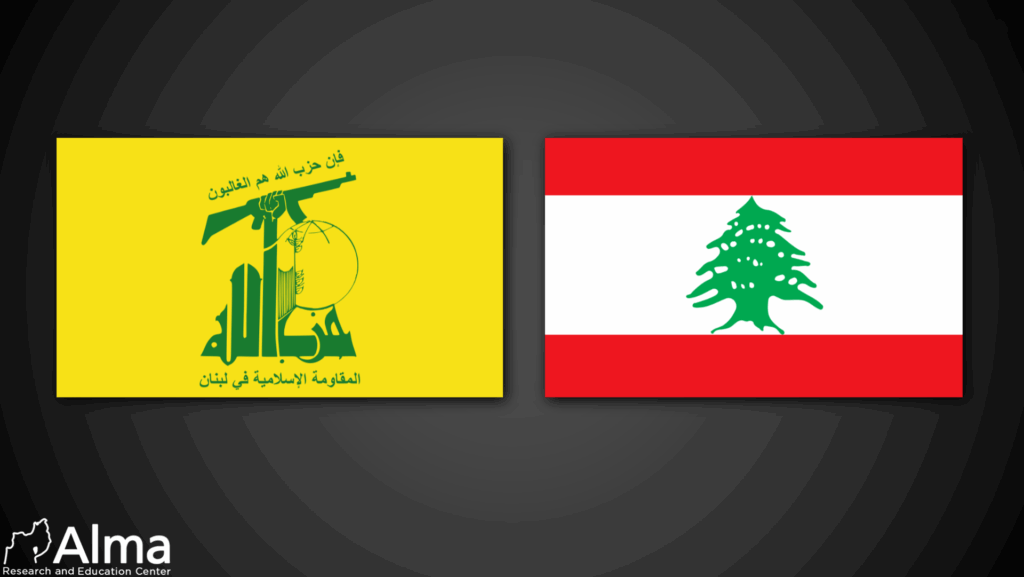
A sober examination of reality on the northern border is due one year after the ceasefire.
The central message emerging from the field is sharp and clear: Since the state of Lebanon avoids a massive dismantling of Hezbollah’s weaponry, the State of Israel pursues a policy of constant mowing the lawn and sometimes even uprooting actions in regard to terror infrastructure in Lebanon.
The question often arises whether Lebanon cannot or will not act.
There is no dispute that the challenge is great, due to the demographic situation in Lebanon, where it is estimated that Shiites (Hezbollah’s natural base) constitute almost 50% of the citizens – a picture that also affects the composition of the Lebanese Army.
The Lebanese Armed Forces (LAF) consistently avoids entering private areas as part of the efforts to disarm Hezbollah, thus effectively allowing Hezbollah to continue using the Lebanese people as human shields.
Despite the difficulty, there is more to be done beyond Israeli strikes. Intensive work is required here, and primarily a perceptual change by the international community, led by the United States and France, which are already involved in the ceasefire implementation mechanism.
A clear understanding is needed, according to which, without a sequence of economic, social, and political actions – Lebanon will continue to be a failed state, as American Ambassador Tom Barrack has already stated.
Worse yet – without treating the root cause problems, we will not be able to remove Hezbollah’s threat to Israel and, in fact, to the stability of the entire region.
There are four critical layers that are not receiving an adequate response: The money and terror financing, the Iranian octopus head, the political-social deadlock in Lebanon, and the dangerous illusion regarding the LAF.
The Oxygen Line of Terror: The Billion That Wasn’t Stopped
Recently, the US Treasury Department published a staggering figure: Since January 2025, Iran has transferred approximately one billion dollars to Hezbollah.
The main question that must be asked is: How did this happen? How, under the watchful eye of the international community and the sanctions regime on Iran, does such a huge sum flow into the hands of a terror organization?
This is smuggling that is no less severe than the massive weapons trafficking.
The answer lies in mechanisms we at the Alma Center have been warning about for a long time, and about which nothing has been done to stop.
Part of the money passes through currency exchange stores in other countries, for example, Turkey, which conduct offset arrangements with currency stores in Lebanon.
In our assessment, money also enters Lebanon in the good old-fashioned way – via Iranian “diplomatic flights” to Lebanon.
It can be estimated that Iranian diplomats land in Beirut with suitcases loaded with cash, and except for a single and exceptional event where suitcases were checked, this route is completely open.
Moreover, Hezbollah’s financial institutions, such as “Al-Qard Al-Hassan”, continue to operate in Lebanon undisturbed.
So do its sources of income within Lebanon, such as the Al-Amana gas stations.
Both Al-Amana and Qard Hassan have been recognized by the United States as terror entities.
Additional money seemingly comes from the Lebanese Diaspora, which funnels huge capital into the country; this is a financing pipeline that is not easy to track because cover is used by private businesses and many shell companies in every such pipeline.
To all these, one must add Hezbollah’s diverse criminal businesses – a mafia organization with activity in many places in the world.
Stopping this flow of funds requires Sisyphean intelligence work and enormous resources.
The war on terror does not end only with kinetic actions by the Israeli Air Force;
It must include severing the economic artery feeding the Iranian proxy.
The Alternative Economy of Tehran
When we look toward the source – Tehran – we understand that the solution will not arrive as long as the radical Islamist-Shiite regime there remains intact.
The Islamic Republic made a strategic decision, which appears irrational in Western eyes: Despite the catastrophic economic situation inside Iran, and despite the collapse of local infrastructure, the regime continues to invest major resources in cultivating its octopus-proxy arms and the nuclear and missile projects.
Thus, Iranian involvement in Lebanese Hezbollah only deepened after Nasrallah’s assassination, both in terms of budgets, mentoring, and involvement in decision-making processes.
An example of this can be seen in the Iranian statements that threatened a response by Hezbollah to the November 23 targeted strike that killed Haytham Ali Tabatabai, Hezbollah’s Chief of Staff.
The Western perception that sanctions alone will tip the scales has proven to be wrong. The reason for this is the formation of an ‘alternative economy.’
Iran suffers from sanctions, but it is not collapsing, because it created a sanctions-bypassing trade system with countries like Russia, China, Venezuela, and North Korea.
As long as this axis exists, Iran will continue to fund terror at the expense of its citizens’ welfare, and stability in the Middle East will remain a distant dream.
The Political and Social Illusion Inside Lebanon
We are hearing optimistic reports lately speaking of an awakening of Shiite opposition to Hezbollah inside Lebanon. The reality is grimmer.
While such voices exist, and we see them on social networks, it is a small group, devoid of real political power, which is under a daily existential threat from Hezbollah’s security mechanisms.
Can it be provided with protection? Can it be strengthened?
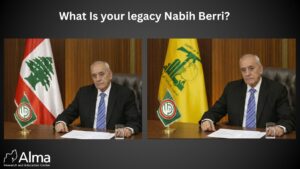
The Speaker of the Lebanese Parliament, Nabih Berri, head of the Shiite Amal movement, is not the solution, but the problem. He is unwilling to detach from the ‘Shiite Duo’ (Amal and Hezbollah), and maintains his ties with Hezbollah. Therefore, as long as Hezbollah and the Amal party run together as one political bloc, the average Shiite in Lebanon has no real alternative. They have no other political address and no one to provide them with protection or services.
Hope for changing this equation lies perhaps in the new election law in Lebanon, which allows the Lebanese diaspora to vote. The assumption is that in the diaspora there is a majority of Hezbollah opponents, but this is an assumption that has not yet stood the test of reality – since Hezbollah has efficient recruitment mechanisms even overseas in Shiite-Lebanese communities.
In any case, the problem is deeper than politics; it is social. Hezbollah is not just a terror army and a forward Iranian base; It is the central service provider for the Lebanese Shiite population. Even today, when it is economically weakened, its civilian array works: the schools, the scout movement, the clinics, and food distribution.
This array, which is completely legal in Lebanon, is the infrastructure enabling terror; it is the basis for building the “Resistance Society” from within the Shiite sect in Lebanon.
This is what produces the loyalty and indoctrination of the Iranian Islamic Revolution’s values, allows the recruitment of operatives, and creates the legitimacy for hiding weaponry inside civilian homes (and the mass use of human shields).
It is impossible to defeat Hezbollah without dismantling these institutions and creating a functioning governmental alternative.
The state of Lebanon must be capable of replacing the service array that Hezbollah grants to residents.
This is not simple – since Lebanon is built on the division of resources and power between the different sects.
For this, strict supervision over international reconstruction funds is required. Before the war, we warned that Hezbollah is willing to risk the destruction of Lebanon because of what it learned from the previous war in 2006, that much international money will flow for reconstruction.
A distinct example of the existing absurdity is the identity of the Advisor to the Lebanese President for Reconstruction Affairs in Lebanon, Ali Hamieh, appointed in June 2025.
Until less than a year ago, this individual served as a minister on behalf of Hezbollah, and was responsible, among other things, for Beirut Airport – that same airport that was under Hezbollah’s control for many years. Could the President of Lebanon truly not find a person unaffiliated with Hezbollah for the role? It must be ensured that international aid money does not turn into aid money for rehabilitating Hezbollah’s base and transferred to contractors working with the organization.
The Lebanese Army: The Solution or the Problem?
The last and most sensitive point touches on the Lebanese Army (LAF). The Western-American concept holds that the solution is to ‘pour money’ on the Lebanese Army: to improve equipment, raise salaries, and thus turn it into a counter-force to Hezbollah.
This is a working assumption that has never been examined in depth.
We must ask ourselves a simple question that has no open research on it: What is the composition of the Lebanese Army?
As stated, estimates speak of about 50% of it being Shiite Muslims.
Do these soldiers see themselves committed to disarming Hezbollah, or do they see Hezbollah as the defender of the Shiite sect? How could a soldier in the LAF act against his brother, a Hezbollah member?
In the absence of a political and economic alternative for Shiites, the likelihood that they will turn their weapons against their brothers is low.
Why is money not the solution? The most dangerous scenario, a nightmare scenario we must take into account, is the Iraqi model: a situation where Hezbollah essentially swallows the LAF from within.
In such a scenario, entire brigades in the Lebanese Army, equipped with advanced Western weaponry, will receive their operational orders not from the Army Commander in Beirut, but from Tehran.
This has happened in Iraq, and so too in Syria, when jihadist militias of rebels joined the Syrian Army in their entirety, while maintaining loyalty to local commanders.
In such a situation, Israel might find itself facing a kind of North Korea across the fence, equipped with the best Western technology.
In principle, aid to the Lebanese Army is not a flawed goal in itself, especially given the fact that Russia and Iran are also eager to transfer military aid to it.
But this aid must be conditional on strict supervision and a deep examination of loyalties.
The question of which military equipment is truly required for the army against the threats facing it must be scrutinized – threats mainly from within Lebanon.
On the other hand, the dependence of the Lebanese Army on Qatari money already today provides a new reason for concern, in terms of a growing foothold of the Sunni Muslim Brotherhood inside Lebanon.
Either way, one cannot continue funding a body that might turn, on command, into another arm of the Revolutionary Guards or any number of terror organizations.
Conclusion
At the end of the war, much has been said about a one-time opportunity for Lebanon to bring about change and transform from a failed state to a prosperous one that does not support terror.
One year after the ceasefire, the conclusion is clear: Israel is performing what is required to provide security for its citizens, and Israel must continue to be provided with support for these actions, since they also serve Lebanon’s future and its detachment from the Iranian-Hezbollah stranglehold.
But this is not enough. For the opportunity created last year not to be missed, there is more to be done.
The campaign for Lebanon’s future and security on the northern border requires much more than military force.
It requires work by the Lebanese government alongside international determination to stop the Iranian money pipeline, to dismantle the terror organization’s civilian infrastructure, and to supervise the institutions of the Lebanese state with open eyes.
Without these steps, we may find ourselves again at the same point, facing an enemy that has rehabilitated and strengthened under the cover of global blindness.




4 Responses
What factors make it difficult for the Lebanese Armed Forces to dismantle Hezbollah’s weaponry?
Dear Sarit,
One positive outcome of the October 7 jihaddist attack is that it has opened many blinded eyes. The children of Light now perceive the extreme evil and darkness of the jihaddist’s deceptions, delusions and lies. Your Light of Truth will now expose and destroy the terrorists. The Judge of heaven and earth will execute Justice and destroy the evildoers.
“Vengence is mine, I will repay…”
Hi Sarit,
after my brief visit at your HQ last week with the group from Sweden I looked at your website and found the newsletter subscription which I instantly hit. I am now reading the latest report covering the Lebanon situation, truly insightful analysis that needs to be spread widely. I cant get my head around how the combined mission of the Quatari Sunni and the Teheran Shiites can function side by side apart from their mutual wish to destroy Israel.
Dear Sarit,
The exposing of the treachery of the head of the snake, the ayatollah, is equally important. This despotic dictator has transferred a billion dollars to rebuild a dying hezbollah proxy terrorist force of destabilization, at the expense of the entire capital city of Teheran – which has consequently run out of water. Pure evil on full display for the world to see.
The serpent’s head will now be crushed.