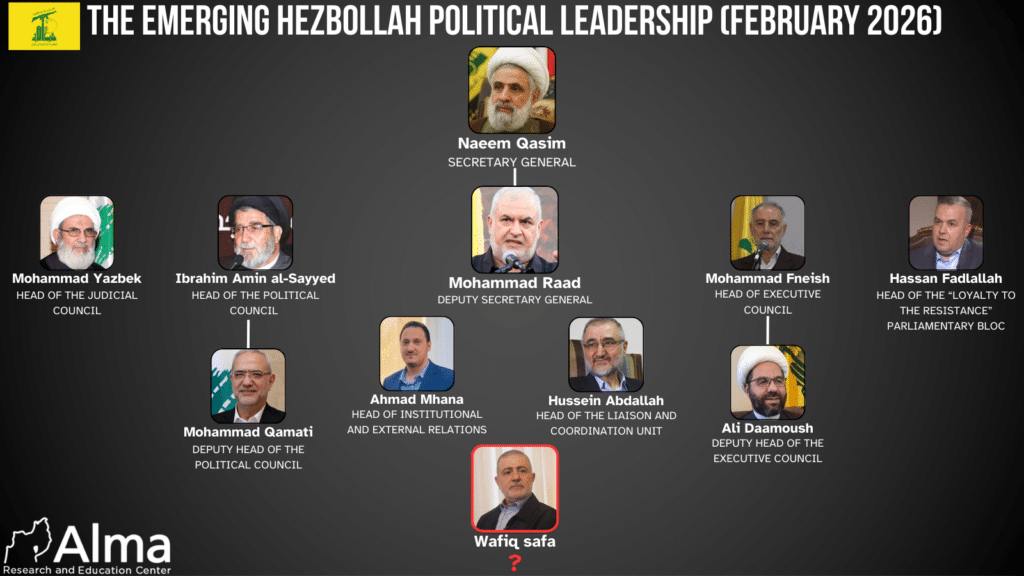
In the wake of the most recent round of fighting with Israel, which reportedly inflicted substantial damage on Hezbollah’s political and military leadership tiers, the organization has—according to multiple reports—initiated a broad internal restructuring process. This process is said to include senior-level appointments, the consolidation of authority, and the creation or reestablishment of dedicated organizational frameworks across the political–civil, administrative, and media domains.
According to the reports, the move reflects a strategic attempt to restabilize decision-making centers, reduce the autonomy of sub-units.
At the same time, there appears to be an effort to recast the organization’s image as a legitimate political–civil actor operating within Lebanon’s internal system.
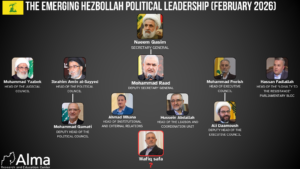
Following the elimination of Hassan Nasrallah and Hashem Safi al-Din in September/October 2024, Naim Qassem was appointed Secretary-General of Hezbollah. A comparison between Qassem and the two figures—particularly Hassan Nasrallah—is inevitable, and this constitutes Qassem’s central challenge. The initial impression he conveyed, immediately after their elimination, was that of a pressured and unsettled leader lacking full control. First impressions are difficult to reverse.
It appears that, in order to consolidate and stabilize his standing within the organization and among the Shiite base, Qassem is being backed by Iran in implementing significant new appointments within Hezbollah. On the surface, there seems to be a preference for figures without a religious background. This may reflect an effort to distinguish and position Qassem as the undisputed leader, to the extent possible, in relation to the rest of the senior political leadership.
Deputy Secretary-General of Hezbollah
According to reports, Mohammad Raad will be appointed Deputy Secretary-General of Hezbollah. Raad is one of the most veteran and influential political figures in Hezbollah. Since 1992, he has continuously served as a member of the Lebanese Parliament on behalf of the organization and as head of the “Loyalty to the Resistance” bloc, while concurrently serving as a member of the Shura Council – the supreme decision-making body. Over the years, he has consolidated his status as responsible for managing the parliamentary arena, coordinating political positions, and serving as Hezbollah’s official representative vis-à-vis the Lebanese establishment.
Raad is not a religious cleric– a fact that deviates from the historical pattern at Hezbollah’s top leadership, in which the positions of Secretary-General and his deputy were until now held by prominent clerics. His potential appointment would therefore represent an unusual shift in the organization’s leadership structure and signal a strengthening of the political–civil dimension at the heart of decision making. His assumption of the role is expected to reflect a formal and substantive integration of the political echelon into the uppermost leadership tier, positioning him as a principal, and relatively exclusive channel for overseeing the organization’s political and institutional affairs.
The Executive Council
The Executive Council is Hezbollah’s administrative body, responsible for managing the organization’s civilian activity in all areas (“Hezbollah’s State”). The Executive Council operates in coordination with the Jihad Council, which is responsible for military activity, and a significant portion of its institutional activity is integrated with military operations.
Nine units operate under the Executive Council, overseeing the entire spectrum of civilian domains in which the organization is active: the Electronic Unit, the Media Unit, the Social Unit, the Education Unit, the Islamic Health Organization, the Jihadist Financial Unit, the Unions Unit, the Foreign Relations Unit, and the Coordination and Liaison Unit. Subordinate to these units are various bodies that address all aspects of the Shiite base’s daily life while also supporting military Activity.
Mohammad Fneish—a prominent political figure who previously served as both a minister and a Member of Parliament—has recently been appointed, According to reports, head of the Executive Council. In this role, he is tasked with overseeing an administrative and institutional restructuring process, as well as managing the portfolio for the parliamentary elections set for May 2026. His appointment signals a distinct preference for political–civil leadership rather than religious leadership in the management of “Hezbollah’s State.”
Fneish is among the senior political echelon of Hezbollah and has been a member of the organization since the early 1980s. At the beginning of his career, he operated in southern Lebanon in the framework of the Islamic committees, was involved in Hezbollah’s activity during the 1980s, and was even arrested by the IDF in 1984. Within Hezbollah, he held a series of key positions, including member of the Decision Council (Shura), member of the Political Council, head of foreign relations, and head of the political bureau. He was elected to the Lebanese Parliament in 1992 on behalf of the “Loyalty to the Resistance” list and held his seat until 2009, serving on central committees including the Economy Committee in the Parliament (which he chaired).
He later served in several ministerial positions in Lebanese governments between 2005–2019, including Minister of Energy and Water, Minister of Labor, Minister of State for Administrative Reform, and Minister of Youth and Sports – positioning him as a key figure in Hezbollah’s political–institutional arena.
As part of the restructuring, Sheikh Ali Damoush is expected to assume responsibility for operations and organizational affairs within the Executive Council. In this capacity, he would function primarily as an executor and coordinator of the reorganization process, rather than as a strategic decision-maker. Damoush previously served as Deputy Head of the Executive Council and, following the elimination of Hashem Safi al-Din in October 2024, was reportedly appointed, apparently on an interim basis, as acting head of the Council. Before that, he led the Foreign Relations Unit and was a member of the central religious-legal committee. He formally joined Hezbollah in 1994 and has since held a range of religious and organizational positions, including membership in the Executive Council, culminating in his appointment in 2017 as Deputy Head of the Executive Council under Hashem Safi al-Din.
Was Wafiq Safa Dismissed?
According to certain reports, the organizational restructuring resulted in the dismissal of Wafiq Safa, who had headed Hezbollah’s Liaison and Coordination Unit and functioned as a “special missions” operative. For years, Safa was regarded as one of the organization’s most influential figures (owing in part to his close personal and familial ties to Hassan Nasrallah) and served as the primary conduit between Hezbollah and the Lebanese army, state institutions (both security and civilian), and various political actors.
In recent months, there has been a growing number of reports pointing to serious disagreements between Naim Qassem and Safa, with Qassem reportedly perceiving Safa as a disruptive figure who poses a challenge to his leadership.
In the framework of his role, Safa was responsible for managing negotiations, maintaining significant political contacts, managing political and media messaging, and involvement in strategic processes such as elections and mediation.
Safa was a key figure in operating and maintaining Hezbollah’s weapons smuggling infrastructure into Lebanon, by virtue of his extensive ties with relevant officials in security bodies, customs, seaports, the airport, and the like. In practice, Safa operated key figures within these organizations, who effectively served as his aides.
According to reports, following the changes, the Coordination and Liaison Unit was redefined as a purely technical body dealing with limited coordination with the Lebanese army, while authorities were dispersed and some were even transferred directly to Naim Qassem and Mohammad Raad.
According to reports, Hussein Abdullah, also known as Hajj Hussein al-Khalil, who is close to Naim Qassem and was recently appointed as his political advisor, is expected to assume responsibility for the unit’s duties. At the same time, Ahmad Mhana has been assigned oversight of communication channels with the state and external actors—an arrangement that ostensibly reflects the dispersal of the concentration of authority previously held by Safa.
However, this does not necessarily indicate Safa’s actual dismissal. In our assessment, even if his overt status has diminished, he may continue to play a significant role behind the scenes due to his extensive influence in the smuggling issue, which is a critical component in Hezbollah’s military rehabilitation. In our assessment, another scenario is that any “dismissal of Safa” move is a form of deception — a deliberate reduction of his external visibility due to his being a dominant figure with potential for targeted elimination (according to several reports, an attempt to eliminate him occurred in October 2024), while in practice he will continue to serve as a key factor in decision-making centers behind the scenes.
Hezbollah’s Leadership in Lebanese Politics
In a scenario in which Mohammad Raad is appointed Deputy Secretary-General of Hezbollah, Hassan Fadlallah will be appointed Chairman of the “Loyalty to the Resistance” bloc. Fadlallah has served as a Member of Parliament on behalf of Hezbollah since 2005 and from the outset of his career operated in the civil–political arena rather than the military one. He has consolidated his status as a central voice of the organization on issues of law, administrative reforms, and the contest against corruption. Such an appointment would reflect the transfer of bloc management to a civil–legal figure and would strengthen the trend toward deepening the parliamentary and institutional character of the organization’s leadership.
The Media Apparatus
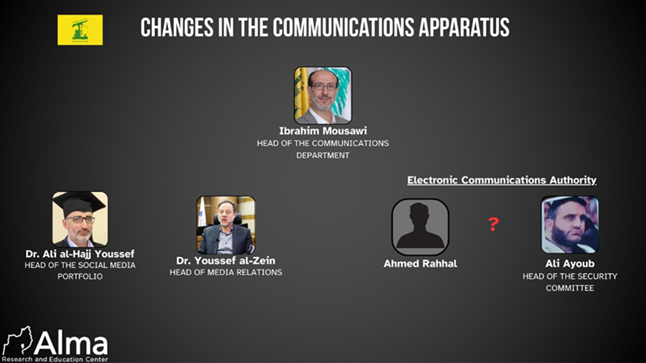
Alongside the changes in leadership, Hezbollah’s media organisation is also undergoing a reorganization process, including centralization of authorities and tightening control over messaging.
As part of this framework, Ibrahim Mousawi is set to assume the role of head of the Media Authority “Hay’at al-I‘lam”, where he will oversee the unification of messaging, coordinate media appearances, supervise spokesperson operations, and exercise overall oversight of the media apparatus. Mousawi has been a Hezbollah Member of Parliament since 2018 and is regarded as one of the organization’s leading political spokespersons.
Dr. Youssef al-Zein is expected to assume the position of head of media relations, succeeding Mohammad Afif, who was eliminated in November 2024. In this capacity, he will oversee ongoing engagement with Lebanese and international journalists, coordinate interviews and media appearances, and act as the official representative of the media apparatus in coordination forums and formal meetings with political actors.
Dr. Ali al-Hajj Youssef is expected to be appointed as head of the social media portfolio. In this role, he will be responsible for managing and coordinating Hezbollah’s activity in the digital arena, supervising messaging, campaigns, and content on social media platforms, and coordinating between the public diplomacy bodies, media relations, and the political echelon. He will serve as a senior professional–technical figure, without authority to shape policy, and will be subordinate to the central media apparatus.
Two names are reportedly under consideration for the role of head of the Electronic Communications Authority: Ahmad Rahhal and Ali Ayoub. This position is part of the newly formed digital array created within the reorganization process. It is possible that the body is intended to function as a security-oriented arm, tasked, among other things, with monitoring and censoring content published on social media from an intelligence perspective.
Ali Ayoub currently serves as head of Hezbollah’s Security Committee, an unofficial security body (functioning as a quasi-police force) that operates in parallel to Lebanon’s official security institutions and constitutes part of the broad military-intelligence apparatus the organization has built over the years.
Summary
The elimination of Nasrallah and Hashem Safi al-Din created a significant leadership crisis within Hezbollah. Naim Qassem represents a default choice. The crisis intensified internal tensions and disagreements among the remaining leadership. Accordingly, based on reports, we are witnessing an attempt (which, in our assessment, is being fully backed and actively driven by Iran) to advance senior appointments and structural changes aimed at stabilizing the organization’s decision-making centers—and in particular, at consolidating Qassem’s position at the head of the organization.