General:
Today, November 27, 2025, marks one year since the ceasefire with Hezbollah in Lebanon. Since the agreement went into effect, the IDF has conducted daily operations in response to Hezbollah’s violations and its ongoing reconstruction efforts. The key question that remains unanswered is: Who is prevailing in the struggle between Israel’s disruption efforts and Hezbollah’s drive to rebuild?
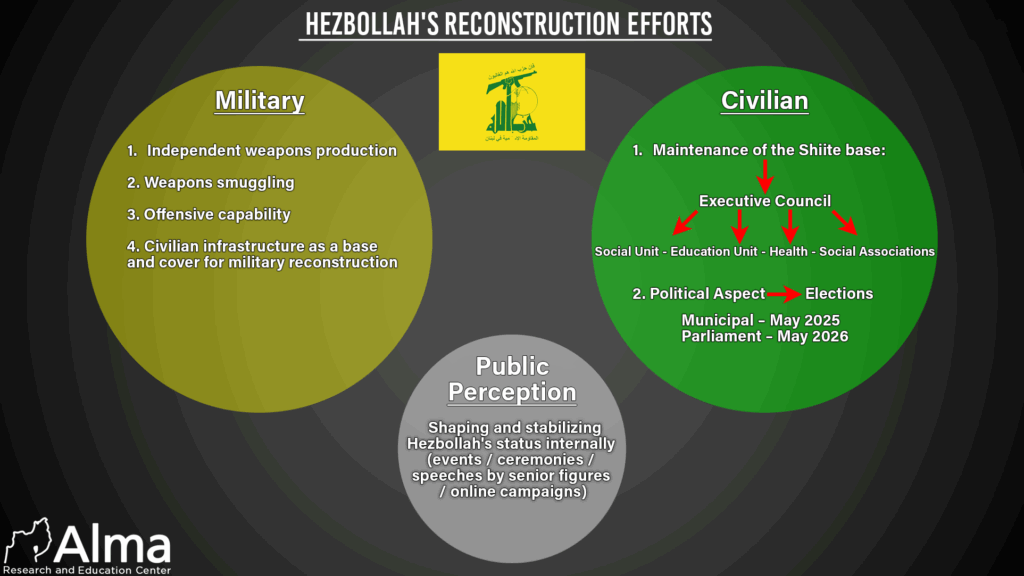
By monitoring data on IDF strikes in Lebanon since the beginning of the ceasefire and analyzing it, insights can be derived regarding Hezbollah’s reconstruction efforts and its central core focal points. Hezbollah’s reconstruction efforts can be divided into three main aspects: military, civilian, and perceptual reconstruction (see our article “Special Report – Hezbollah’s Rehabilitation Composite in Lebanon — Situation Report” published in October 2025).
The core of Hezbollah’s ideology is “armed resistance” – an identity that cannot be relinquished. Hezbollah is driven by honour, pride, and deep belief in armed struggle against Israel. Armed resistance is not a means but an identity. Therefore, reconstruction processes are not only an operational necessity but stem first and foremost from Hezbollah’s basic identity.
During the ceasefire over the past year, the IDF carried out 669 airstrikes throughout Lebanon (it should be noted that this is not the number of targets struck, but rather the number of strike events; that is, multiple targets may have been hit in a single strike). The fact that the IDF has struck consistently over the past year indicates that Hezbollah continues to conduct continuous reconstruction efforts and maintain operational presence on the ground.
The strikes were carried out against the reconstruction of Hezbollah’s military infrastructure in general and against the central core efforts of reconstruction in particular, such as: weapons smuggling, independent production, and repair of weapons (see our article “Hezbollah – Independent Weapons Production: A Hybrid Doctrine in Light of Strategic Need” published in November 2025) and against Hezbollah operatives from various units involved in general reconstruction and in organizational infrastructures tied to offensive capability, recruitment, and training.
Regarding offensive capability, it appears that most strikes target the fire-array infrastructures that endured the war (between 20,000 and 25,000 rockets and missiles of various types, hundreds of UAVs, and an unknown number of launchers) as well as operatives and infrastructures of the Radwan Unit.
The IDF also strikes civilian-economic infrastructures that serve as a base and cover for Hezbollah’s military reconstruction, including engineering equipment, quarries, concrete factories, and Hezbollah operatives who, by virtue of their civilian professions, assist Hezbollah’s military reconstruction.
Military and civilian reconstruction are intertwined, and civilian reconstruction enables Hezbollah’s renewed military entrenchment. Accordingly, in recent months Hezbollah has also increased its civilian activity and is working to strengthen its influence over the Shiite base and the base’s dependence on the organization.
Despite repeated statements by the Lebanese government and the Lebanese Army regarding the success of the operation to disarm Hezbollah south of the Litani (in early November the Lebanese government claimed that the Lebanese Army had completed 85% of the disarmament south of the Litani and was expected to complete it by the end of the year), it appears that the situation on the ground is far from this, to say the least. This assessment is based on the scope of Israeli strikes in that region.
The Lebanese state does not have the capability (and sometimes not even the desire) to genuinely confront Hezbollah. Lebanon’s significant force for “disarmament,” the Lebanese Army, is very limited in its operations and is neither interested nor able to confront Hezbollah. The army’s demographics (60%-40% Shiite), fear of civil war, Hezbollah’s restrictions on the army’s freedom of movement and activity, and cooperation and coordination between elements inside the army and Hezbollah—all of these are central reasons for this situation.
The Lebanese Army provides very little evidence of what it has accomplished on the ground so far (there is no documentation or even clear data on quantities and numbers of what has been located and confiscated). At the same time, by monitoring IDF strikes in Lebanon, it is apparent that Hezbollah is accelerating its reconstruction processes and working to strengthen its operational and strategic capabilities.
While the Lebanese state and Lebanese Army are not acting effectively against Hezbollah, the IDF is forced to do so. The IDF is the primary actor operating against Hezbollah’s reconstruction processes, which are being carried out in direct violation of the ceasefire agreement and Resolution 1701.
Key Findings:
Most of the Israeli airstrikes during the ceasefire were carried out in the southern front area, south of the Litani and north of it (the Badr Unit sector), indicating intensive Hezbollah activity in reconstructing its infrastructures in the southern front, as well as a high presence of operatives in those areas.
Although during the ceasefire Hezbollah appeared to have acted to distance its infrastructures north of the Litani, based on the nature of the targets struck recently south of the Litani, it appears that there is a trend of reconstruction and some return to this area. This trend is reflected, among other things, in the reconstruction of sites struck by Israel during the war and/or the ceasefire.
Based on analysis of the strike data, focusing by areas and presenting them in a heat map, South of the Litani, along the contact line area, in the region of the villages of Aitaroun (over 50 strikes) and Ayta ash-Shaab (over 40 strikes), these areas are the most frequently struck, together with the Adaisseh and Houla area.
Most of the strikes were carried out in the initial period of the ceasefire. Today, the number of airstrikes in the contact-line area has decreased. Additionally, areas that sustained numerous strikes include the Bint Jbeil area, Zebqine, Tair Harfa, and Naqoura.
North of the Litani, the Nabatiyeh region and to its east, has experienced the highest number of strikes (with a total of 52).
The Bekaa region accounts for only 13 percent of all strikes, making its share significantly smaller than that of the southern front, even though it serves as a crucial strategic-depth hub for key fire arrays, force buildup, and logistics. These elements form a core pillar of Hezbollah’s reconstruction efforts.
The issue of the strike volume and rate becomes extremely sharp in relation to the Beirut area (1.6 percent of all strikes).
The overall average of strikes stands at 51 strikes per month throughout the ceasefire. Despite recent reports of an alleged escalation in strikes, a breakdown of the data since June 2025 shows that the number of strikes has remained almost identical, with an average of 48 strikes per month.
Nearly half (49%) of the targeted operative eliminations occurred south of the Litani River. Overall, these targeted eliminations made up roughly one-third of all airstrikes.
The data shows that the targeted-elimination campaign can be divided into three distinct phases: From November 2024 to February 2025, a period marked by relatively few eliminations. From March 2025 to July 2025, a steady rise in activity, culminating in a notable peak in July 2025 with 30 eliminations. From September 2025 to November 2025, following a sharp decline in August (11 eliminations), apparently linked to visits by senior U.S. officials to Lebanon for discussions on the Hezbollah issue, a gradual upward trend resumes.
21 percent of the eliminated Hezbollah operatives belong to the Radwan Unit.
In total, there are 28 operatives from other organizations who were eliminated during the ceasefire. The overwhelming majority are from Hamas (18). The remaining eliminated operatives belong to Amal, the Lebanese Resistance Brigades, the Syrian Social Nationalist Party, Jamaa Islamiyah, and the Popular Front (1–4 eliminated per organization).
Detailed Analysis of IDF Airstrikes and Insights on Hezbollah Activity:
Air strikes
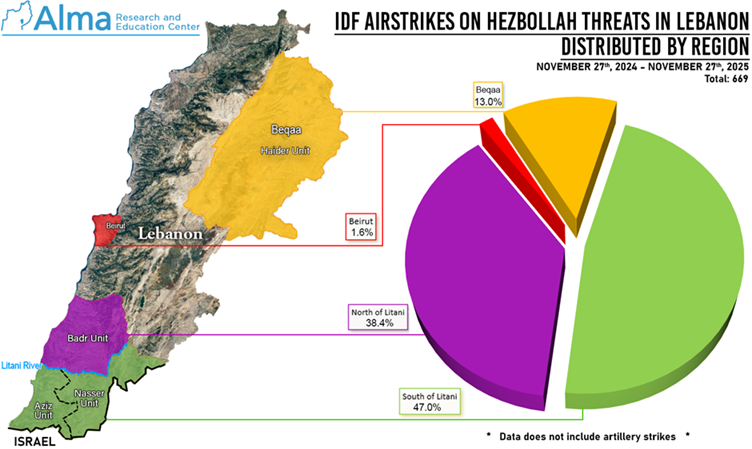
According to the data we have monitored, since the ceasefire went into effect the IDF has carried out 669 airstrikes in Lebanon:
47% of the strikes were south of the Litani. Prior to the war, this area contained, thousands of fixed Hezbollah infrastructure targets, including underground infrastructure. According to our understanding, current strikes in this area are carried out against targets that were not addressed during the war, either by strikes or maneuvers, and against targets for which new intelligence has emerged related to reconstruction attempts.
The purpose of the strikes in this area is to disrupt and even prevent Hezbollah’s involvement in reconstructing the front-line area and the contact line with Israel, and to push Hezbollah operatives and their capabilities north of the Litani River.
Although during the ceasefire Hezbollah appeared to have acted to distance its infrastructures north of the Litani, based on the nature of the targets struck recently south of the Litani, it appears that there is a trend of reconstruction and some return to this area. This trend is reflected, among other things, in the reconstruction of sites struck by Israel during the war and/or the ceasefire.
38.4% north of the Litani. Before the war, the center of gravity of Hezbollah’s southern-front deployment was south of the Litani, in the Nasser and Aziz Unit sectors. Following the war, due to the severe damage inflicted on these units, the operational center of gravity of the southern front has shifted for now to the area north of the Litani—to the Badr Unit sector. This shift is being made by Hezbollah for the purpose of reorganizing, with the intention of reconstructing what can be rebuilt in the area south of the Litani.
Most strikes were carried out in the areas south of the Litani and north of it (the Badr Unit sector), indicating intensive Hezbollah activity aimed at reconstructing its infrastructures in the southern front, as well as high operative presence in those areas.
13% of the strikes were carried out in the Bekaa, which remains Hezbollah’s strategic-depth area, both operationally and logistically. The Bekaa contains, among other things, training infrastructures, weapons-production and storage infrastructures, and sites belonging to Hezbollah’s strategic arrays: missiles and UAVs.
1.6% of the strikes took place in Beirut (11 in total). In addition to the headquarters situated in the city, Hezbollah had already positioned elements of its strategic systems and production lines there before the war, and it is now working to maintain them.
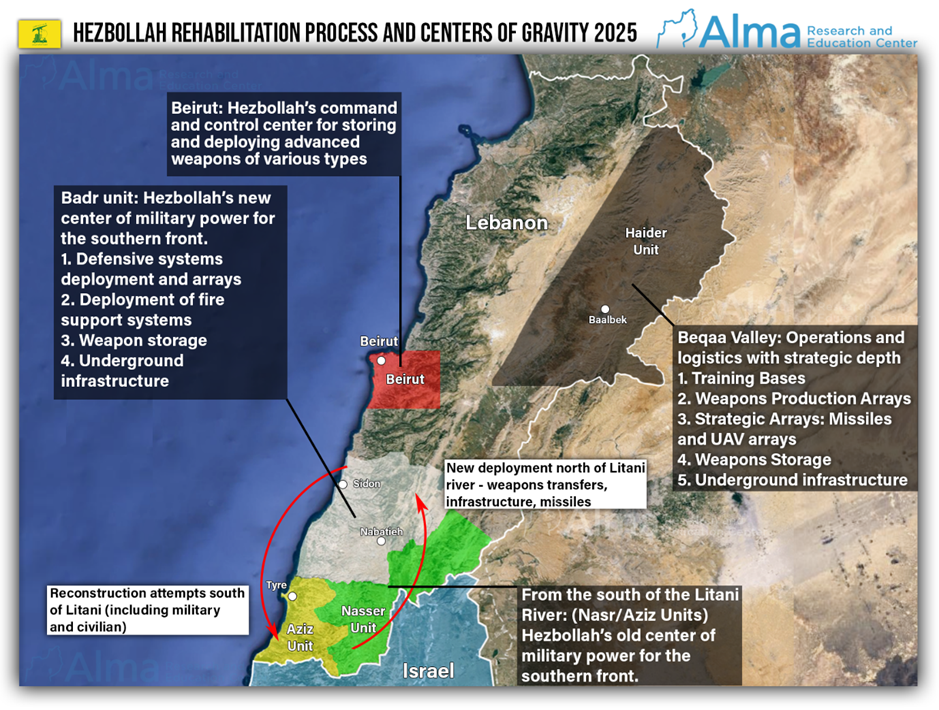
Prominent geographic zones in which concentrated strike efforts were undertaken:
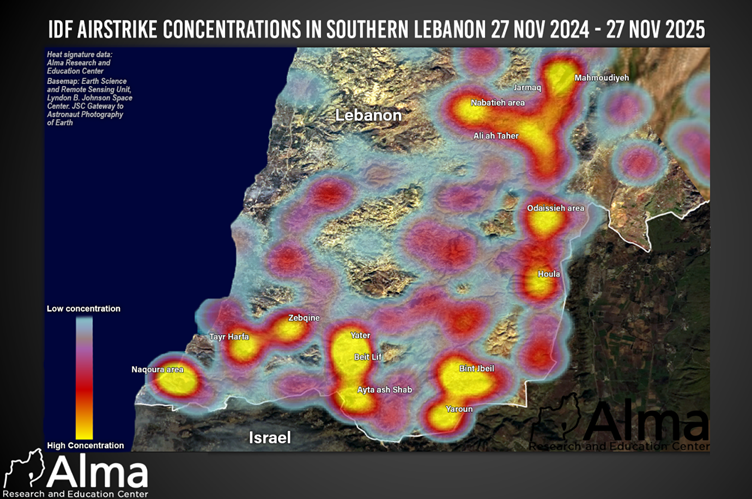
Distinct geographic zones show clear patterns of concentrated strikes over time.
Based on analysis of the strike data, focusing by areas and presenting them in a heat map, South of the Litani, along the contact line area, in the region of the villages of Aitaroun (over 50 strikes) and Ayta ash-Shaab (over 40 strikes), these areas are the most frequently struck, together with the Adaisseh and Houla area.
Most of the strikes were carried out in the initial period of the ceasefire. Today, the number of airstrikes in the contact-line area has decreased. Additionally, areas that sustained numerous strikes include the Bint Jbeil area, Zebqine, Tair Harfa, and Naqoura.
North of the Litani, the Nabatiyeh region and to its east, has experienced the highest number of strikes (with a total of 52).
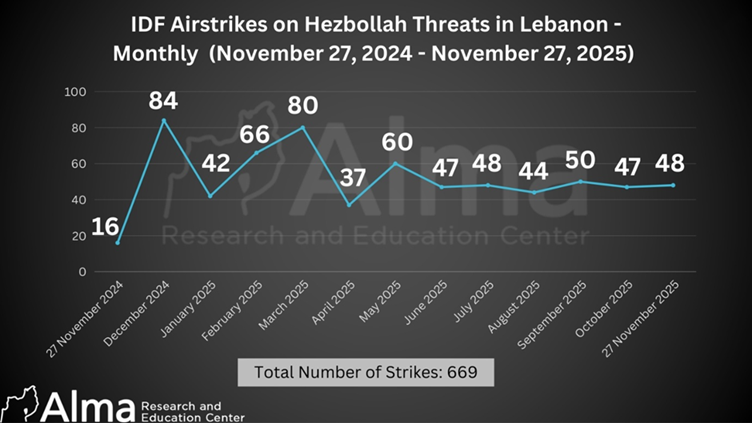
Since the beginning of the ceasefire, the IDF has carried out 669 strikes against Hezbollah targets in Lebanon. The average number of strikes is 51 per month, with December 2024 and March 2025 being the months with the highest number of strikes (84 in December and 80 in March). These increases were in response to firing incidents from Lebanon into Israeli territory, (on December 2 the firing of two mortar shells toward Har Dov, on March 16 the firing at a vehicle in the Avivim area, and on March 28, two launches from Lebanon toward Kiryat Shmona).
The months with the lowest number of strikes were January and April 2025.
Despite recent reports of an alleged escalation in strikes, since June 2025, the number of strikes has remained almost identical, at an average of 47 strikes per month.
Targeted Eliminations:
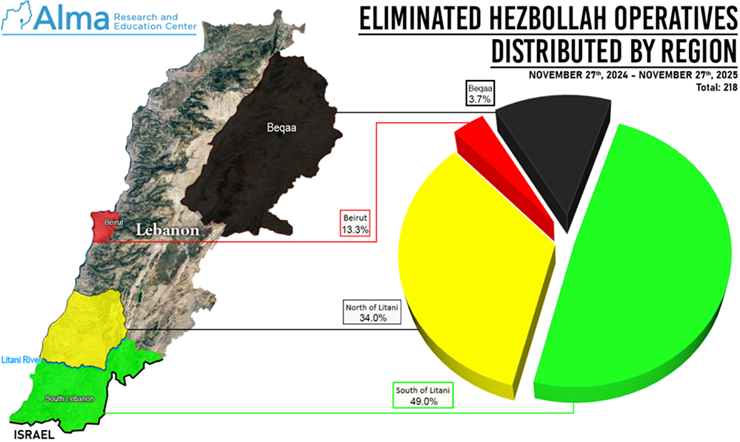
Since the ceasefire went into effect, 218 Hezbollah operatives have been eliminated, constituting about one-third of all IDF attacks in Lebanon. (While according to IDF publications approximately 350 operatives were eliminated, our analysis is based solely on the database of eliminated operatives whose details were published and verified from open sources):
34% of the eliminations were carried out north of the Litani (74 eliminations), 49% were carried out south of the Litani (107), 13.3% in the Bekaa (29), and 3.7% in Beirut (8).
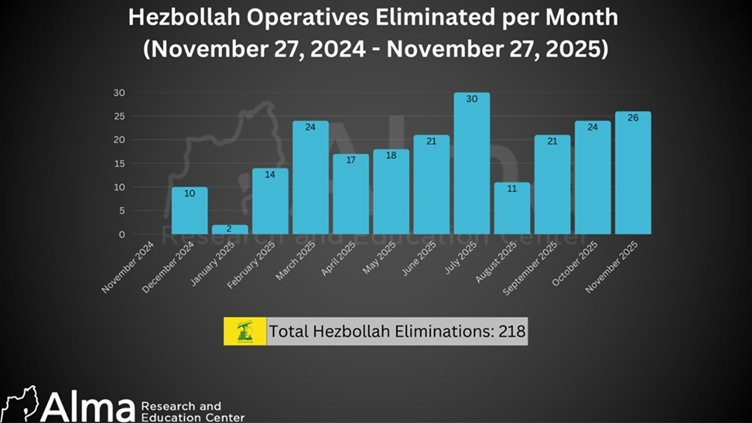
The data indicates that the eliminations can be divided into three periods, November 2024 till February 2025, months characterized by a low number of eliminations; from March 2025 till July 2025, a consistent increase is evident, continuing until the significant peak in July 2025 (30 eliminations); from September 2025 to November 2025, a gradual upward trend is evident. One possible reason for the drop in August (11 eliminations) is the visits of senior U.S. officials to Lebanon for discussions regarding the Hezbollah issue.
The most intense months in terms of Hezbollah operative eliminations are July and November 2025.
It must be considered that fluctuations in the number of operatives eliminated do not only reflect changes in operational activity intensity but also depend on intelligence availability.
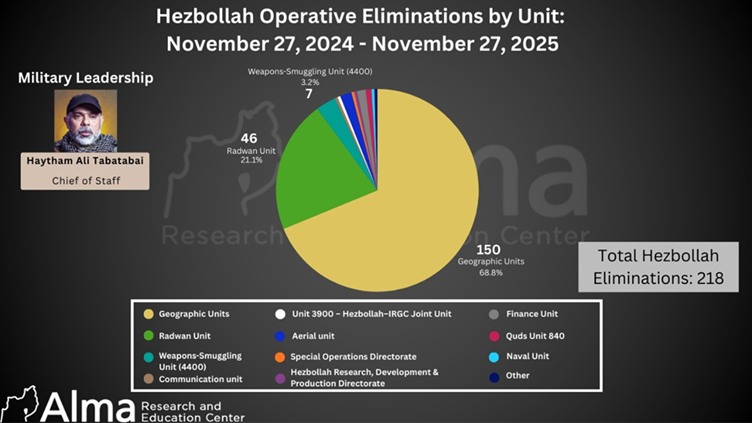
Most of the eliminated operatives belong to Hezbollah’s geographic units (Nasser, Aziz, and Badr), who operate in the field to reconstruct the organization’s infrastructures, transfer weapons for their preservation and rehabilitation, and gather intelligence.
Some operatives were also involved in civilian reconstruction and in many cases hold civilian roles (in parallel to military activity), such as engineers, educators, and municipal clerks. These individuals are “Rabats”, i.e. Hezbollah’s liaison personnel to local residents.
The distinction that some Lebanese, Arab, and international media outlets attempt to create between Hezbollah’s military and civilian activity is incorrect and misleading.
These activities are intertwined and together express the idea of Hezbollah’s “Resistance Society.”
During the year, 46 operatives from the Radwan Unit were eliminated (21% of all eliminated operatives). This unit is still considered Hezbollah’s central offensive unit and possesses the capability to conduct focused operations against Israel (see our article “Radwan Unit – Status and Readiness” published October 2025).
Furthermore, personnel belonging to Unit 4400 (responsible for smuggling and procurement), Unit 127 (the air unit), Hezbollah’s research, development, and production directorate, Unit 3900 (foreign operations), and Unit 840 of the Quds Force were eliminated. Several operatives from Hezbollah’s financial system were also eliminated, mainly those involved in foreign exchange, in order to weaken Hezbollah’s civil-economic activity.
The most senior operative eliminated since the beginning of the ceasefire is Haitham Ali Tabatabai, Hezbollah’s military commander ( Hezbollah’s Chief of Staff), eliminated in the Beirut strike ( November 23, 2025).
Geographic Breakdown of Strikes – Eliminations vs. Terror Infrastructure:
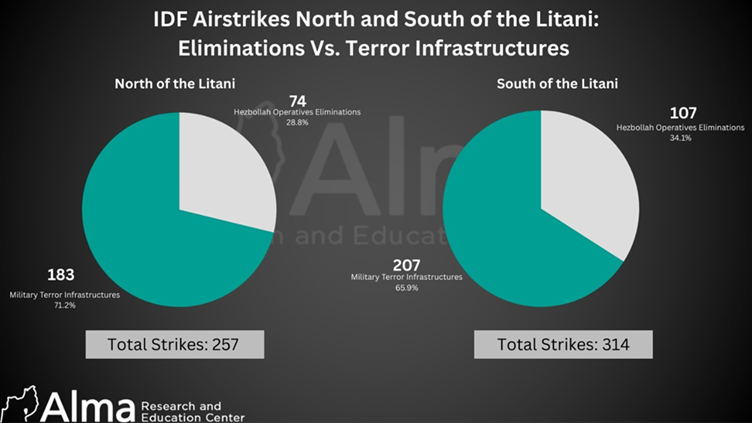
As noted, most of the strikes were carried out north and south of Litani. A comparison of IDF attacks from the north and south of the Litani indicates a consistent pattern of action, according to which most of the attacks are against Hezbollah terrorist infrastructure – 71.2% north of Litani and 65.9% south of it.
The percentage of eliminated operatives out of the total number of strikes in both areas is nearly identical and constitutes about one-third of all strikes.
Overall, out of 571 strikes in southern Lebanon (north and south of the Litani), 390 were directed at infrastructure, and 181 were targeted eliminations of operatives – this reflects a strategy combining systematic damage to the organization’s infrastructure alongside targeted eliminations based on intelligence opportunities.
Eliminations of Operatives from Additional Organizations:
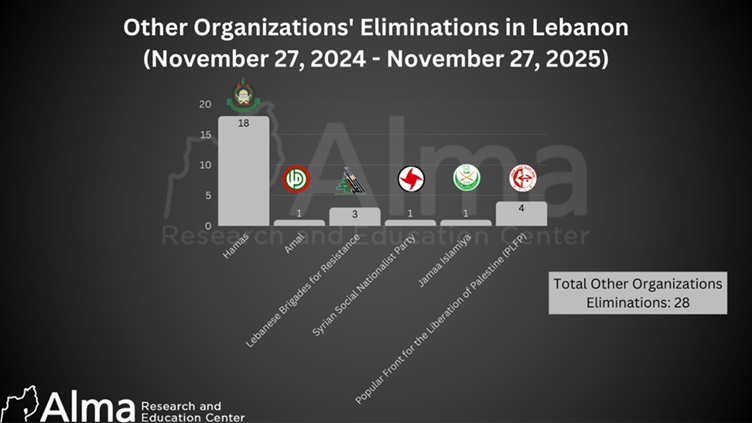
Aside from Hezbollah, several other terrorist organizations operate in Lebanon and are involved in fighting against Israel, although on a much smaller scale. Hamas stands out significantly above all others with 18 eliminated operatives, primarily due to the strike on November 18, 2025, in the Ein al-Hilweh refugee camp near Sidon, which targeted a Hamas training compound where 13 operatives were eliminated.
Other organizations — including Amal, the Lebanese Resistance Brigades, the Syrian Social Nationalist Party, Jamaa Islamiyya, and the Popular Front — appear with much lower numbers (1–4 eliminated per organization).
In total, there are 28 eliminated operatives from organizations other than Hezbollah. The involvement of additional organizations has decreased during the ceasefire compared to the wartime period. It is possible that part of their activity is independent while another part is conducted in cooperation with Hezbollah.
Offensive Ground Activity
The IDF is also operating on the ground against Hezbollah’s reconstruction attempts along the contact line, including in the villages of Houla, Meiss El Jabal, and Ayta ash Shab.
The permanent return of Lebanese residents to villages along the contact line with Israel constitutes a significant risk of civilians being used as human shields and creates potential for Hezbollah’s military reconstruction close to the border with Israel. At this stage, no permanent, continuous, or significant Hezbollah presence or activity is identified along the contact line. A permanent return of civilians to the border area will enable Hezbollah’s re-entrenchment along the border and poses a significant threat to northern Israeli communities. The presence of the IDF at the five strategic points along the border is essential for monitoring Hezbollah activity in the area and preventing its return to the contact line.
According to data revealed by the IDF on November 24, since the beginning of the ceasefire 1,200 ground raids have been carried out along the contact line.
Summary
Given the limited capabilities of the Lebanese government and the Lebanese Army to act toward disarming Hezbollah, the IDF is obligated to continue the policy of strikes and targeted eliminations against Hezbollah’s reconstruction efforts and its violations of the ceasefire agreement. Long-term weakening of the organization will be possible only through continuous damage to its military and civilian infrastructures.
Hezbollah is determined to renew its activity and presence in southern Lebanon, and it has the support of the Shiite base, which remains dependent on it for essential services (welfare, healthcare, education, food, electricity, and more). Therefore, diplomatic pressure alone is not sufficient to disarm the organization. Hezbollah has no intention of relinquishing its weapons without a struggle, and the Lebanese Army has neither the capabilities nor the will to enter into direct confrontation with the organization.
Hezbollah will not give up the ideology of “armed resistance,” and it is prepared for a long struggle, Israel’s strategy must therefore match this, demonstrating endurance, determination, and persistence.
Hezbollah, backed by Iran, is preparing for the next confrontation and the next war with Israel. This is not a question of “if,” but a question of “when.” Monitoring the strike data indicates accelerated reconstruction processes of offensive readiness and the development of independent strategic and operational capabilities, alongside the drawing of lessons from the last war.
Will the strikes against Hezbollah’s infrastructures and operatives, harsh as they may be, halt Hezbollah’s activity? Will Hezbollah truly disarm and “relinquish” the reconstruction of the Kalashnikov on its flag? Will it renounce “the resistance” and the restoration of its military arrays?
The answer is no.
Through a long-term strike policy across “the entire Lebanese arena,” Israel can weaken Hezbollah, make it as irrelevant as possible, and keep it as a relatively weak organization.
This policy must be carried out in cooperation with the United States, certain European countries, and states from the moderate Sunni bloc in the Middle East.
It must also include significant additional elements (not only kinetic strikes) that will damage Hezbollah’s reconstruction efforts and force-building.