
Tal Beeri and Dana Polak
Since Ahmad al-Shara’s ascent to power, relations between the new regime and the Kurds have remained highly strained, despite official efforts to portray them as moving toward regulation and integration. The agreement signed on March 10, 2025, intended to formalize the status of the SDF (Kurds) within state institutions, has not led to any tangible reduction in tensions. Instead, frictions and clashes continued to build, culminating about two weeks ago with the entry of al-Shara regime forces into Kurdish-controlled areas in northern Aleppo, followed by the expansion of the regime’s military focus to additional Kurdish-held territories in northeastern Syria.
In the background of these developments, and with a high probability, the military operation conducted by the al-Sharʿa regime is being carried out with political backing and full operational support from Turkey, a key supporter of the Syrian army, which views the dismantling of Kurdish power centers in Syria as a strategic objective aligned with its security interests along its southern border.
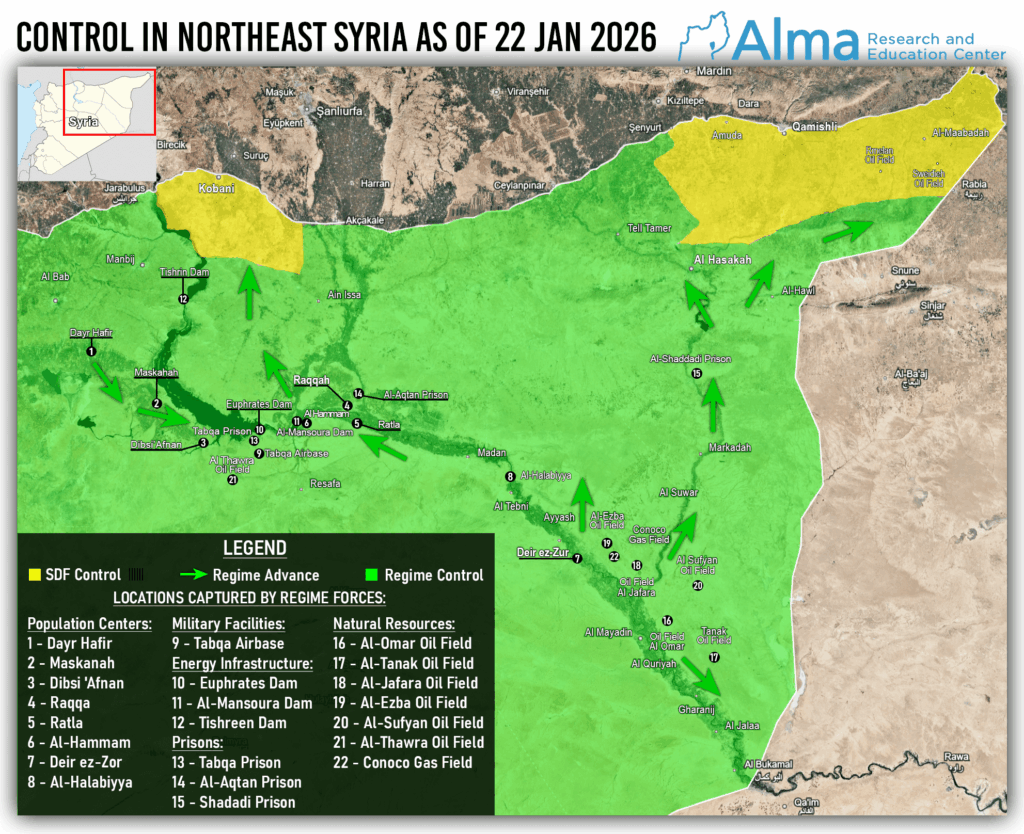
In recent days, regime forces have taken control of extensive areas in northeastern Syria that had been under SDF control and are now advancing toward the Kurds’ last and most significant strongholds—Kobani and Qamishli.
During the fighting, exchanges of fire between the two sides were documented, including the use of suicide UAV’s and improvised explosive devices. However, the fighting does not appear to have escalated into a broad military confrontation. In practice, SDF forces withdrew from most of the areas entered by regime forces, avoiding a comprehensive and direct campaign.
Sequence of Events
On January 16, preparations began as a preliminary stage for the operation, including a declaration of parts of the area as a closed military zone and the evacuation of tens of thousands of civilians from the Deir Hafir and Maskanah area (east of Aleppo) toward areas under Syrian regime control. The following day, on January 17, regime forces entered these areas, and Syrian internal security forces deployed in parallel with the army to establish control and stabilization. Regime forces took control of Jarrah Air Base, east of Deir Hafir, and began mine- and IED-clearing operations. At the same time, regime forces began advancing into Raqqa District.
On January 18, regime forces took control of al-Tabqa, including the military airfield and additional targets in the Raqqa area, as well as the Euphrates Dam (Tabqa Dam) and related facilities. In parallel, reports indicated the withdrawal of SDF forces from areas in Deir ez-Zor District and the expansion of government control in the western Euphrates region.
That same day, reports emerged of talks aimed at formulating a ceasefire agreement between al-Shara and Mazloum Abdi, commander of the SDF forces.
Despite reports regarding efforts to reach an agreement and implement a ceasefire, it was clear that the confrontations persisted. Multiple flashpoints emerged, primarily in Hasakah District and around ISIS detention facilities, which became a key measure of the area’s stability. At the same time, the Kurds called a general mobilization, and shortly thereafter videos circulated showing thousands of Kurds from Iraq and Turkey crossing the border to take part in the fighting against the Syrian regime.
On January 20, the Office of the President of Syria announced new understandings between the Syrian government and the SDF. The understandings included an immediate ceasefire (which at this stage is limited to four days) and the withdrawal of SDF forces from active friction areas, including a realignment east of the Euphrates River.
It also emerges that the understandings outline a broad process of dismantling the SDF as an independent military framework, alongside the integration of its fighters and personnel into the Syrian army and state institutions. As part of this, it was also determined that control over border crossings, oil and gas resources, and detention facilities for ISIS operatives would be transferred to the regime—a step with economic, security, and symbolic significance alike.
On the political-institutional level, it was reported that Abdi would propose a Kurdish candidate for the position of Deputy Syrian Minister of Defense, a move indicating an attempt to anchor formal Kurdish representation within the state security system. In addition, according to a statement by the Syrian Presidential Office, Kurdish villages will remain under Kurdish military control.
The difference between the new agreement and the March 10, 2025 agreement is expressed in the fact that the March agreement outlined a broad “road map” for institutional unification, whereas the agreement signed now was presented as a focused agreement, including faster steps and mechanisms for the actual transfer of control at key points—especially in areas sensitive from a security and economic perspective.
At the same time, it was reported that the Syrian government published steps intended to strengthen the integration of the Kurds within the state framework, including granting full Syrian citizenship, recognizing Kurdish as a national language, and declaring March 21 (Nowruz) an official national holiday in Syria and a paid day off. These reports present this as a political message aimed at enabling a broader basis for an arrangement with the SDF and creating internal and international legitimacy for the restoration of Damascus’s sovereignty over the northeast of the country.
Despite the declaration of a ceasefire, regime forces continue to advance toward the outskirts of the SDF’s last remaining strongholds—Kobani, al-Hasakah, and Qamishli.
On 21 January, under the cover of the ceasefire, the Syrian army continued its advance in the villages surrounding Kobani (Ayn al-Arab District). In parallel, further military advances were recorded by al-Sharaa’s forces and allied Arab tribal elements along the southern outskirts of al-Hasakah Governorate and on the periphery of the city of Kobani, which is currently under siege.
Strategic Infrastructure and Oil and Gas Fields
The western Euphrates area, which was the focus of the operation (Deir Hafir–Maskanah–Dabsi Afnan–Tabqa–Raqqa), is characterized by a high concentration of strategic infrastructure, whose importance goes beyond the military-tactical context. The regime’s main operational emphasis was placed on controlling oil and gas fields, major transportation routes, Jarrah Base, the Tabqa area (including the airfield), and the Euphrates Dam. These are critical assets, as the Euphrates Dam and Tabqa infrastructure constitute a fundamental component of Syria’s energy and water system and directly affect the supply of electricity and water on both national and regional scales.
Syrian regime forces succeeded in taking control of several key energy assets, including the al-Omar field (حقل العمر النفطي)—the third-largest oil field in Syria—as well as the Conoco gas field (حقل كونيكو للغاز). The regime also took control of the al-Tanak oil field (حقل التنك النفطي), al-Jafra oil field (حقل الجفرة النفطي), al-Izba oil field (حقل العزبة النفطي), the Safiyan field (حقل صفيان النفطي), and the al-Thawra field (حقل الثورة النفطي).
However, two significant oil fields remained in Kurdish hands—Suwaydiyah and Rumailan—with the SDF headquarters also located at the Rumailan field.
Northeastern Syria concentrates the bulk of the country’s oil production, with approximately 90% of current production coming from this area. Regime control over the oil fields reduces the Kurds’ sources of income, which over the years generated considerable profits from their control of the energy sector in the northeast of the country. Therefore, the question of control over oil and gas fields is not only an economic component, but a key element in the struggle over the balance of power, stability, and governing capability in Syria as a whole.
The Fighting Forces
As part of the operation against the Kurds, various units of the Syrian army are operating, deploying infantry, artillery, armored forces, mine clearance and disposal units, and additional support elements. These are complemented by Internal Security Forces that entered urban areas following withdrawals in order to establish stabilization and control. The most prominent divisions involved include:
- Division 76, considered pro-Turkish and composed predominantly of Turkmen fighters.
- Division 72, formed through the unification of pro-Turkish rebel factions (SNA – Syrian National Army). This division is supported by and cooperates closely with the Turkish army, and its fighters also took part in the events in Suwayda Governorate in July 2025.
- Division 86, which likewise operates with Turkish backing, and whose fighters also were previously part of the pro-Turkish Syrian National Army (SNA).
For a detailed overview of Syrian army units, see the special report we published: The New Syrian Army.
The connection to Turkey is not incidental. Turkey has a clear strategic interest in acting against Kurdish forces along its border, and with a very high degree of probability, the operation is being conducted with full Turkish backing and operational support.
Alongside these forces, Arab tribal elements known as the “Sanadid Shammar” fighters (صناديد شمر) are also operating. These tribes were previously aligned with the SDF but have since shifted their support to the al-Shara regime.
On the Kurdish side, the main military body within the Syrian Democratic Forces (SDF) is the YPG, a Kurdish militia established during 2014 as part of the war against ISIS and estimated to number up to approximately 50,000 fighters. Alongside it operates the YPJ unit, composed of Kurdish female fighters. In addition, several other smaller organizations and coalitions operate. The most prominent among them is the Jaysh al-Thuwar alliance, which includes the Kurdish Front, the Seljuk Brigade, Brigade 99, Sultan Selim Brigade, Ahrar al-Zawiya, and others. These include additional Kurdish and Arab organizations as well as various minorities (Turkmen, Assyrians, Syriacs, and others). The number of combatants operating within these frameworks is estimated at several thousand.
Delegitimization of the Kurds
The al-Shara regime is making a concerted effort to secure international legitimacy for its military and security operations against the Kurds, framing them as part of a sovereign campaign to reassert full territorial control over the state. To this end, it is waging an extensive media and influence effort designed to portray its actions as a security imperative while reducing the scope for international criticism.
Within this framework, selected journalists and media figures are granted access to combat zones and areas recently taken from Kurdish control. This is intended to project images of order, authority, and restored sovereignty, while advancing a narrative that casts SDF military activity as a source of instability, security disorder, and civilian harm. Through this approach, the regime aims to undermine the legitimacy of Kurdish military actions and erode their standing as a credible partner in the fight against ISIS in the eyes of the international community.
It is evident that the al-Shara regime has drawn lessons from the harsh international criticism following the severe violent events against the Alawites on the Syrian coast (March 2025) and against the Druze in the Suwayda area (July 2025). Accordingly, it now takes care to present a pattern of action that appears institutionalized, controlled, and legitimate, emphasizing discipline, a chain of command, and ostensible adherence to accepted rules of warfare. However, behind the reputational façade, many jihadist elements are embedded within the regime’s security forces and army, having undergone a rebranding process and been integrated as organic units within state mechanisms.
In practice, the extreme ideology of these elements continues to serve as a central scheme for their operational conduct. Although during the current operation the forces strictly enforced a ban on photographing and publishing their actions, the materials that were published clearly reveal a violent and extreme ideological character that illustrates the gap between the official narrative promoted by the regime and the actual patterns of action on the ground. This gap raises doubts regarding the ability—or willingness—of the al-Shara regime to restrain the forces operating on its behalf over time, despite the considerable efforts it invests in establishing external legitimacy.
In footage released since regime forces entered the northern neighborhoods of the city of Aleppo approximately two weeks ago and up to the time of writing, scenes have emerged showing the humiliation and abuse of Kurdish men and women—some of whom were likely fighters—who were captured, the execution of detainees, the burning of bodies, the throwing of bodies from balconies, and harm to civilians, including wounded women and children who were unable to flee the fighting zones.
In addition, a video was published showing a Syrian soldier or internal security personnel smashing gravestones in a Kurdish cemetery in the al-Hasakah area. There were also reports of ISIS flags being raised upon the entry of regime forces into the village of al-Karama, east of the city of al-Raqqa.
Implications of the Kurdish–Regime Confrontation on ISIS and the Stability of Northeastern Syria
The Kurdish forces constituted the main fighting force in the struggle against ISIS in recent years, under the auspices of the international coalition led by the United States. Within this framework, major detention facilities were established and operated in areas under their control, holding thousands of ISIS operatives, and constituting a sensitive component with regional and international security significance.
Against the background of the latest round of confrontations, reports emerged of the escape or release of hundreds of ISIS operatives from prisons. According to the Kurdish narrative, the loss of control occurred following the entrance of Syrian army forces into the area, which undermined the security mechanism. Conversely, regime sources claimed that the Kurds themselves released the prisoners, and that this event served as a central pretext for the entry of regime forces. As of the time of writing, the re-arrest of 81 ISIS operatives has been reported.
ISIS is currently regarded as one of the central drivers of instability in Syria and continues to carry out terrorist activity against the regime. According to several reports, the organization even attempted to assassinate al-Shara himself a few months ago.
There is no doubt that a scenario in which large numbers of ISIS operatives are released from detention facilities would strengthen the organization’s terrorist infrastructure in Syria. At present, ISIS operates in Syria primarily in the eastern regions, in the south—particularly in Daraa Governorate—and in the Damascus area. Veteran and experienced ISIS operatives released from prisons would significantly reinforce ISIS’s force buildup in Syria in general, and in southern Syria in particular.
In southern Syria, ISIS constitutes a direct tactical threat to the buffer zone and the Israeli border, where there is a physical Israeli presence. Relatively small ISIS cells are capable of operating against Israeli forces through various modes of terrorism, including small-arms fire, improvised explosive devices, and even physical infiltration into Israeli territory.
The prisons that came under Syrian regime control are: Tabqa Prison (سجن الطبقة), Shaddadi Prison (سجن الشدادي), and al-Aqtan Prison (سجن الأقطان). In addition, the regime took control of al-Hol Camp (مخيم الهول للاجئين), a refugee camp containing 40–50k women and children of ISIS operatives families held in the nearby Shaddadi and al-Aqtan prisons.
The chaos resulting from the fighting between the Syrian regime’s security forces and army and the Kurds (SDF) in northeastern Syria has created a security vacuum that ISIS is already exploiting. The Kurds constituted the effective “boots on the ground” force to curb ISIS’s resurgence in northeastern Syria and to physically guard the detention camps in which thousands of ISIS fighters have been held in recent years. The Kurds were committed to this task.
Will the al-Shara regime security forces, having recently taken control of most areas formerly held by the Kurds, that include elements influenced by extreme Islamist ideologies associated with the “ISIS family,” some of whom openly identify with ISIS—demonstrate the same level of commitment to this mission? Although the al-Shara regime is aggressively pursuing full territorial control throughout Syria, with the support of Western states that see this as a pathway to stability, it appears that one of the most capable and dedicated forces confronting ISIS has been sidelined. This development is likely to weaken prospects for stability in Syria. It is also important to note that the Kurds functioned as a buffer against potential Iranian activity in northeastern Syria, including smuggling networks, influence operations, and related efforts. Whether that restraining role will persist remains an open question.
It is possible that the U.S. intention, reported on 21 January, to transfer ISIS detainees from the aforementioned detention facilities to Iraqi territory indicates that, despite publicly and formally supporting and backing the al-Shara regime, the American administration does not yet fully trust it with regard to securing these prisons and guarding the ISIS prisoners held within them. This assessment appears to stem from an understanding that some units of the Syrian army and security forces are driven by ideological currents similar to, or even identical with, those of ISIS.



One Response
Dear Tal and Dana,
Thank you for reporting on these critical issues taking place in Syria. My assessment is that al Sharra is a jihaddist terrorist snake puppet of a larger turkish muslim brotherhood radical jihaddist mother python.
The good forces of the Kurds are being confronted with both disinformation lies and isis jihaddists originating from both the snake and the mother python with connections to the qatari aljazeera snake venom empire of islamonazi propaganda lies. The current turkish regime, the current qatari regime, and the current syrian regime are all ideologically the sworn enemies of Israel and the enemies of peace and stability in the region. BE NOT DECEIVED!!!
Secular humanistic exultation of man above G_d is delusional, just as jihaddist sharia law to dominate the world is delusional. G_d rules in the affairs of men to execute Judgement and Justice in all the earth.