
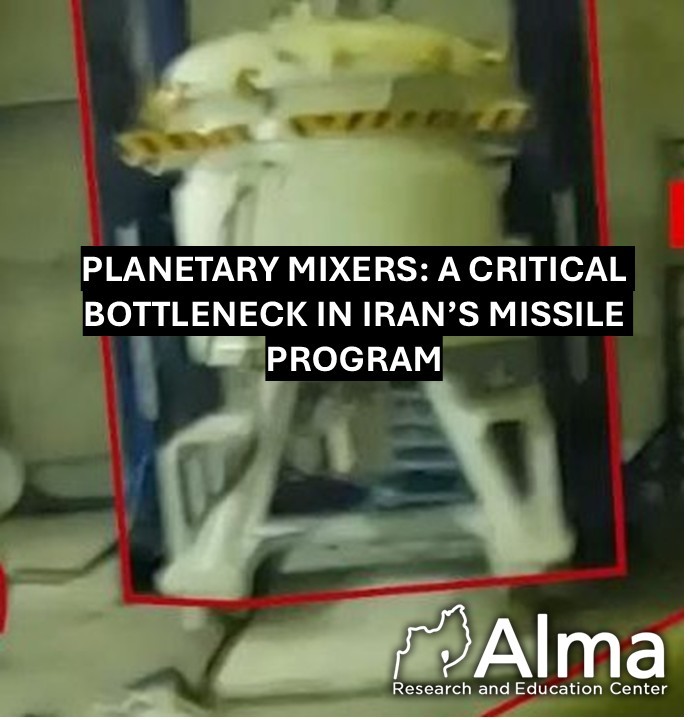
United States Special Forces reportedly raided a cargo ship in the Indian Ocean during the month of December 2025, targeting a ship that was making its way from China to Iran, and seized military cargo intended for the Islamic Revolutionary Guard Corps.
The report on this naval raid, which joins reports of shipments of planetary mixers being foiled – shipments that departed China and did not reach their destination – exposes the depth of the industrial crisis in which Tehran finds itself and its great dependence on the Chinese supply chain to rebuild its strategic military capabilities.
A mixer of this type is critical for the creation of solid fuel, which a significant aspect of Iranian long-range ballistic missiles that are relevant for striking Isra theel, require, such as:
- “Fattah 1” (apparently hypersonic) with a range of approximately 1,500 kilometers.
- “Kheibar Shekan” with a range of approximately 1,500 kilometers.
- “Haj Qasem” with a range of approximately 1,500 kilometers.
- “Sejjil” with a range of approximately 2,000 kilometers.
The industrial planetary mixer is the technological heart of the solid fuel production process for these missiles.
Iranian long-range ballistic missiles that rely on liquid fuel (rather than solid) require more complex fueling and chemical mixtures prior to launch, compared to solid-fuel missiles, which are simpler and faster to launch.
The slower and more cumbersome the pre-launch preparation of the missile, the higher the chance that intelligence coverage will detect the preparation stages and foil the launch. Hence the increased value of solid-fuel missiles and the planetary mixers that produce their fuel.
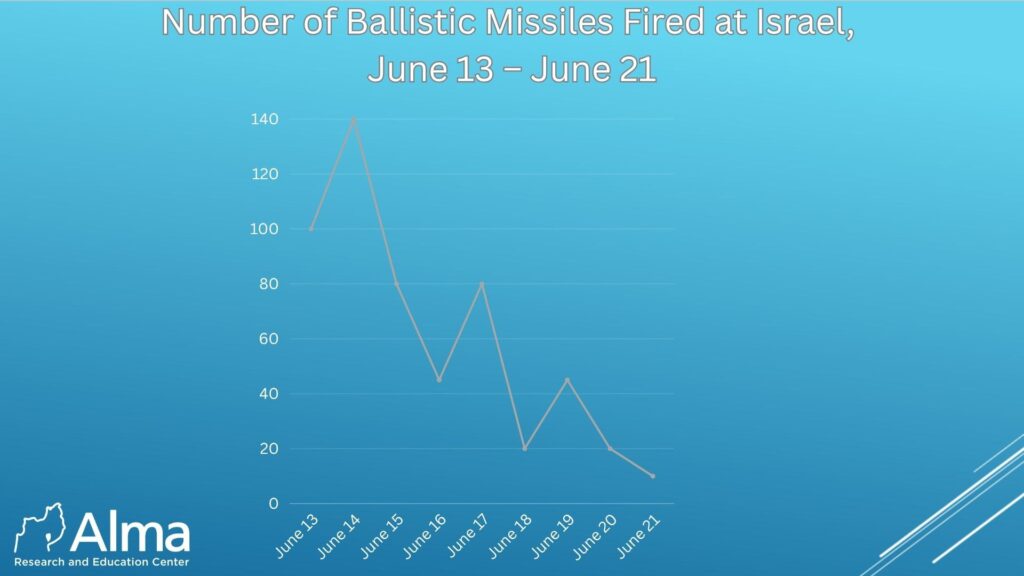
For example, from June 13, 2025, the start of the war with Iran, until June 21, 2025, Iran launched more than 500 ballistic missiles toward major cities in Israel.
From an analysis of the data regarding the number of missiles launched at Israel daily, it can be seen that in the first two days, Iran launched heavy barrages of 100 missiles and more.
Since then, a downward trend was observed (single digits to tens of missiles).
The downward trend in launches also stemmed from the cumbersome launch preparation process for liquid-fuel missiles, a process which encountered, as noted, an intelligence interdiction capability that improved during the fighting.
This capability yielded a concentrated offensive effort by the Israeli Air Force against missile launch arrays deployed in Iran.
Iran, which lost in the June 2025 campaign dubbed Operation Rising Lion between a third to half of the ballistic missile arsenal it had prior to the operation (the Iranian arsenal before June 2025 contained about 2,500 ballistic missiles), and lost about two-thirds of its launch capabilities (about 250 launchers were destroyed), is currently managing an arms race in an attempt to rebuild its missile inventory.
Before the campaign in June 2025, the IDF assessment was that Iran aspired to amass an arsenal of about 8,000 ballistic missiles, which would have posed a conventional existential threat to Israel.
Recently, this assessment was joined by a report in the Iran International website, identified with the Iranian opposition, stating that the IRGC Air Force is working on developing unconventional warheads for ballistic missiles – chemical and biological.
It is reasonable to assume that intelligence regarding the progress of the Iranian missile program and attempts to smuggle the program’s components is a subject of close coordination between the intelligence communities of Israel and the US.
It is possible that the meeting between Prime Minister Netanyahu and President Trump in Florida, on December 30, 2025, dealt among other things with coordinating positions and agreeing on criteria that would constitute a trigger for an additional Israeli strike on Iranian production sites, with US consent.
Already on October 26, 2024, in the Israeli strike in Iran that occurred in that month, at least 12 planetary mixers were reportedly destroyed, a blow that set back the Iranian missile production program.
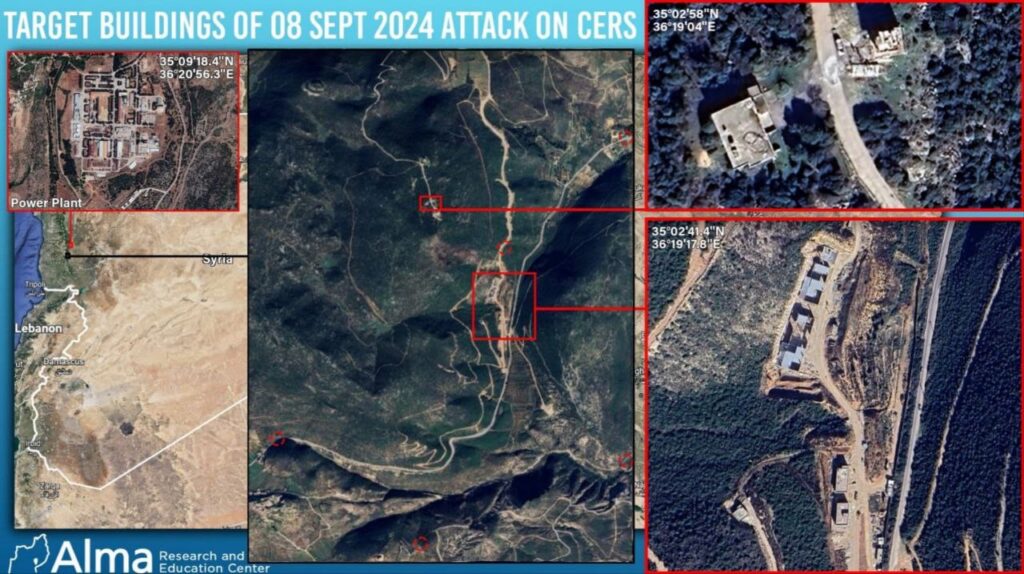
Even before the outbreak of the war in October 2023, as part of the Iranian desire to streamline missile production processes and shorten logistical ranges, planetary mixers were transferred to Syrian soil (Institute 4000 at CERS) and into the hands of Hezbollah in Lebanon.
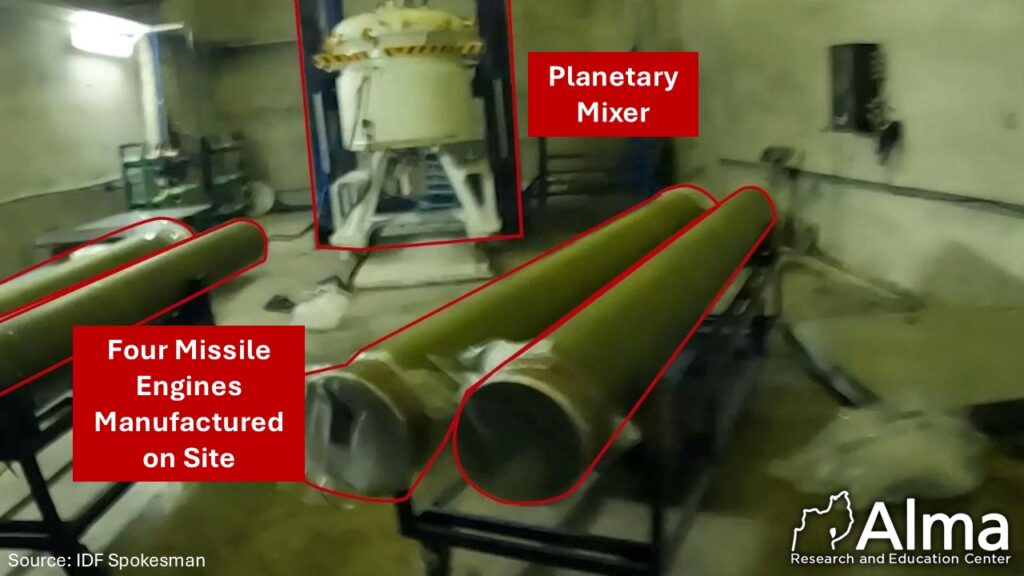
On September 8, 2024, an Israeli commando raid was carried out on a weapons development site of CERS (Institute 4000) in Masyaf, which was under the control of the Shiite axis in Syria. In the raid, precision components for missile production were destroyed, including a planetary mixer and four missile engines.
In August 2019, according to various reports, an attack drone destroyed a planetary mixer in the Dahiyeh district in Beirut, minutes before it was transferred to an underground Hezbollah production site.
In 2020, according to Lebanese reports, a ship carrying a replacement planetary mixer was attacked by the Israeli Navy while it was on its way to Lebanon.
The Chinese smuggling route: Economic and technological oxygen
Against the backdrop of the destruction of local production infrastructure, it appears that Iran turned to China with an urgent request for assistance.
China, which purchases around 90% of Iranian oil and thereby provides the regime with the necessary funding for military reconstruction, now serves as the almost exclusive supplier of critical components.
According to a number of reports, in recent months around 10 to 12 maritime shipments were identified departing from China to the central port in Iran – Bandar Abbas port.
The shipments carried some 2,000 tons of Sodium Perchlorate – a key component in the production of solid fuel.
The use of Sodium Perchlorate, which is not subject to tight supervision like Ammonium Perchlorate, allows China and the companies involved a certain space of deniability vis-à-vis the sanctions regime.
Parallel to the industrial reconstruction efforts, the Israeli defense establishment was recently forced to raise alertness due to signs of unusual Iranian missile activity.
According to a report in Axios, in late December 2025, the IDF Chief of Staff, Lt. Gen. Eyal Zamir, held an urgent conversation with the Commander of US Central Command (CENTCOM), Admiral Brad Cooper. Zamir warned of a scenario – although not considered probable – that a widespread missile exercise announced by the IRGC could constitute a cover for preparations for a surprise attack against Israel.
The Israeli warning was based on intelligence that identified unusual movements of missile forces, UAVs, and air defense arrays, as deviating from known patterns of routine training. This warning reflects Israel’s high threshold of sensitivity following October 7, 2023, and the concern that Iran will try to exploit the transition period or divided global attention to carry out a strategic ‘snatch.’ This concern was raised further in light of the instability rocking Iran domestically in recent days, although the scenario still appears less than likely. Iran is focused on rebuilding capabilities.
According to several reports, analysis of commercial satellite imagery (Planet Labs) confirms that Iran has begun rebuilding at missile production sites damaged in Parchin, Khojir, and Shahroud, where solid fuel production factories are located.
However, the restoration of the structures (“the envelope”) is the simple part; the real challenge remains obtaining the planetary mixers.
As long as Iran does not succeed in smuggling or finding a way to manufacture a significant number of planetary mixers, its production capability will remain limited regarding the ability to fuel the missiles that require solid fuel, and these are the missiles Iran needs to try to build a rapid launch capability with a reduced chance of early Israeli detection.
The Iranian Foreign Ministry, via spokesman Esmaeil Baghaei, continues to rebuff any attempt to include the missile program in diplomatic negotiations, claiming it is intended solely for the defense of Iranian sovereignty.
These declarations, alongside threats from senior leadership (Supreme Leader Khamenei and down) and commanders in the IRGC of a “severe response” to any aggression, are intended to cover up the temporary weakness created in the regime’s main offensive array.
Operational Implications and Conclusions
The campaign over the planetary mixers is effectively the campaign for the rate of fire in the next war.
The ability of Israel and the United States to monitor, identify, and foil equipment shipments from China, whether at sea, at destination ports, or via land and air routes, is a critical factor that will influence the pace of Iran’s rearmament.
The assumption that Iran lacks the ability to manufacture planetary mixers should also be taken with a grain of salt when dealing with such a large country with a large pool of talented engineers and raw materials.
In the meantime, it appears that the damage to domestic production is forcing Iran to rely on long and vulnerable supply chains, which creates additional intelligence and operational opportunities for Israel.
However, Iranian determination, backed by China’s economic and strategic interest, requires constant vigilance.
Every shipment that slips through the interdiction net will translate directly into hundreds of ballistic missiles that will be directed against the Israeli home front.
Every such shipment will shorten the rehabilitation time of the Iranian production capability, which was damaged by Israeli strikes in 2024 and 2025.




4 Responses
Amazing detail. Please keep this reporting coming
Dear Yaakov,
Thanks for the timely updates about the evil intentions and attempts by the islamonazi ayatollah regime to quickly rebuild their ballistic missile arsenal with Chinese support for attacking Israel again. The time has come to crush the head of the ayatollah snake, destroy the IRGC forces loyal to him, and expose the “x king pin” in China. I propose an opportunity for free and fair elections in mainland China with international verification and monitoring, to endorse a “One China” reunification by the adoption of a free and liberated mainland China ruled as a constitutional republic with the rejection of the dictates of the CCP entirely. “Proclaim Liberty Throughout All the Land unto All the Inhabitants Thereof.”
Every US reaction to Israel/Iran, Ukraine/Russia and Latin America is carefully assessed and calibrated by China in the context of taking over Taiwan.
Dear Steven,
The Chinese CCP wobbling delusional empire is about to collapse along with its nefarious dictatorship allies. The x king pin is living in fear. Look at his ally Putin, the three day special operation they were scheming to execute is about to collapse the entire empire of lies and disinformation into a joint economic black hole of self destruction. The CCP is structurally comparable to the islamic republic, and is also destabilizing. Putin bragged he could take out president Zelenski in three days. Ha Ha!!! Trump sent USA Armed Forces to Venezuela and took out the narcoterrorist Maduro in three hours!!! No wonder “Kim gone soon”, the “Poo tin”, and the “x king pin” are shaking in their boots!!!