
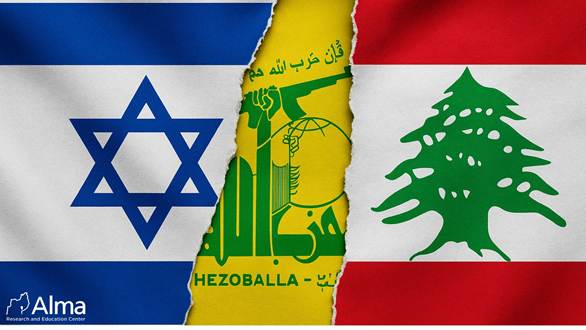
On 4 December, Israel and Lebanon sent civilian representatives to direct talks between the two countries. On the Israeli side, the acting head of the National Security Council, Gil Reich, participated, and on the Lebanese side, Simon Karam, former Lebanese ambassador to the United States, participated.
The announcement that representatives would be sent was preceded by Lebanese President Joseph Aoun’s call for direct or indirect negotiations with Israel in order to reach a security agreement. This came following reports in recent weeks of a possible escalation in Israeli strikes against Hezbollah and the Lebanese government’s failure to dismantle Hezbollah’s weapons. In addition, American pressure on both sides to hold talks also led to the decision to send civilian representatives to conduct direct talks.
It is important to note that in Lebanon there is a law prohibiting any cooperation or contact with Israel, which is defined as an enemy state. Therefore, to date, military representatives have been sent to discuss operational matters only, through a third party, and no direct diplomatic channels of communication have existed between Israel and Lebanon.
The statement issued by Israel’s Prime Minister’s Office described the move as a “historic development” and a diplomatic and economic opportunity for Lebanon. By contrast, Lebanon’s Prime Minister, Nawaf Salam, was quick to temper the enthusiasm and stressed that these were not talks about normalization or economic ties with Israel but only talks about preventing escalation and security arrangements.
Opening a diplomatic channel with Lebanon is primarily a symbolic act. As long as Hezbollah remains in Lebanon, the chances of reaching a normalization agreement between Israel and Lebanon are negligible to non-existent. The chances of reaching a security agreement that would be acceptable to both sides are very small. First and foremost, any security arrangement the sides reach must include a credible monitoring mechanism to ensure that the Lebanese government meets its commitments and does not allow Hezbollah’s rehabilitation. Second, alongside diplomatic moves Israel must continue its policy of strikes against Hezbollah, because Hezbollah will not disarm and its rehabilitation will continue. While the strikes are the main pressure lever pushing the Lebanese government to the negotiating table, the Lebanese government will likely insist on a halt to the strikes and an Israeli withdrawal from five strategic points along the border as a precondition for any agreement. Therefore, it is likely that the sides will find it difficult to reach an understanding on these points.
Are there nevertheless advantages to diplomacy? The Lebanese government is struggling, to say the least, to meet its commitment to disarm Hezbollah. Israel is indeed acting on an ongoing basis against Hezbollah’s rehabilitation efforts, mainly through airstrikes, and as we have already published, it should pursue a policy of strategic weakening against Hezbollah for an indefinite period, with further rounds of escalation of varying intensity against Hezbollah. At the same time, diplomacy can advance a range of steps against Hezbollah in the regional and international arenas and support the campaign of strikes:
- Direct talks with Lebanon, mediated by the United States and perhaps also involving local actors such as Egypt, which is already working to advance a solution, or Saudi Arabia, can strengthen the authority of the Lebanese government and weaken Hezbollah’s legitimacy. Hezbollah’s power stems not only from its military capabilities but also from its political influence in Lebanon and the civilian support of its Shiite base. Direct talks between Israel and Lebanon, held despite Hezbollah’s opposition, that lead to understandings and cooperation between the two countries (even if, for now, only in the security sphere) can isolate Hezbollah, make it less relevant, and expose it as an organization that has lost its political and regional influence. Regional and international backing for the Lebanese government also strengthens its ability to act against Hezbollah and weaken its political and economic grip in Lebanon.
- Israel needs a long-term strategy on the Lebanon border—the passage of time works in Hezbollah’s favor, as it exploits every opportunity to rebuild its capabilities. Israel’s daily strikes against the organization’s infrastructure rehabilitation do weaken it, but they cannot uproot the problem at its root—namely, undermining Hezbollah’s political/economic/civilian power. Only a political solution that incorporates the Lebanese government, regional actors, and the international community can advance comprehensive steps against Hezbollah and its dismantling as an organization and not merely address its weapons.
- A regional perspective – At a time when regional actors such as Turkey, Qatar, and Saudi Arabia are making every effort to increase their involvement and control in weak states in the region such as Syria and Lebanon, Israel cannot afford to miss opportunities to develop diplomatic channels with these countries, work to create balance in regional relations, and prevent the entrenchment of new threats on the border.
- Strengthening Lebanon’s economy – Hezbollah has a dependent base that continues to support it because the Lebanese government is unable to provide essential services to all its citizens. Any economic cooperation with the Lebanese government (even indirect or unofficial) that enables it to offer Shiite citizens alternative civilian services instead of Hezbollah has the potential to undermine the base’s support for Hezbollah and weaken the organization’s existence as a state within a state and limit its freedom of action in Lebanon.
- Containing Iran’s influence – Establishing diplomatic, economic, and security arrangements with countries in the region will help contain Iran and weaken its influence. Israel should promote understandings and cooperation with actors in the region that oppose Iran in order to prevent the rehabilitation of the Shiite axis. Iran relies not only on military capabilities but also on extensive “soft power” (civilian, economic, educational activity and diplomacy) to strengthen its control and influence in the region. Containing Iran requires sophisticated diplomacy by regional countries and complex cooperation across multiple arenas.
- The international arena – Direct negotiations and Israel’s willingness to reach a political agreement will help Israel strengthen its international standing and image.
Negotiations with Israel may perhaps help weaken Hezbollah, mainly politically, and isolate it. But the significant challenges to the diplomatic track must also be taken into account:
- The main risk – Increased international pressure on Israel to halt/scale back the strikes and withdraw from the five points, which would allow Hezbollah to recover and rebuild its military strength. It must be ensured that in the name of negotiations or agreements, with no guarantees that they will be upheld, Israel does not give up its security, as has already happened in the past, both in the Lebanese arena and in other arenas.
- The Shiite outlook is based on survival and separatism, “Us against the world.” Increasing diplomatic pressure may only strengthen solidarity and support among Hezbollah’s Shiite base and lead to the opposite result from what is desired.
- Hezbollah (and its Shiite partner, Amal) still has representation in the Lebanese government that can prevent, or at least make it very difficult, any attempt to reach an arrangement with Israel. Hezbollah’s leader, Naim Qassem, responded sharply to the Lebanese government’s decision to send a civilian representative and opposed any agreement other than a halt to the strikes and a full Israeli withdrawal.
- In order to advance real cooperation between Israel and Lebanon, Lebanon would need to designate Hezbollah as a terrorist organization—a step that is highly unlikely to happen.
- The Lebanese government still maintains diplomatic ties with Iran. Will Lebanon close Iran’s embassy in Beirut and cut its diplomatic ties with Iran? The answer is probably no. Lebanon enables Iran’s continued influence and interference in Lebanon’s internal affairs. Iran will act to thwart any diplomatic effort to improve relations between Israel and Lebanon and harm Hezbollah.
In conclusion, Israel cannot forgo its military activity in Lebanon. However, alongside the military activity and in parallel to it, Israel needs to promote a policy guided by long-term strategic thinking and a regional perspective. Therefore, opening a direct diplomatic channel with Lebanon is an important step. Yet alongside the advantages of negotiations, there are quite a few challenges, and the likelihood that the sides will be able to bridge the gaps and reach understandings is not high.




One Response
Dear Dr Zoe,
The long term strategy must be that hezbollah must be totally disarmed, or it will be totally destroyed. Any presence of hezbollah is a direct threat to both Lebanon and Israel, and the world.