The intensification of pressure and oversight on Hezbollah’s financial apparatus places the organization before a significant challenge in a non-military arena: preserving the legitimacy, dependence, and loyalty of its support base. In recent months, there have ostensibly been signs that Hezbollah is struggling to meet its financial obligations – foremost among them the provision of compensation and assistance to families affected by the war – and that it is being forced to adapt to a more complex financial reality.
Do the recent developments reflect merely a temporary cash-flow difficulty, or might they indicate structural erosion in the economic mechanism upon which Hezbollah’s social and political power rests?
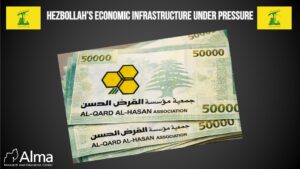
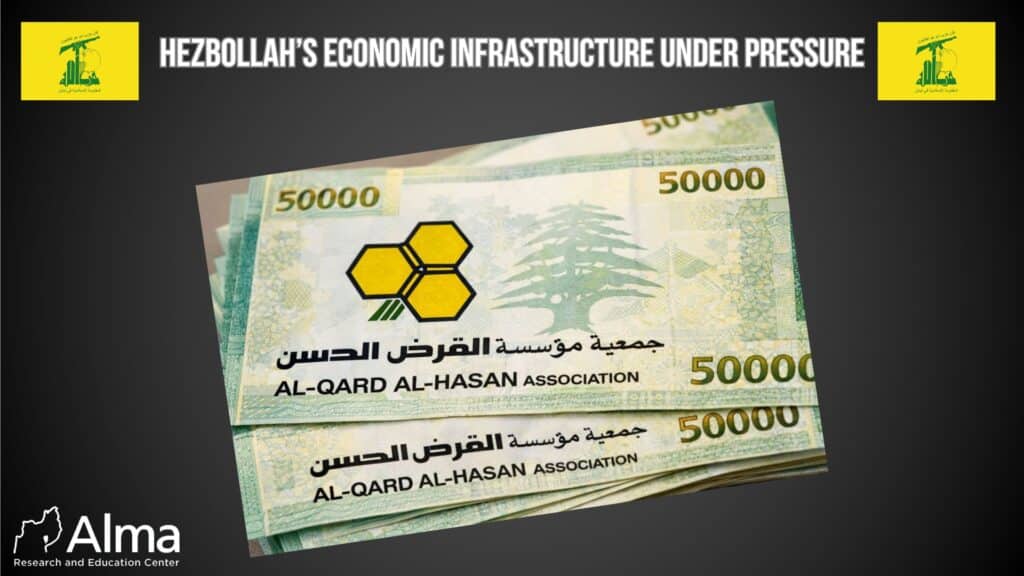
Conflicting reports published in recent weeks underscore the depth of the uncertainty. On February 6, it was reported that Al-Qard Al-Hasan institution would resume compensation payments to families whose homes were destroyed. Yet only days later, on February 9, it was reported that Al-Qard Al-Hasan was freezing all payments related to war compensation. Invoices for reconstruction, furnishings, and housing remained suspended, with no clear timeline for the resumption of transfers. According to the reports, an internal review found that the volume of funds already disbursed had exceeded the institution’s current financial capacity, leading to a temporary freeze on all obligations.
Does this necessarily indicate an absolute lack of resources? Not necessarily. It may reflect growing difficulty in carrying out financial transfers under a regime of sanctions and close monitoring. In other words, the problem is not only “how much money there is,” but “how much money can be moved.” This highlights the real challenge: damage to the operational capacity of the parallel financial system that Hezbollah has built over the years as an alternative to the official banking system.
On February 10, it was reported that Hezbollah had begun a process of reorganizing its economic system. According to assessments, Hezbollah is expected to move toward a more decentralized model, in which its institutions would operate within independent and more limited budgetary frameworks, rather than relying on a single central fund. Such a move may indicate an attempt to reduce risks and disperse exposure under sanctions pressure, but also a strategic constraint resulting from the narrowing of its financial freedom of action.
In contrast to reports of frozen payments, the organization’s Secretary-General, Naim Qassem, announced in a statement on February 10 that Hezbollah would fund three months of housing for families whose homes were destroyed, even though, according to him, this is the responsibility of the state. This statement reflects a clear perceptual effort to preserve the organization’s image as a protective actor and provider of welfare.
Alongside these developments, the U.S. Department of the Treasury announced a new sanctions package on February 12. The package targets Hezbollah financing networks operating through Lebanon’s informal economy, as well as along international channels in Turkey and Russia and in coordination with Iran. Unlike previous measures that focused on external channels, the message this time is clear: the objective is also to dismantle the local economic base that enables the organization to maintain political and social influence. Among the targets are actors linked to the gold trade and socio-financial institutions, foremost among them Al-Qard Al-Hasan.
The public response in Lebanon reflects the depth of concern. On February 13, it was reported that citizens approached Al-Qard Al-Hasan institution seeking to quickly redeem gold deposited as collateral for loans and to fully settle their debts. Gold has become a central anchor of the parallel economy following the collapse of Lebanon’s banking system. The accelerated redemptions reflect growing sensitivity among the Shiite public in Lebanon, which depends on Hezbollah’s service network, and concern over further deterioration in the standing of Al-Qard Al-Hasan.
Taken together, the recent developments point to a weakening of Hezbollah’s economic-political influence. For years, the organization has relied on a unique model: a combination of military power, a political framework, and an independent civilian network that created dependency among its Shiite base.
Damage to the economic component is not merely a financial matter, it may also undermine the mechanism of loyalty and social dependence upon which Hezbollah’s control over its Shiite base rests.
Accordingly, the continued application of targeted financial pressure may serve as an effective tool to weaken both the organization’s military and civilian recovery capabilities. Whereas in the past the campaign focused primarily on the military arena, today the financial arena is emerging as a decisive strategic space. Undermining funding capacity does not guarantee the organization’s collapse, but it constrains its room for maneuver, increases the cost of its operations, and deepens its reliance on external channels—foremost among them Iran.
The struggle against Hezbollah is therefore waged not only on the battlefield, but also in bank balance sheets, gold reserves, and money transfer systems. In this reality, sanctions are not a secondary tool, but a central lever in shaping the future balance of power in Lebanon.