
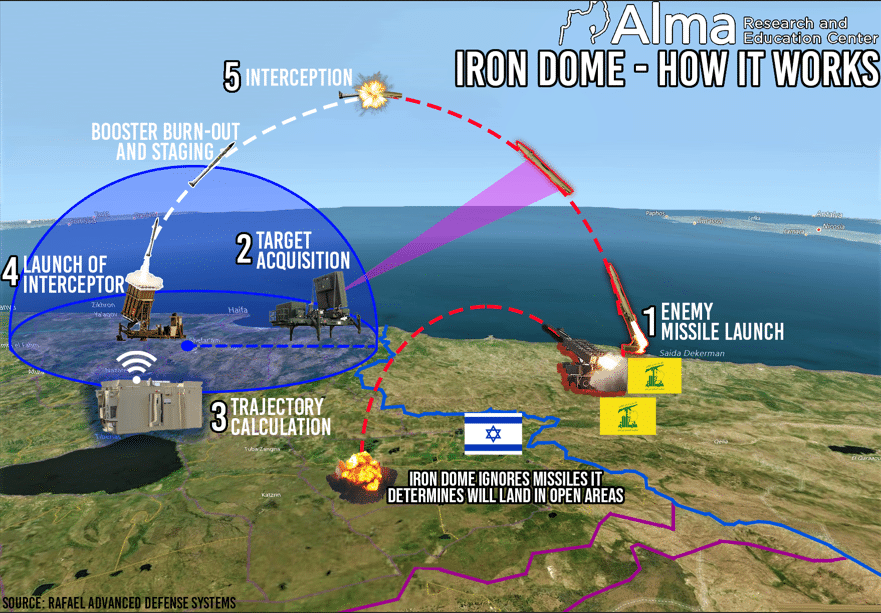
The Israeli Ministry of Defense and Rafael signed a huge agreement worth billions of shekels on November 28, 2025, to expand the serial production lines of the Iron Dome.
The deal, which is intended to ensure a continuous supply of Tamir interceptors for the Air Force’s air defense array, is part of a broader strategic move designed to strengthen Israel’s multi-layered defense, and accelerate Israel’s ability to replenish interceptor stockpiles and improve readiness.
The system itself is also being upgraded on an ongoing basis, as part of an arms race with the Iranian-Hezbollah axis, as well as in the face of the possibility that Israel will have to confront Sunni jihadist forces from Syria in the future.
Continuous improvements are taking place in algorithms for threat detection and interceptor guidance, command and control software, the radar, and the interceptors themselves.
An American military aid package totaling 8.7 billion dollars, which the US Congress approved in April 2024, included a designated package of 5.2 billion dollars for strengthening the air defense systems of the State of Israel – Iron Dome, David’s Sling and the high-power laser system that is in the final stages of development.
On November 21, 2025, the American defense company Raytheon announced together with Rafael the opening of a joint Iron Dome interceptor factory in the US state of Arkansas. The factory will also produce the American version of the Tamir interceptor (known as Sky Hunter) for use by the US Marine Corps. To date, Raytheon has produced components for the interceptor missile that were integrated with components made in Israel, to assemble the interceptor in Israel. Rafael will continue to assemble Tamir interceptors in Israel alongside production in the US.
The system consists of Tamir interceptor missiles, in two versions, one radar-guided and the other guided by an electro-optical sensor, an MMR radar made by IAI-ELTA, and a command and control system from mPrest.
During the Swords of Iron War, tens of thousands of rockets, mortar shells, and UAVs were launched by Hezbollah in Lebanon and Hamas in Gaza.
Iron Dome achieved over a 90 percent interception rate of the threats it was launched to neutralize.
Iron Dome was also activated against UAVs (unmanned aerial vehicles) launched by Hezbollah, and also against UAVs launched by the Houthis from Yemen.
This is a type of threat that is harder to detect due to its low altitude relative to the ballistic trajectory of a rocket.
Iron Dome also intercepted a significant number of mortar shells during the war.
The massive procurement of Iron Dome by the Ministry of Defense is taking place against the backdrop of a quiet revolution that has occurred within the Iron Dome system during the last two years of the Swords of Iron war.
While externally the air defense batteries look unchanged, the system has undergone dozens of significant operational upgrades, which have transformed it from a point solution in 2011 against short-range rockets into a versatile shield with increased interception ranges capable of intercepting cruise missiles and advanced UAVs as well. According to international media reports, the system also assisted defensive efforts against Iranian ballistic missiles during the 12-Day War against Iran.
The selection of the Tamir interceptor by the US Marines indicates that the interceptor can be adapted for medium-range interception capabilities.
The operational tempo of the war has turned Israel into a global battle lab, accelerating and improving development processes.
The ‘battle lab’ effect allows Israeli engineers to close gaps in real time, and to adapt the system to the changing tactics of the various enemies in the different arenas.
According to Western sources, the current Iron Dome system of late 2025 is fundamentally different from its predecessors, especially regarding its radar and interception envelope. These changes reflect the arms race between Israel and Iran and its proxies, in both defense and offense.
One of the most critical operational changes occurred in the radar component. While the first two batteries were equipped with a small radar, a mini-MMR, over time the radars were enlarged and improved. The transition to large radars made it possible to achieve protection against dozens of threats simultaneously.
This capability was clearly demonstrated during the heaviest barrages of the war.
The most significant feature regarding the upgraded Iron Dome concerns its extended range.
The system, originally designed to intercept rockets from a range of 4 to 70 kilometers, has evolved into an interceptor that can intercept distant threats.
Regarding the integration of the laser and mainly the Iron Beam system from Rafael, it is important to note that the laser is not a standalone solution but a complementary “effector” (response tool) that integrates into the existing Iron Dome architecture to create a stronger interception matrix.
Laser cannons will be integrated into the Iron Dome’s radar and response system.
The laser offers a significant economic advantage, with an interception cost of a few dollars per interception (the cost of electricity), compared to approximately 50,000 dollars for each Tamir interceptor.
However, lasers have physical limitations, especially regarding the amount of time the laser must focus on the target to destroy it, and weather conditions.
The rate of fire of the laser against a heavy barrage is much slower compared to Iron Dome, because the laser operates sequentially against one threat and then against the next threat, and only switches between threats after it has downed the previous threat.
However, for specific threats, such as long-range UAVs attempting to penetrate deep into Israel, the laser is ideal. The current laser range is estimated at about 10 kilometers.
A process of ‘spiral development,’ in which system upgrades occur while in use, common in defense industries – plays a critical role in the development of these systems.
This is a highly complex process, as any change can lead to an unexpected change in another component.
Regarding the UAV challenge, the ability to detect the UAV remains the main bottleneck, not the ability to down the targets.
In this context, improvements have been made in detection and tracking capabilities, especially in the north against Hezbollah.
Ultimately, while the threat landscape continues to evolve – as Iran and its proxies improve the precision, range, and lethality of their arsenal – Israel’s air defense array is in a constant race to stay one step ahead of the enemy.
It is possible that the next threat will be one of massive swarms and autonomous enemy small drones.




One Response
Dear Yaakov,
I slept peacefully in Jerusalem throughout the 12 day war, and both before and after. The Iron dome was nice to have, but the motto my parents lived through WWII and throughout their lives: “In God We Trust” let me sleep like a baby every night undisturbed. I simply turned off my phone and went to bed!