
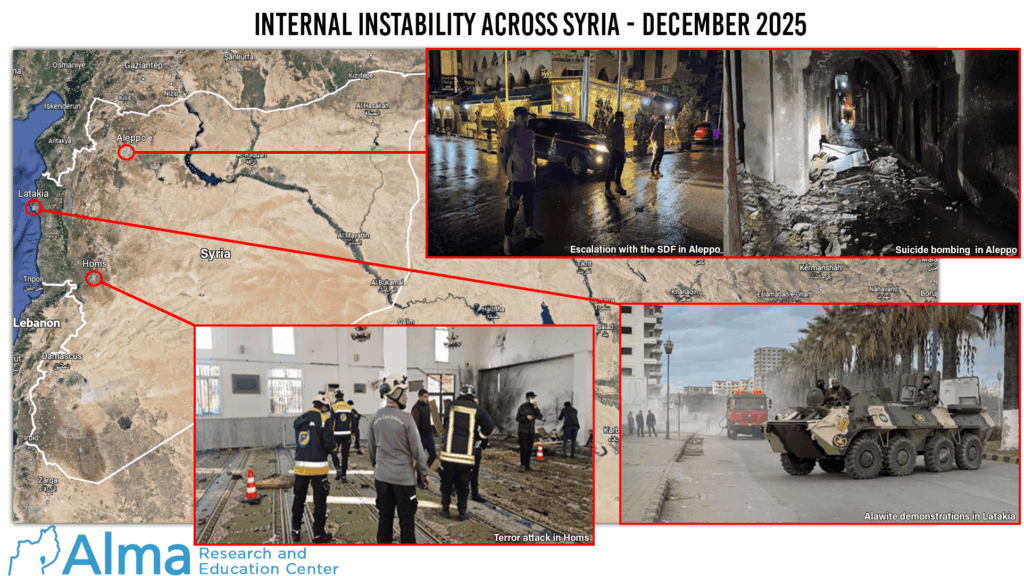
About a year after the consolidation of the new regime in Damascus, Syria continues to grapple with profound internal instability, reflecting an ongoing failure of the authorities to enforce order, ensure civilian security, and rebuild trust between the state and the diverse communities that comprise it. A series of security incidents at the end of December—including a severe terrorist attack in Homs, a suicide bombing in Aleppo, a renewed outbreak of tensions with the Alawite population in the coastal cities, and an escalation of clashes between the regime and Kurdish forces in Aleppo and the country’s northeast—are not isolated events, but rather a symptom of a fragile political and security structure.
Attack on the “Ali ibn Abi Talib” Mosque in Homs: An Attempt to Ignite Sectarian Tensions
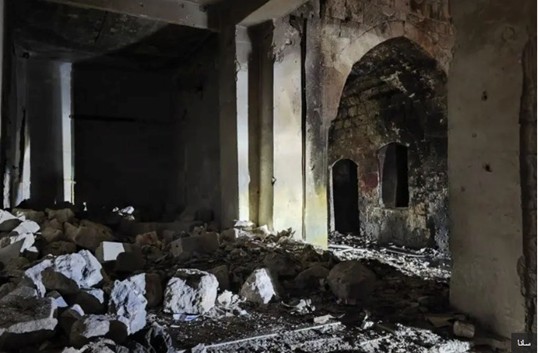
On Friday, December 26, 2025, a terrorist attack took place at the “Ali ibn Abi Talib” Mosque in the Wadi al-Dhahab neighborhood of the city of Homs. Several explosive devices planted inside the mosque detonated during Friday prayers, killing at least eight worshippers and wounding more than 18 others. Syrian authorities described the incident as a deliberate terrorist attack against civilians and a place of worship, aimed at undermining the fabric of shared life in the city and creating an atmosphere of fear and instability.
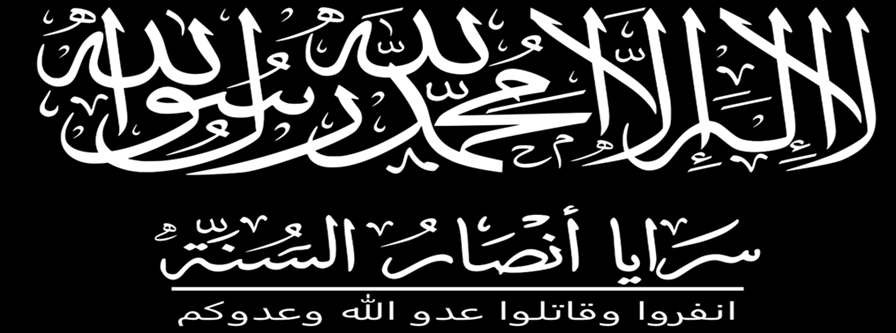
A radical Sunni jihadist organization calling itself “Saraya Ahl al-Sunna” (also known as “Saraya Ansar al-Sunna”) claimed responsibility for the attack. The group focuses on targeting religious sites and sensitive civilian locations with the aim of fueling sectarian tensions. In its statement, the organization asserted that the attack was carried out using several explosive devices with the assistance of an additional, unidentified party, and made clear its intention to continue its activities. The group was also involved in the attack on the Mar Elias Church in the Dweilaa neighborhood of Damascus in June 2025, in which dozens of civilians were killed.
Various figures within the Syrian regime noted that the choice of a Shiite mosque in a mixed city such as Homs was not incidental but rather intended to stir sectarian tensions and draw Syria back into a cycle of internal violence. The attack underscores the vulnerability of the domestic arena and the regime’s difficulty in preventing the infiltration of extremist elements into areas under its control.
ISIS Suicide Attack in Aleppo
On December 31, a suicide attack occurred in the city of Aleppo, killing one person and wounding several others. According to Syria’s Ministry of Interior, the attacker was affiliated with ISIS. Syrian security forces had suspected the attacker, when they attempted to question him, he opened fire on them, killing one of the officers, before detonating himself. The security forces had been acting on intelligence indicating that ISIS intended to target churches and civilian public places, particularly in Aleppo, in the context of New Year celebrations.
Rising Tensions with the Alawite Population in the Coastal Cities
On December 28, 2025, widespread protests erupted in the coastal cities, primarily Latakia, Tartus, and Baniyas, which quickly deteriorated into violent clashes, gunfire and casualties. According to local reports, at least four people were killed and dozens wounded. The protests began in the wake of the attack in Homs, in which Alawite civilians were also harmed, but they reflected deep and persistent frustration within the Alawite population.
The demonstrators called for the establishment of a decentralized system of governance and even raised demands for federalism and regional autonomy, alongside the release of thousands of Alawite detainees. These demands reflect not only anger over a specific security incident, but also a cumulative sense of insecurity, a rise in violence and harassment, and growing economic distress among a population that had previously relied heavily on state salaries and the security apparatus.
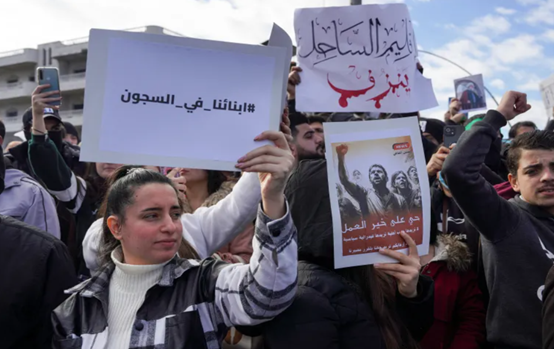
“Our sons are in prison,” “The coastal region is bleeding,” “We earn a living just to survive,” “We don’t want a civil war; we want a political federation.”
In response to the events, the regime deployed internal security forces, military police, and army units in the coastal cities, and imposed a nighttime curfew in an effort to stabilize the situation. However, many view these steps as superficial, short-term measures that do not address the roots of the crisis.

“Syrian security forces enforce the nighttime curfew in Latakia.”
Following the violence against Alawites along the Syrian coast in March 2025, the regime established the “Supreme Committee for the Preservation of Civil Peace,” intended to placate the Alawite population and prevent further escalation. The committee operates by providing economic assistance, repairing property damage, and granting amnesties to those involved in the March events and to fighters from the civil war, primarily in exchange for cooperation with the regime and the maintenance of “calm.” However, the committee’s activities have drawn sharp criticism: many Alawites view it as a symbolic measure that does not enhance their security, while others criticize the granting of amnesties as undermining transparency and due process and as conferring legitimacy on violence.
Escalation with Kurdish Forces and the Crisis in Northeastern Syria
At the same time, over the past two weeks an additional escalation has been recorded in the clashes between the Syrian regime and the Kurdish Syrian Democratic Forces (SDF). In the city of Aleppo, serious confrontations developed, during which SDF forces attacked positions of the Syrian police and army, fired at checkpoints, and deployed snipers, including fire directed at civil defense teams. SDF forces also carried out rocket fire toward residential neighborhoods, causing deaths and injuries among the civilian population. Damascus claims that the SDF initiated the fire and that the Syrian army’s actions were purely retaliatory.
The escalation is taking place against the backdrop of a stalemate in negotiations over the implementation of the “March 10 Agreement.” Damascus has accused the SDF of dragging their feet, distorting the understandings reached, and attempting to effectively preserve separate systems of governance, security, and military control in the northeast of the country, including control over borders, crossings, and oil and gas resources. According to the regime, the Kurdish demand for “self-administration” goes beyond administrative autonomy and has become a national-security project that threatens Syria’s sovereign integrity. In Damascus, there is a prevailing assessment that the SDF are seeking to improve their bargaining position through the use of force alongside negotiations.
The United States, the United Kingdom, France, and Germany are exerting heavy pressure on both sides to reach a detailed military agreement that would regulate the integration of approximately 90,000 SDF fighters and “Asayish” (the Kurdish internal security forces) into Syria’s Ministries of Defense and Interior.
According to several reports, the Syrian government proposed the establishment of three special SDF divisions under the Ministry of Defense in Deir ez-Zor, Hasakah, and Raqqa. However, deep disputes remain regarding the entry of the Syrian army into the Kurdish region in the country’s northeast, the appointment of commanders, decision-making mechanisms, and the future of the internal security apparatus. SDF demands to preserve independent units, including a women’s force and a Washington-backed counterterrorism force, have met with strong opposition in Damascus and Ankara.
Turkey has drawn a clear red line: the removal of all foreign fighters from the SDF, foremost among them PKK operatives. According to assessments, more than 8,500 SDF fighters are not Syrian citizens. Ankara views this as a strategic security threat and made it clear that it will not accept an independent armed Kurdish presence along its southern border.
Taken together, these developments indicate that the Syrian regime, a year after its consolidation, is struggling to move from a phase of survival to one of governance. Internal security remains fragile, relations among different sects and populations continue to be volatile, and internal and external actors are exploiting these divisions to undermine stability. The regime’s response oscillates between ad hoc crisis management and the use of force, without a comprehensive political initiative or deep structural reforms. In the absence of a long-term solution to social and ethnic cleavages, Syria is likely to remain a fragile arena prone to escalation, a stability of instability, even without a return to full-scale war.




One Response
Dear Dr Zoe,
Syria is comparable to a large fragmentation bomb. There would seem to be several burning fuses of possible different lengths. Jihaddist rule is incompatible with minority Liberty and Justice. Unless jihaddist sharia law is confronted and defused the bomb will eventually explode. A peaceful plan to provide minority independence with political boundaries seems preferable to prevent jihaddist oppression, violence and domination over time.