
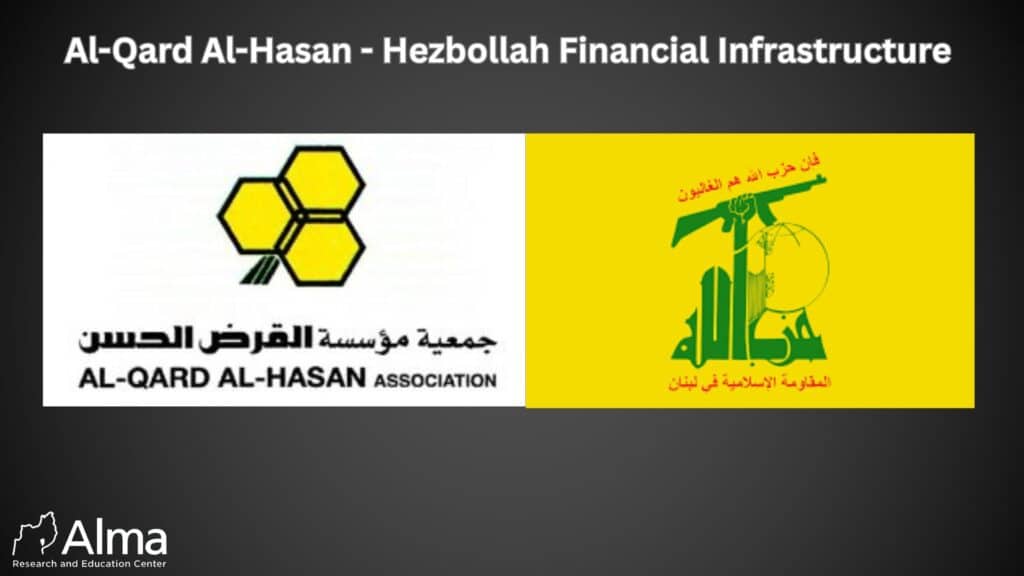
Hezbollah’s recovery process depends not only on military capabilities but, to a large extent, on its economic and financial infrastructure. At the center of this system is the “Al-Qard al-Hasan” institution, which serves as a key pillar of the organization’s economic activity and its ties with the Shiite support base in Lebanon. The institution has approximately 300,000 clients, and the scope of its activity is estimated at more than $3 billion, figures that underscore its strategic importance to Hezbollah.
Subsequently, it was reported on December 8 that a delegation from the U.S. Treasury Department visited Lebanon and delivered an unequivocal demand to the Lebanese government to shut down “Al-Qard al-Hasan.” According to the reports, the Americans urged the Governor of the Banque du Liban, Karim Saeed, to begin taking initial steps to implement the move, including setting a timetable for gradual implementation. It was further reported that Saeed approached Lebanon’s Internal Security Forces with a request to begin entering the institution’s branches and closing them gradually. However, officials within the Lebanese government clarified that the governor lacks the legal authority to act unilaterally, as “Al-Qard al-Hasan” is formally registered as an association rather than as a licensed bank.
In this context, it was also reported that additional alternatives are being examined in Lebanon, including significantly curtailing Al-Qard al-Hasan’s ability to conduct banking activities through the imposition of strict oversight and monitoring, ongoing supervision, and restrictions on the use of gold as a mechanism for loans and collateral. These steps reflect an attempt to meet U.S. demands without being drawn into a broad political and social confrontation.
At the same time, a meeting took place between Governor Saeed and Hezbollah-affiliated Member of Parliament Ali Fayyad, who warned against steps that could, in his words, lead to harm to private property. Fayyad argued that the exclusion of Hezbollah’s institutions from the formal banking system is what pushed the organization and its supporters toward a cash-based economy.
Hezbollah’s response to U.S. involvement was swift. In an official statement, the organization claimed that this constituted an American attempt to “strangle” its economic and social environment. According to reports, internal discussions are taking place within the organization to prepare politically and legally, and a special committee has been established to examine possible alternatives to “Al-Qard al-Hasan.” The future of the institution’s hundreds of thousands of clients in the event of its closure represents a central challenge, as such a move could deal a severe blow to Hezbollah’s economic apparatus in Lebanon.
Furthermore, it was reported on December 14 that Hezbollah is examining an alternative through a new association named “Joud,” which operates on a model based on the buying and selling of gold or the provision of gold as a loan in exchange for monetary repayment in installments. According to the reports, the association does not transfer physical funds and does not engage in classical banking activity and is therefore not subject to supervision by the Banque du Liban. It operates as a regular “business,” a distinction that illustrates the organization’s anticipated shift toward activity in more regulatory gray areas.
In response to reports on the Al-Hadath channel regarding the possibility of changing the institution’s name in order to circumvent sanctions and bring it under the oversight framework of the central bank, “Al-Qard al-Hasan” issued an official statement on December 17 asserting that the institution continues to operate under its current name and across all its branches throughout Lebanon. According to the statement, its activity focuses on managing a community-based loan mechanism between donors and borrowers for social needs, and that the buying and selling of gold are not carried out by the institution itself but rather through licensed commercial companies.
These developments illustrate that dismantling or weakening Hezbollah cannot be confined to the military dimension alone. Comprehensive political and international pressure is required that also targets the organization’s civilian-economic dimension. Hezbollah’s financial system enables its recovery and the consolidation of its social base, and therefore, much like the issue of weapons, the organization will not relinquish it easily and will continue to seek alternative mechanisms to sustain its financial activity.
In light of the legal and bureaucratic obstacles, Hezbollah’s opposition, and the high level of public sensitivity, the likelihood that the Lebanese government will actually succeed in shutting down “Al-Qard al-Hasan” appears low. Even if such a step were to be implemented, enforcement that stops at this stage alone would render the move largely symbolic.
Therefore, Lebanon would be required to establish effective and sustained oversight and enforcement mechanisms, a significant challenge for a state whose economic system is in deep crisis, but a necessary step as part of structural and regulatory reforms aimed at removing Hezbollah from the economic and political arena.
Can the Lebanese state both implement and sustain meaningful and substantial measures against the Al-Qard al-Hasan institution? There is likely a problem of capacity in this regard, just as there is a capacity problem when it comes to taking meaningful and substantial steps to disarm Hezbollah.
Hezbollah has already made clear that any harm to Al-Qard al-Hasan constitutes a red line from its perspective.



One Response
Dear Dr Zoe,
Anything hezbollah defines as a red line must be considered a high value target in our war against evil. ALL funding must be targeted before it reaches ANY of hezbollah’s support or “humanitarian” affiliates or direct terrorist activities. These are all varying forms of cancerous governmental destabilization. ALL hezbollah activities are jihaddist ideological fronts to conquer and overthrow existing legitimate governance.