
Executive Summary
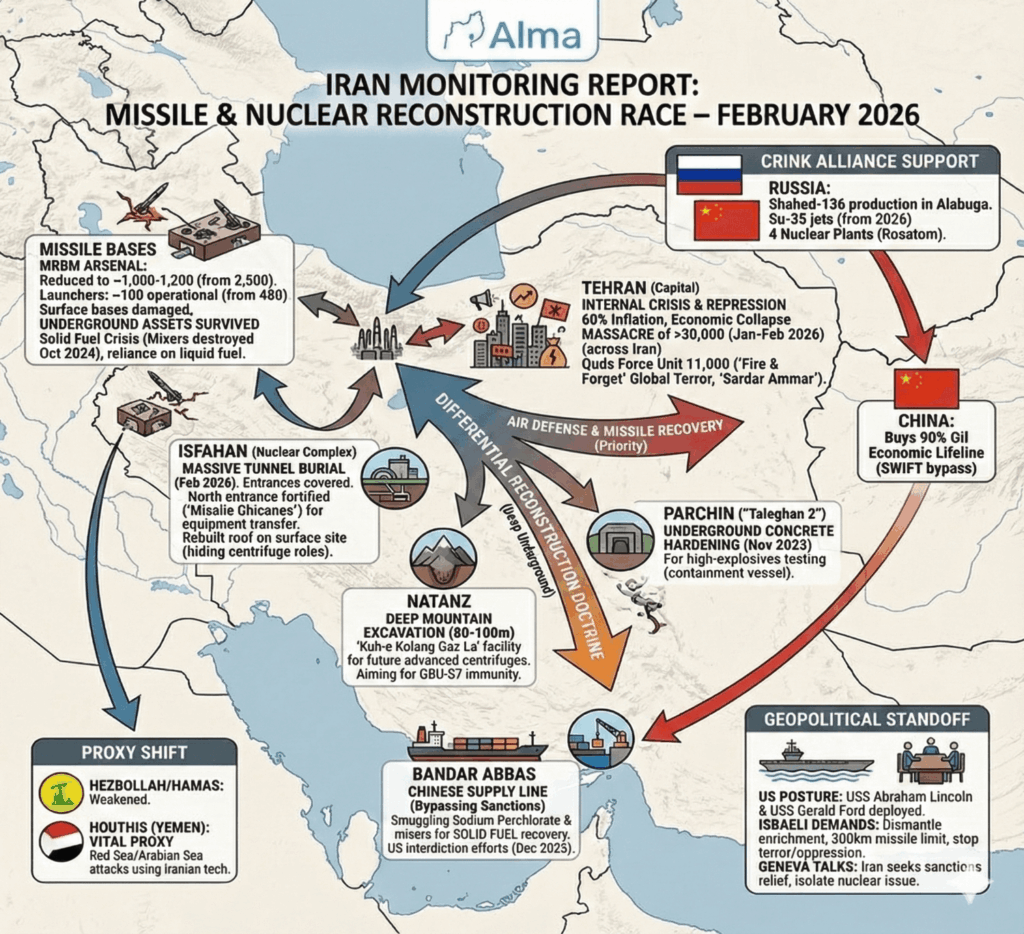
Some eight months after the end of the 12 Day War (Operation “Rising Lion),” June 13–24, 2025), the Islamic Republic of Iran is at a historic and strategic crossroads, and appears to have adopted a differential reconstruction doctrine regarding its core capabilities.
This doctrine combines a semblance of willingness for diplomacy with the West, while prioritizing the rehabilitation of air defense capabilities, the restoration of the ballistic missile program, and the acceleration of the fortification of nuclear facilities damaged in June 2025 deep underground.
The Israeli strategy over the past two years, which transformed from containing Iranian proxies to directly striking Iran itself, succeeded in neutralizing Hezbollah’s second-strike threat in Lebanon and the air defense systems in Syria, thereby opening a direct flight path that allowed absolute aerial freedom of operation in Iranian skies. This enabled the destruction of about two-thirds of Iran’s ballistic missile launchers, and between a third to half of the Iranian ballistic missile arsenal on the eve of the war, which was estimated at about 2,500 missiles.
However, the updated analysis for February 2026 suggests that Iran is attempting to turn the physical damage to the missile infrastructure into a strategic catalyst for infrastructure reconstruction. Simultaneously, Iran is trying to protect the remainder of its nuclear program and is working to restore its detection and air defense capabilities.
In recent days, it has been reported that Iran is conducting an extensive engineering operation to seal tunnel openings at the nuclear complex in Isfahan, accelerating work at the “Pickaxe Mountain” facility, a site located south of Natanz that may contain centrifuges at great depth, and establishing sanctions-bypassing supply chains from China to replenish solid fuel stocks for missiles.
According to Israeli assessments, the war in June 2025 dealt a severe blow to Iran’s nuclear infrastructure and delayed the progress of the Iranian nuclear program by a number of years, but did not eliminate the scientific knowledge or the stock of fissile material enriched to 60%, amounting to about 400 kilograms, and it is still unclear if the Iranians managed to get their hands on or if it remains buried under the rubble at Iran’s 3 main nuclear sites.
Before the war, this uranium was held at Fordow, Natanz, and Isfahan. After the war, the IAEA assessed that the material had not been moved from these sites. It appears as if one of the Iranian lessons from the war is the transfer of the remainder of the program to underground facilities that are more immune and hidden from the eyes of IAEA inspectors and intelligence satellites.
Alongside the military buildup, the Iranian leadership is required to decide between allocating resources for the reconstruction of military infrastructure and dealing with acute civil crises, including 60% inflation, the collapse of basic services, and historic waves of protest stemming from the economic collapse.
The Iranian regime chose a path of unprecedented repression, which peaked in January and February 2026 with the massacre of over 30,000 Iranian citizens, an unprecedented number, in a desperate attempt to preserve its stability.
In the face of Iran’s attempts to fence off the ongoing negotiations to the nuclear domain only, the United States is thickening its military presence, which includes the aircraft carriers “Abraham Lincoln” and soon also the “Gerald Ford.” Israel, for its part, places 4 demands on the regime that in its opinion should guide any diplomatic process: dismantling enrichment capabilities and removing the enriched material, limiting ballistic missiles to a range of 300 kilometers, ceasing support for the various proxies, and stopping the brutal repression of the Iranian people.
The Race to Rebuild Nuclear Infrastructure: Deepening, Sealing, and Camouflage
Towards February 2026, an extraordinary development occurred at the nuclear complex in Isfahan. Reports and satellite imagery analysis by the Institute for Science and International Security (ISIS) point to a massive logistical operation to seal the entrances to the underground facilities, aiming to protect them from future strikes and prevent surprise inspections.
Satellite photos show that the middle entrance and the southernmost entrance to the tunnels were completely covered with huge piles of dirt, using continuous truck (Dump trucks) and heavy engineering equipment activity operating from a nearby staging area. In addition, the northern entrance to the tunnels remained open and was reinforced with graduated protective walls (“Missile Chicanes”) designed to block direct penetration of cruise missiles.
The American institute’s assessment is that Iran is using this active opening to transfer centrifuges and sensitive equipment rescued from other sites inside, aiming to establish protected production and assembly lines deep in the mountain.
Furthermore, at the surface site in Isfahan that was destroyed in the Israeli strikes, a new roof was built between December 2025 and January 2026 on top of the steel skeleton that survived. This structure, containing architectural features identical to the centrifuge production facility in Karaj, was apparently rebuilt to hide rotor and bellows production from satellites, while compartmentalizing the activity from weather hazards and intelligence observations.
Additional Concealment Projects: “Pickaxe Mountain” and Taleghan 2
Parallel to the work in Isfahan, the excavation of the “Pickaxe Mountain” (Kuh-e Kolang Gaz La) facility south of Natanz continues with greater intensity. The facility is being dug at an estimated depth of about 80 to 100 meters under hard granite rock, out of an Iranian understanding that this depth might provide immunity against the American GBU-57 bomb (of the type dropped by B-2 bombers in Operation “Midnight Hammer”).
The security walls have been completed, and it appears the facility is designated to house the future generation of thousands of advanced centrifuges. Likewise, at the Parchin site, at the Taleghan 2 facility which previously served the past nuclear weapons development program (“Amad”), the completion of underground concrete infrastructure construction was identified in November 2025. This structure is designed to contain a blast chamber (containment vessel) whose purpose is conducting high-explosive experiments, essential for developing mechanisms required to activate a nuclear device.
The Medium-Range Ballistic Missile (MRBM) Array: Damage Assessment, the Solid Fuel Crisis, and the Chinese Route
The medium-range ballistic missile array, which constituted the backbone of the Iranian deterrence doctrine, experienced critical attrition, but its underground infrastructures survived and allow for a reconstruction process if Iran obtains the missing raw materials.
The Iranian strategic goal on the eve of the war in June 2025 stood at building an arsenal of 8,000 ballistic missiles to generate a target-saturated saturation capability that could overwhelm Israeli defense systems (“Arrow 2,” “Arrow 3,” and “David’s Sling”).
As of early 2026, the inventory has shrunk from an estimated stock of 2,500 missiles before the fighting to between 1,000 and 1,200 available missiles (after Iran fired about 550 missiles during the war, and Israel destroyed between a third to half of the stockpile) and to only about 100 serviceable mobile launchers (from a pool of 480 launchers before the war).
The Alma Center assessment report from February 11, 2026, analyzed 25 major ballistic missile launch bases in Iran designated for ranges of 1,000 to 3,000 km. Nineteen of the bases were directly attacked during the 12 Day War. Satellite imagery analysis (Landsat and Sentinel-2 L2A) indicates that the damage above ground rendered the bases temporarily unserviceable only, as all assets hidden in the underground complexes likely survived the bombings completely.
One of Israel’s main achievements in June 2025 was hitting 293 active launchers during the ‘launcher hunt.’ Of these, 95 launchers were buried inside tunnel openings/shafts that collapsed, a step that denied Iran the flexibility to generate extensive attack barrages.
Iran is now pinning its hopes on rapid reconstruction but faces a critical technological-logistical obstacle. The Iranian capability to produce solid-fuel based missiles (which provide short preparation time and rapid launch capabilities making early detection difficult, such as the “Sejjil,” “Kheibar Shekan,” and “Fattah 1” missiles) was paralyzed due to the destruction of about 12 to 20 planetary mixers used to produce this fuel back in an Israeli strike in Iran in October 2024.
The loss of this equipment delayed the project and forced Iran to rely again on liquid-fuel propelled missiles requiring long fueling times and are more exposed to surveillance and preventive strikes.
To bypass this crisis, according to international media reports, the regime diverted vast resources to import components from China, which serves as the almost exclusive supplier for Iranian buildup needs for these machines and also apparently for chemicals for fuel production. The procurement networks operate through shell companies to smuggle tons of chemical materials.
Even before the war in June, it was reported that Iranian cargo ships were documented unloading shipments of Sodium Perchlorate at Bandar Abbas port – a substance that bypasses existing monitoring mechanisms on Ammonium Perchlorate – in a quantity that could suffice for about 800 new ballistic missiles.
The United States is operating covert interdiction efforts to disrupt the supply: in December 2025, American special forces raided a merchant ship in the heart of the Indian Ocean making its way from China to Iran and confiscated military cargo intended for the Revolutionary Guards (IRGC) in an effort to prevent the replacement of the destroyed mixers.
The New Proxy Architecture: Casual International Terror and Maritime Threat
The severe blows suffered by Hezbollah and Hamas, which effectively ceased to function at least for the time being as a strategic offensive force deterring Israeli action against Iran, forced the leadership in Tehran to shift operational focus to Yemen, Iraq, and the Quds Force’s international terror networks, while funneling funds to Hezbollah in an attempt to encourage the rehabilitation of its capabilities.
The Houthis in Yemen have become the most important proxy arm, being deployed to harass the global economy and trade routes in the Red Sea and the Arabian Sea, along with the ability to continue attacking Israel on a ‘low intensity’ basis with missiles and UAVs, despite significant damage suffered by the Houthis from Israeli responses.
The Houthi arsenal relies exclusively on Iranian developments, and it appears that Iran continues to try to arm its proxy in Yemen via the sea.
Quds Force – Unit 11,000 and ‘Fire and Forget’ Terror
Recently, the identity of the commander of Unit 11,000 of the Quds Force, “Sardar (General) Ammar,” operating under the direct command of Quds Force commander Esmail Qaani, was revealed. The unit focuses on carrying out attacks against Jewish and Israeli targets around the world. Understanding that Iranian terror agents are exposed to monitoring by Western intelligence agencies, Unit 11,000 adopted a “Fire and Forget” doctrine based on outsourcing based on criminal infrastructure.
The unit’s operatives recruit local criminals and mercenaries who are not necessarily aware of their true handlers. Among other things, a plot to assassinate the Israeli ambassador to Mexico, Einat Kranz-Neiger, which was planned over long months, was foiled. In another case, in Berlin, a citizen with dual citizenship (Danish-Afghan) was activated to collect intelligence on synagogues after secretly visiting Tehran.
Terror experts estimate that diplomatic punitive measures (such as expelling ambassadors) are meaningless for a regime that views itself as a ‘pariah state’ anyway. On January 29, 2026, the European Union declared the Revolutionary Guards a terrorist organization.
The Revisionist Alliance (CRINK): Evasion Economy and Arms Trade
Iran does not operate in a vacuum; its buildup is enabled thanks to its deep integration into the revisionist CRINK alliance (China, Russia, Iran, North Korea). The triangle of relations with Moscow and Beijing constitutes Tehran’s economic and technological insurance policy.
China constitutes Iran’s main oxygen line and purchases about 90% of its total oil exports, which reached a peak of 1.38 million barrels per day on average in 2025.
This export provides the Revolutionary Guards with billions of dollars a year, despite US sanctions and the snapback sanctions activated by Germany, Britain, and France in September 2025.
To bypass the SWIFT clearing system and American sanctions, China and Iran created a dark barter and credit system. Simultaneously, the mutual dependence between Moscow and Tehran has turned into an alliance of advanced military technology transfer. Following the Russian shortage of munitions in Ukraine, Iran established an industrial production line for suicide UAVs of the Shahed-136 type (known in Russia as Geran-2) in the Alabuga industrial zone in Russia, with a production capacity of about 10,000 units per year and at a cost of about $193,000 per unit.
So far, Russia has launched over 38,000 of these items against Ukraine. In return, according to leaked documents from the Russian arms corporation (Rostec), Russia is expected to supply Iran with 48 advanced Su-35 fighter jets (Generation 4++) which would dramatically improve Iranian air defense capability starting in 2026. This cooperation also spills over into the civil-nuclear field, with a mega-deal worth $25 billion in which Rosatom will build four new nuclear power reactors in Iran, a legal cover that makes attacking these facilities difficult.
Regime Stability: Inflation, Civil Collapse, and Internal Massacre
Despite the vast resources diverted to military buildup, the domestic arena in Iran is at an extreme boiling point. The economy is collapsing under the burden of 60% inflation, there is a severe energy shortage and initiated power outages paralyzing communication and internet networks, about 80% of pharmacies in the country face bankruptcy due to currency devaluation, and there is a shortage of medicine imports. The frustration, despair, and bitterness among the population escalated in January and February 2026 into a widespread popular uprising that endangered the regime’s survival. The leadership responded with murderous and unprecedented repression: during January 8th and 9th alone, security forces and the Revolutionary Guards carried out a mass massacre of over 30,000 Iranian citizens across the country according to several reports, in an attempt to crush and deter the spirit of resistance.
Conclusion
The successful Israeli campaign of June 2025 did not end the conflict with the Iranian regime determined to complete its ideological mission to destroy Israel, and to become the dominant power in the Middle East.
Iran was damaged but not defeated. Now, some argue that the United States and Israel face a historic window of opportunity that may close quickly given the accelerated pace of Iranian reconstruction and Tehran’s diplomatic subterfuge. However, others warn that without an armed and well-organized Iranian underground force, there is no precedent for air or naval power alone toppling a regime.
These days (mid-February 2026), President Trump’s envoys, Steve Witkoff and Jared Kushner, are conducting contacts in Oman and Geneva in an attempt to reach an arrangement with Iran.
Iran demands to isolate the negotiations to the nuclear issue only, aiming to gain sanctions relief vital for infusing foreign currency and to postpone the renewal of UN sanctions (“Snapback”). All this while covertly rebuilding its missile capability to try to reach a stock of 2,000 missiles.
While it is clear that Iran cannot be allowed to possess an existential threat capability like a nuclear bomb or military-grade uranium enrichment capability, a state with a radical Islamic ideology, advocating the export of the Islamic Revolution worldwide and the physical destruction of the State of Israel, must not possess a significant strategic threat capability like medium-range ballistic missiles and above, and hold a global system of financing and operating proxies.
Meanwhile, the American military has significantly raised its readiness in the Middle East region, positioning the Abraham Lincoln carrier strike group and now deploying the Gerald Ford strike group in staging positions in case the president orders a widespread strike, should the diplomatic contacts collapse. There is no knowing how the Iranian regime will respond – will it try to buy time with a new deal? Or will it gamble on its ability to survive an American attack and deter the Iranian people from taking to the streets so it can declare a ‘divine victory’ due to its staying power?



2 Responses
It’s now or never for US and Israel to demolish the Iranian regime, otherwise the poo will hit the fan,and soon rather than later the Hezbollah and Hamas will be on their feet again and peace for Israel will be the story of the past
Dear Yaakov,
The entire CRINK axis of evil tyrants is collapsing into their individual black holes of lies and attempted power and land grabs all over the globe. For each of them the Board of Peace is the BEAM of of the gallows to crink each of their necks with the rope they had prepared to kill innocents, in an attempt to expand their illusions of empires that will now never exist. It is fitting that the Abraham Lincoln carrier group is proceeding toward Iran. The slaves of 1860’s time period who were being liberated, referred to the president as “Father Abraham” who was delivering them from the bondage of slavery. The abolitionists who were a minority political force won the day pointing to the Liberty Bell and the Declaration of the Almighty through the prophet Moses “Proclaim Liberty Throughout All the Land unto All the Inhabitants Thereof”. Let the yolk of bondage of all the CRINK tyrants now be thrown off, and the cries of Liberty be heard around the world!