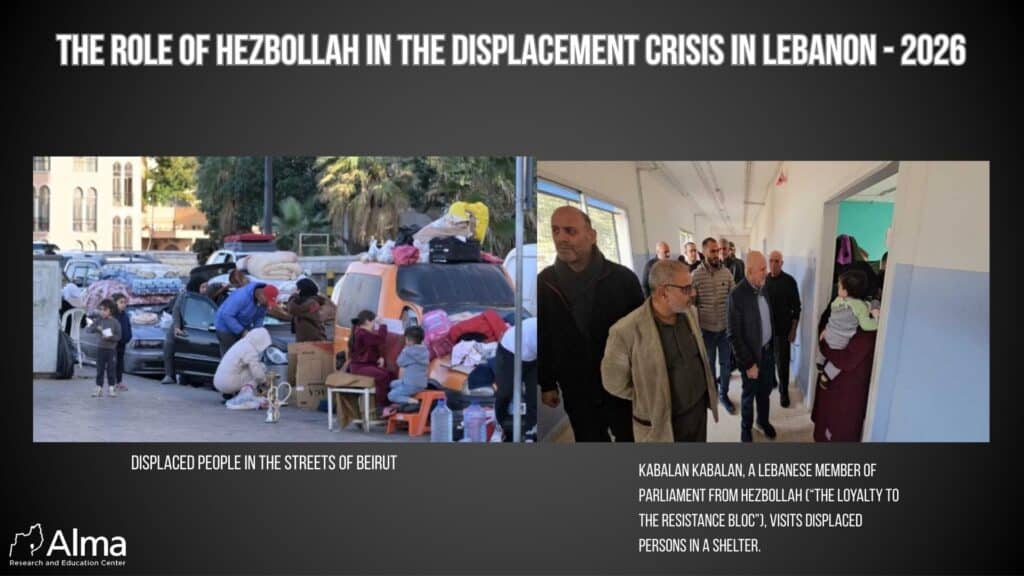
Human Shields and Displacement
Hezbollah’s “human shield” tactic is one of the core characteristics of its military activity in Lebanon. As part of this strategy, the organization uses the civilian population, primarily from its supporting Shiite base, as cover for its military operations. Residential buildings, public structures, schools, and hospitals are used to store weapons and military equipment, to launch rockets and missiles, and to conceal operatives, headquarters, and the organization’s military infrastructure.
This reality places the civilian population in Lebanon in the line of fire. During fighting, and in order to reduce harm to uninvolved civilians, the IDF often issues evacuation notices to towns and villages from which Hezbollah operates.
Hezbollah’s transformation of the civilian space into a military arena causes hundreds of thousands of civilians—and sometimes even more—to be forced to leave their homes. The result is a deepening humanitarian crisis, which constitutes one of the most severe internal crises Lebanon has experienced in recent years.
The area south of the Litani River has become the main center of displacement in Lebanon in 2023 and 2024 and also today, following Hezbollah’s entry into the war on March 2, 2026. The extensive evacuation orders and the repeated strikes against Hezbollah infrastructure have led a large population to leave the area. Most of the displaced have concentrated in several main reception areas in Lebanon, including Greater Beirut, the Mount Lebanon district, major cities such as Sidon, and areas in the north of the country. On the other hand, in the Beqaa region, almost no shelters were opened; most of the displaced who evacuated to this area moved to relatives’ homes or private houses. In addition, relatively normal daily life continues in the Beqaa, in contrast to southern Lebanon.
As of March 14, the number of displaced people officially registered in Lebanon stood at 831,882, although estimates suggest that the actual number exceeds one million. To address the crisis, 619 reception centers were opened, hosting 132,419 displaced individuals from 33,902 families. The receiving cities have reached the limits of their absorption capacity, and many schools and reception centers are filled to capacity. This situation places a heavy burden on the education, health, and municipal service systems in a country that is already suffering from a deep economic crisis and has not yet begun to recover from the previous war.
Hezbollah Also Operates Outside Its Natural Base Areas
Hezbollah’s activity is not limited to areas where its supporting Shiite base resides. The organization also operates from civilian homes and communities that are not necessarily part of its Shiite base, in order to complicate IDF operations against it and to expand its military operational space within the civilian environment. This phenomenon increases tensions within Lebanese society, particularly due to concerns among various communities that civilian neighborhoods may become operational bases or shelters for armed operatives.
In cities receiving the displaced, efforts are being made to manage the movement of displaced people with great caution. Local authorities and residents are trying to maintain a delicate balance between civilian solidarity and the fear of becoming directly involved in the fighting. In many cases, identity checks are conducted and monitoring mechanisms are implemented to supervise population movements, out of concern that Hezbollah operatives or the organization’s infrastructure may be hiding among the displaced.
At the same time, while the Lebanese government is struggling to cope with the scale of the crisis and is forced to rely on international assistance, Hezbollah is cynically exploiting the situation and activating its social aid network in order to strengthen its public standing.
Organizations and bodies affiliated with Hezbollah operate in the civilian and social spheres and provide assistance to the population displaced from their homes, such as medical and humanitarian aid, the distribution of food packages, and logistical support to displaced families staying in schools and neighborhoods in Beirut.
According to various reports, the next stage of Hezbollah’s assistance program is expected to focus on reaching families who have moved into apartments and private homes rather than shelters, in order to expand the scope of aid and reinforce the population’s dependence on Hezbollah’s civilian network.
Displaced Shiites Express Support for Hezbollah: “There Is No Solution Except Resistance”
Since the beginning of the war, public and political criticism has also been heard in Lebanon regarding Hezbollah’s decision to open a confrontation with Israel and join the war, in light of the severe consequences of this decision for the country. However, this criticism appears to come mainly from opponents of the organization. In contrast, the Shiite base, which constitutes a large portion of the displaced, largely continues to express support for Hezbollah and for the “path of resistance.”
This support is largely based on the narrative promoted by Hezbollah, according to which the current situation in Lebanon is a direct result of “Israeli aggression.” According to this narrative, Hezbollah acts to defend Lebanese citizens and the country’s sovereignty, while the Lebanese government has failed over the years to protect its citizens and to achieve full sovereignty. Within this message, it is argued that Israel is responsible for the destruction of homes, the damage to institutions, and the devastation of civilian life in Lebanon, and that “there is no solution except resistance.”
This narrative is deeply rooted among significant parts of the Shiite base that supports the organization. For example, in an article published by the Associated Press, a Shiite woman who had been displaced from her home was quoted as saying that whether Hezbollah had attacked or not, Israel would have attacked Lebanon in any case. This statement reflects the deep level of trust among large parts of the Shiite base in the narrative promoted by Hezbollah and the security reality through which they perceive events.
In the same article, a Professor from the Lebanese University was also quoted explaining that Hezbollah’s social base is accustomed to coping with situations of crisis and hardship. According to him, it is a community characterized by strong internal cohesion, patience, and a willingness to bear the costs resulting from the ongoing struggle.
The attached video also shows a displaced woman expressing her support for the resistance and praising Hezbollah.
Suffering as Part of “Resistance” and as “Contribution and Sacrifice”
This perception, which views suffering as an integral part of the struggle of resistance, strengthens the organization’s ability to maintain public support even during periods of deep crisis and severe harm to the civilian population. A clear expression of this perception can be found in the words of Hezbollah’s Secretary-General, Naim Qassem, who in his speech on March 13 emphasized that the displaced and evacuees are part of the campaign. According to him, they are in a “place of contribution and sacrifice,” and they are “satisfied and believe in the path.” In this way, the organization presents the suffering of civilians as an inseparable part of the struggle of resistance.
The Cycle of Dependence (Ideology, Social Services, and Fear)
This reality creates a deep cycle of dependence between the Shiite population and Hezbollah. The organization provides many essential services—food, medical treatment, electricity, fuel, and financial assistance—in places where the Lebanese state fails to provide a response. The more difficult the situation of the population that supports the organization becomes, the greater its dependence on Hezbollah’s assistance mechanisms, and this dependence strengthens its political and social commitment to Hezbollah.
This cycle is further reinforced by the fear among parts of the Shiite base of expressing criticism of the organization. Fear of losing essential assistance, and at times fear of retaliation by the organization against those who attempt to criticize or oppose it, limits the public’s ability to oppose its policies.
In practice, Hezbollah has an inherent interest in maintaining a situation of social and economic dependence among the Shiite population. By combining military activity from within the civilian environment with the operation of civilian assistance mechanisms, the organization succeeds in strengthening its political and social control. At the same time, it continues to promote the message that Israel is responsible for the suffering of civilians, while presenting itself as the defender and savior of the Shiite community and of Lebanon as a whole.
Conclusion
The humanitarian crisis in Lebanon is not only the result of the fighting, but also of the strategy employed by Hezbollah—a strategy that combines the deliberate use of the civilian population, control over social assistance mechanisms, and the management of a political narrative that perpetuates public dependence on the organization.