The Iranian Arena
On April 8, in the early morning hours, a ceasefire was declared between the United States and Israel and Iran.
Prior to the announcement, on April 7, the IDF carried out several strikes on Iranian territory. As part of these operations, the main facility for the production of sonar systems and underwater detection systems in Shiraz was targeted. In addition, the aluminum plant of the company “Iranalco” in the city of Arak was struck. The petrochemical complex in Mahshahr was also targeted for the second time.
Following the ceasefire declaration, reports were received of strikes on Iranian oil facilities on Lavan Island in the Persian Gulf, one of Iran’s four main ports for crude oil exports. Additional strikes were also reported on Sirri Island. These strikes were likely not carried out by the United States and/or Israel.
Iranian Activity in the Regional Arena
Qatar – As of April 8, following the ceasefire announcement, the Qatari Ministry of Defense reported that seven missiles and UAVs launched from Iran toward the country were intercepted.
Saudi Arabia – On April 8, after the ceasefire declaration, nine UAVs launched toward the country were intercepted.
Bahrain– A fire was reported following an Iranian strike. In addition, damage was caused to residential buildings as a result of interceptor debris fired at an Iranian UAV.
United Arab Emirates – In Abu Dhabi, the Habshan gas facility was temporarily shut down בעקבות a fire that broke out at the site, apparently due to shrapnel impact. According to reports, three people were injured in the Iranian strike, which was carried out before the ceasefire came into effect.
Kuwait – On April 8, after the ceasefire announcement, 28 UAVs targeting vital oil facilities and energy stations in the south of the country were intercepted. Damage was caused to oil infrastructure as well as to power and desalination plants.
In this context, Iran claimed that the missile and UAV attacks against the United Arab Emirates and Kuwait were carried out in response to strikes on oil facilities in Lavan and Sirri.
Iraq
Prior to the ceasefire announcement, a source within the Shiite militias in Iraq told Al Jazeera that a militia camp in eastern Iraq was struck twice by American forces.
At the same time, protesters affiliated with pro-Iranian militias stormed the Kuwaiti consulate in the city of Basra after holding a demonstration outside the building.
It was also reported that “Kata’ib Hezbollah Iraq” announced the release of American journalist Shelly Kittleson, who had been kidnapped in Baghdad.
Following the ceasefire announcement between the United States and Iran, the “Islamic Resistance in Iraq” declared a two-week ceasefire.
In addition, media outlets affiliated with pro-Iranian militias reported that Harir Airport in the Kurdistan region was attacked by a UAV.
The Israeli Arena
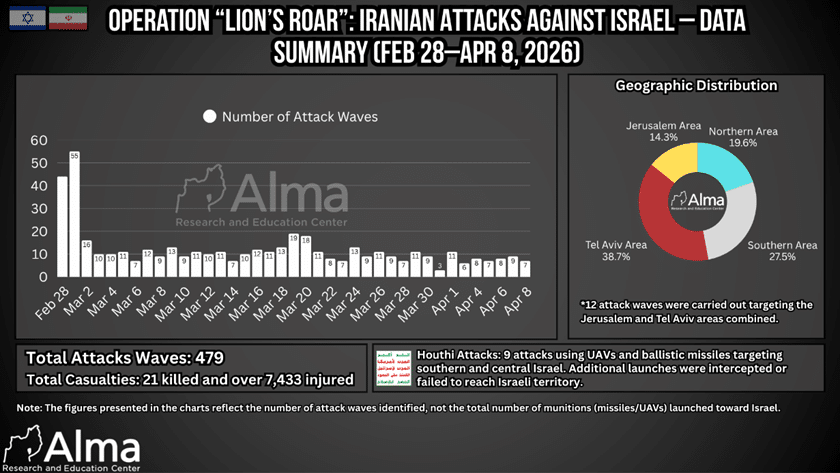
In light of the ceasefire that came into effect in the early morning hours of April 8, the following are preliminary summary data on Iranian (and Houthi) attacks against Israel במסגרת Operation “Roaring Lion”:
The campaign between Iran and Israel was characterized by a consistent pattern of continuous waves of attacks, with a total of 479 Iranian attack waves identified between February 28 and April 8, 2026, carried out primarily using ballistic missile fire. During these attacks, 21 people were killed and more than 7,433 were injured.
The Iranian effort relied mainly on ballistic missiles, most of which were equipped with multiple warheads. The use of this capability enables the dispersal of submunitions over a wide area, thereby increasing the potential scale of damage and raising the risk to civilian populations, especially in densely populated areas and areas with significant strategic infrastructure.
Geographically, most of the attacks were directed toward central Israel—primarily the Tel Aviv metropolitan area (38.7%)—alongside extensive activity in the south (27.5%), the north (19.6%), and the Jerusalem area (14.3%), indicating an attempt to concentrate strikes on densely populated areas.
In addition, Houthi involvement (as an Iranian proxy) was recorded, with nine additional attacks carried out using ballistic missiles and UAVs toward southern and central Israel. It should be noted that some of these launches were intercepted or failed and did not reach Israeli territory, and are therefore not included in the figures.
In the northern front, on April 7 Hezbollah carried out 43 attacks. On April 8, no attacks were carried out.
In the early morning hours of April 9, fire resumed, mainly toward border communities. As of 13:45, 15 attacks had been carried out, primarily in the eastern sector—Kiryat Shmona and Metula.
Lebanon and Hezbollah
Immediately after the announcement of the ceasefire between the United States and Iran, uncertainty arose as to whether Lebanon was included in the agreement. Iran and the mediator, Pakistan, claimed that it was. Pakistan’s Prime Minister issued a statement in the early morning hours of April 8, noting that the ceasefire also includes Lebanon.
In contrast, Israel claimed that Lebanon is not included in the agreement, and later the United States firmly confirmed (through the President, Vice President, and the White House spokesperson) that Lebanon is not part of it.
Lebanese President Joseph Aoun welcomed the ceasefire with Iran and expressed hope that this announcement would serve as a first step toward a final and comprehensive agreement on the key issues in the region, in a way that preserves the sovereignty of each state.
According to reports on Al Jazeera, the Lebanese President is holding international contacts, including with the President of France, in an effort to include Lebanon in the ceasefire. Official Lebanese sources told the newspaper “Al-Araby Al-Jadeed” that Lebanon is working with international actors to pressure Israel to respect the ceasefire, while emphasizing its commitment to disarming Hezbollah through state institutions and the importance of supporting the Lebanese Army in carrying this out.
In addition, Aoun met with Foreign Minister Youssef Raji and Army Commander Rodolphe Haykal, and discussed with them the security situation in the country, particularly in southern Lebanon, as well as the steps taken by the army to maintain security and stability in Beirut and other areas, including areas hosting displaced persons.
The Lebanese government announced that the Al-Masnaa border crossing between Syria and Lebanon will be reopened.
Lebanese Prime Minister Nawaf Salam stated after the cabinet meeting (April 8) that the state will act immediately to strengthen its control in Beirut, and that weapons will be held exclusively by the state. He added that any violation will be addressed in accordance with the law.
A senior Hezbollah official told Al Jazeera that the organization is giving an opportunity to efforts aimed at compelling Israel to adhere to the ceasefire, but will not accept a continuation of the strikes as seen prior to the campaign. According to him, the organization’s position will be determined in accordance with developments.
The Lebanese channel “Al-Jadeed” reported that a ceasefire between Israel and Lebanon could serve as a basis for future negotiations to end the war, based on Hezbollah’s disarmament and an Israeli withdrawal. However, according to the report, Israel did not agree to allow residents of the south to return to their homes in exchange for disarmament, and therefore residents have been instructed not to return at this stage.
Strike Against Hezbollah Command and Control Systems:
On April 8, in the afternoon hours, the IDF carried out the most extensive strike in Lebanon since the beginning of the operation, targeting Hezbollah’s command and control systems. The strike included attacks on approximately 100 Hezbollah headquarters and infrastructures, including intelligence headquarters, central command centers, fire and naval array infrastructures, as well as assets of the “Radwan Force” and the aerial unit (127).
As a result of the strike, hundreds of Hezbollah operatives were affected.
In Lebanon, the strike was condemned. Prime Minister Salam stated that while Lebanon is welcoming the agreement between Iran and the United States and advancing efforts toward a ceasefire in Lebanon, Israel continues to escalate its actions. He added that Lebanon will appeal to the UN Security Council.
The Lebanese presidency accused Israel of deepening its aggression and undermining efforts to achieve calm and stability. Parliament Speaker Nabih Berri claimed that Lebanon is included in the ceasefire agreement and that Israel is violating it, and even contacted the Pakistani side to apply pressure on the United States.
Hezbollah condemned the strikes and emphasized that they reinforce the “right to resistance.” The organization called on residents of the south, the Bekaa, and Dahieh not to return to affected areas before an official ceasefire is declared, and claimed it is “on the verge of a historic victory.” In addition, it stated that it will continue to attack Israeli targets as long as the “Israeli-American aggression” continues.
Members of parliament from Hezbollah claimed that Israel is attempting to evade its ceasefire obligations and that the strikes primarily harm civilians.
In a joint statement, the United Kingdom, France, Germany, and the European Union called on the parties to apply the ceasefire to the Lebanese arena as well.
In the international community, condemnations of the strike were also heard. The EU High Representative for Foreign Affairs warned that continued Israeli strikes in Lebanon could jeopardize the ceasefire with Iran.
Kaja Kallas, Vice President of the European Commission, stated that Hezbollah dragged Lebanon into the war, but Israel’s right to defend itself does not justify such a scale of destruction. According to her, the Israeli strikes yesterday, in which hundreds of people were killed, make it difficult to argue that such actions fall within the definition of “self-defense.” She further noted that Israel’s actions place heavy pressure on the ceasefire between the United States and Iran, and emphasized that the agreement should be expanded to include Lebanon. Finally, she stressed that Hezbollah must be disarmed, and that the European Union supports Lebanon’s efforts to disarm the organization.
French President Emmanuel Macron condemned the Israeli strikes and expressed support for Lebanon, while calling to include it in the ceasefire.
Pakistan condemned the strikes and called for international action to stop them.
At the same time, the UK Foreign Secretary called to include Lebanon within the framework of the agreement.
Spanish Prime Minister Pedro Sánchez sharply criticized the continued Israeli strikes in Lebanon following the ceasefire, calling it “completely unacceptable.”
Additional IDF Strikes:
The IDF continues to operate in Lebanon. On April 8, the IDF struck the Al-Qasmiya bridge in Lebanon.
On the same day (April 8), the IDF struck and eliminated in Beirut Ali Youssef Harshi, the personal secretary and nephew of Hezbollah leader Naim Qassem.
In addition, on April 8, the IDF eliminated in the Sidon area Maher Qassem Hamdan, commander of Hezbollah’s proxy militia “The Lebanese Brigades” in the Shebaa area of southern Lebanon (the militia’s formal name is “The Lebanese Brigades for Resistance to the Israeli Occupation”).
According to Lebanese sources, in the strikes in Beirut, Fadl Abbas Najm (Abu Abbas), the bodyguard of Hezbollah Secretary-General Naim Qassem, was also eliminated.
Sheikh Sadeq al-Nabulsi, a Shiite cleric affiliated with Hezbollah, was eliminated in a strike in Sidon. Al-Nabulsi was the brother of Mohammad Afif—the spokesperson and head of Hezbollah’s media apparatus—who was eliminated in 2024.
The International Arena
Turkish President Recep Tayyip Erdoğan welcomed the ceasefire with Iran and called for the full implementation of the agreement. He expressed hope that the agreement will hold and that the region can return to a path of peace. In a phone call with U.S. President Donald Trump, Erdoğan emphasized that no factor should be allowed to undermine the ceasefire with Iran.
The Omani Ministry of Foreign Affairs also welcomed the announcement, expressing appreciation for Pakistan’s mediation efforts. In addition, Oman’s Minister of Transport and Communications, Said bin Hamoud Al-Maawali, announced that Oman has signed an international agreement ensuring that no transit fees will be imposed on ships passing through the Strait of Hormuz.
Anwar Gargash, advisor to the President of the United Arab Emirates, commented on the agreement on his X account, stating that the UAE “won a war it sought to avoid,” emphasizing the defense of sovereignty and national achievements, as well as aspirations for greater regional influence in the future.
Saudi Arabia welcomed the ceasefire and expressed support for Pakistan’s mediation efforts to achieve a permanent agreement that would ensure regional stability. It also stressed the need to guarantee freedom of navigation in the Strait of Hormuz in accordance with UN conventions.
Kuwait’s Ministry of Foreign Affairs welcomed the agreement but emphasized the need for its full implementation, including stabilizing the security situation and creating appropriate conditions for dialogue. The statement called on Iran and its proxies, including pro-Iranian militias, to immediately cease destabilizing actions, respect state sovereignty, and ensure freedom of navigation in the Strait of Hormuz and other maritime routes.
Egypt welcomed the ceasefire and described it as a real opportunity to launch constructive negotiations leading to regional stability. The Foreign Ministry in Cairo emphasized the importance of preserving the sovereignty of the Gulf states and Jordan, noting that their security is an integral part of Egypt’s own security.
Iraqi President Abdul Latif Rashid described the ceasefire as “an important development toward calming the region.”
UN Secretary-General António Guterres welcomed the agreement and called on all parties to respect its terms in order to promote a stable and comprehensive peace in the region.
Ukrainian President Volodymyr Zelensky welcomed the ceasefire.
India welcomed the agreement and emphasized that dialogue and diplomacy are essential to ending the ongoing conflict. According to a Reuters report, India is expected to receive Iranian oil this week for the first time in seven years.
Indonesia also welcomed the ceasefire and called on all parties to respect sovereignty, territorial integrity, and diplomatic solutions.