
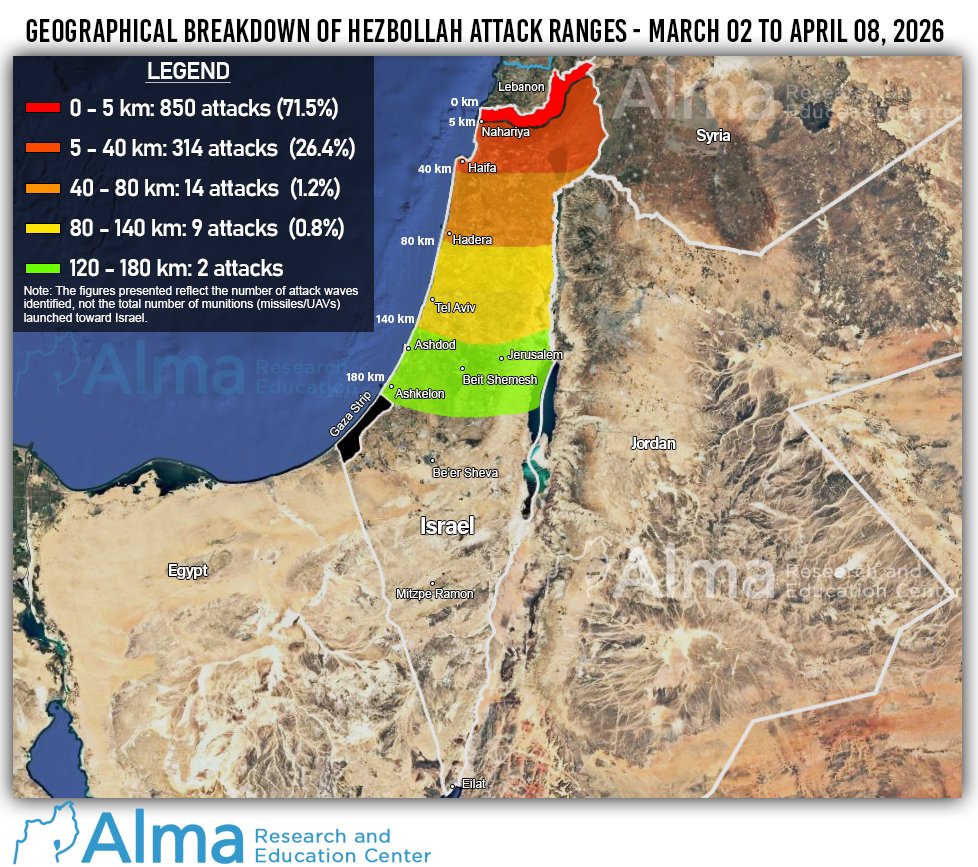
The graphic presents a quantitative breakdown of Hezbollah launches by geographic range, enabling an examination of operational patterns throughout the analyzed period. The data clearly indicates the nature of Hezbollah’s fire deployment, reflecting both the characteristics of the organization’s rocket and missile arsenal and the operational considerations and constraints derived from it. First, there is a clear dominance of very short-range fire within Israeli territory. Approximately 71.5% of all launches were carried out at ranges of up to 5 km. This figure indicates a sustained focus on border-line areas, creating continuous pressure on northern communities and IDF forces present in the region. At the same time, this operational pattern is also integrated into a psychological warfare effort, through which Hezbollah seeks to generate a persistent sense of threat among border and northern residents, with the aim of prompting evacuations and thereby achieving a cognitive/psychological gain. Second, a significant volume of fire was also recorded at short-to-medium ranges within Israel (5–40 km), accounting for approximately 26.4% of all launches. These ranges include communities and cities across the Galilee up to the Haifa line, and indicate the capability to extend fire toward densely populated areas and strategic infrastructure zones in northern Israel. This distribution is not random, but rather reflects the structure of Hezbollah’s arsenal, which is primarily based on short- and medium-range rockets. Accordingly, the majority of firepower is directed at these ranges, as clearly demonstrated by the data. The use of medium-to-long range fire remains extremely limited. Fewer than 3% of launches were carried out at ranges exceeding 40 km, despite the existence of isolated launches reaching distances of up to 180 km. This situation aligns with the fact that Hezbollah possesses a very limited arsenal of rockets and missiles for such ranges, along with operational challenges in employing them—leading to a measured and restrained use of these capabilities. In conclusion, the overall picture reflected in the data is one of an operational pattern consistent with Hezbollah’s force structure: a central and sustained effort at short and medium ranges, alongside the retention and measured use of long-range capabilities. This combination enables continuous pressure and attrition in the northern arena, while preserving the ability to strike deeper into Israel.


2 Responses
Hezbollah’s Missile Fire Is Organized In A Deliberate Three-Tier Targeting Framework:
1) Tier -Strategic depth (south of Caesarea, ~140+ km) , Target Set: Air/missile defense bases, C2, satellite comms, strategic HQs, Weapons: Fateh-110 ballistic missiles (~350 km), “precision missiles,” long-range drones, Examples: Palmachim AB, Tel HaShomer, Glilot intelligence base, Elah Valley satellite station, Home Front Command Ramla
2) Tier – Operational (northern Israel, 20–100 km) Target Set : Airbases, radar sites, naval bases, division HQs, Weapons : Drone swarms (Ababil-T, Sayyad-107, Shahed-101), rocket barrages, Examples: Ramat David AB radars/control rooms, Meron surveillance base, Haifa naval base, Camp Yitzhak, Nafah/210th Division HQ in Golan
3) Tier – Tactical (border zone / south Lebanon) Target Set : IDF troops, armor, posts, observation points, Weapons: ATGMs (Kornet, Almas-1/2/3), RPGs, IEDs, artillery shells, small arms, tactical drones Examples: Merkava tanks at Khiyam, IDF positions in Markaba, Aitaroun, Kafr Kila, Maroun al-Ras
The ITIC assessment notes that Hezbollah began with precise weapons against high-value targets, then escalated to larger-volume barrages a deliberate escalation ladder, not indiscriminate fire.
The Logic Is Layered Saturation:
1. Hezbollah fires close-range rockets and drone swarms (100–200 km range from southern Lebanon) to occupy and disperse Israeli air defense batteries, particularly Iron Dome
2. In the same time window, Iran launches ballistic missiles (Sejjil, Emad, etc.) at longer range, exploiting the engagement window while Israeli radars and interceptors are handling the nearer-range Hezbollah threat
3. The combined effect forces Israeli AD to handle multiple threat profiles simultaneously — slow, low-altitude drones; fast, high-altitude ballistic missiles; and medium-trajectory rockets — stressing discrimination, allocation, and magazine depth
The largest demonstrated barrage was March 11: approximately 200 rockets in under one hour from Hezbollah, simultaneous with Iranian ballistic missile salvos. The IDF claims it destroyed launchers intended to fire an additional ~600 rockets before they could be used (Tel Aviv Diary, ITIC).
Tactic Aimed At Israeli Air Defenses
Retired Brigadier General Yaroob Sakher said the parallel launches reflect a tactic aimed primarily at confusing Israel’s air defense systems.
He said barrages fired by Hezbollah from southern Lebanon, given the group’s geographic proximity to Israel, serve to occupy defense systems and disperse their ability to respond to threats, opening a time window for long-range Iranian missiles attempting to penetrate those defenses.
The hezbollah threat must be confronted and defeated to unconditional surrender and be totally removed from Lebanon to restore a secure border for Israel, and to secure the restoration of Liberty for the people of both Israel and Lebanon. The islamonazi evil jihaddist ideology is by definition a genocidal force designed to destabilize legitimate governance and generate terror.