
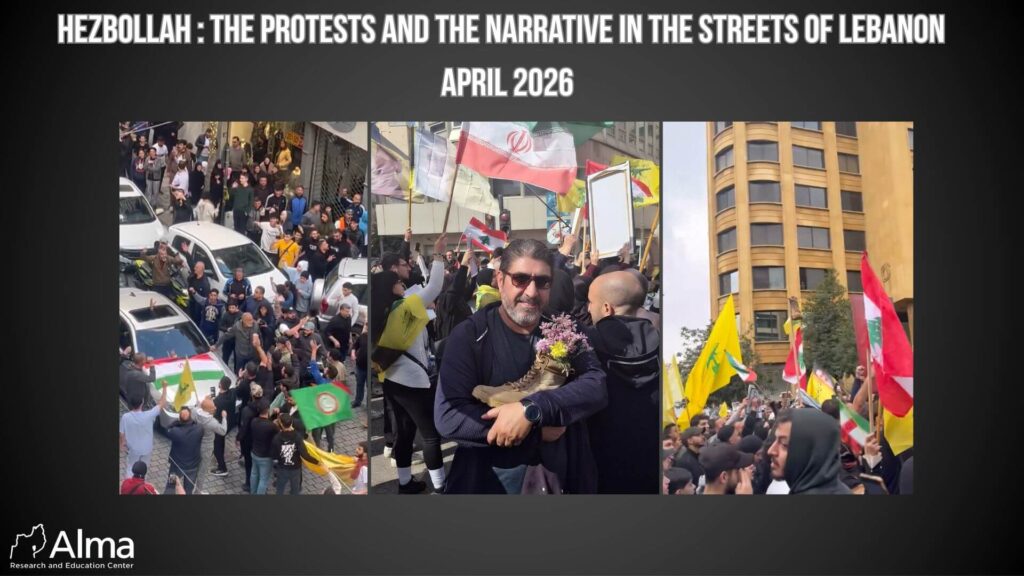
During the past week, against the backdrop of reports ahead of direct talks between Lebanon and Israel, and alongside statements by the Lebanese government regarding the consolidation of weapons under state control, a series of protests by Hezbollah and Amal supporters took place in Beirut. These demonstrations reflected a dual opposition: both to the very existence of negotiations with Israel during wartime, and to attempts to undermine Hezbollah’s status as an independent military force. In this context, the organization was presented as the central—and at times the sole—actor effectively defending Lebanon.
The protesters voiced sharp criticism of Prime Minister Nawaf Salam, whom they labeled a “Zionist,” and argued that advancing political discourse at this time constitutes a dangerous strategic concession.
This reflects one of Hezbollah’s core narratives: the delegitimization of the state leadership when it operates outside the framework of “the resistance,” portraying it as promoting foreign interests or succumbing to international pressure.
On April 10, a protest took place in the Hamra area, followed the next day by another gathering in Riad al-Solh Square and near the government “Serail” (government offices). The protests were limited in scope and included dozens or at most a few hundred participants. During the events, as can be seen in the video below, clear expressions of support for Hezbollah and for the “weapons of the resistance” were heard, emphasizing that these weapons constitute the sole guarantee for Lebanon’s defense.
It is possible that the limited scale of the protests was planned in advance, but it is also possible that this reflects a form of failure in organizing the demonstrations.
The message that emerged from the demonstrations not only rejected the demand to dismantle non-state weapons, but also reframed this demand as a threat to Lebanese national security—an example of a typical narrative inversion carried out by Hezbollah influence campaign.
A prominent symbolic element in the protests was the use of military boots known in Lebanon as “Rangers,” which are associated with Hezbollah’s fighters. Some demonstrators carried the boots on their heads or decorated them with flowers, as a symbol of honor, sacrifice, and protection. This practice aligns closely with the narrative of sacrifice and heroism promoted by Hezbollah, and illustrates how it embeds military symbols within the civilian sphere in order to build public legitimacy for its weapons and activities.
As part of an effort within the influence campaign to build legitimacy, during one of the Hezbollah supporters’ protests, a demonstrator was seen waving the flag of “Tayyar al-Mustaqbal,” the Lebanese political movement led by Saad Hariri (former Prime Minister of Lebanon and son of Rafik Hariri, who also served as Prime Minister and was assassinated on February 14, 2005 by Hezbollah).
“Tayyar al-Mustaqbal” represents the Sunni community in Lebanon and is considered one of the movements that opposes Hezbollah. The raising of Tayyar al-Mustaqbal,” flag was a manipulation by Hezbollah supporters intended to portray the protests as a popular movement representing all of Lebanese society, rather than only Hezbollah’s Shiite “base.”
It is possible that the limited scale of the protests, as noted above, stemmed from Hezbollah’s desire to maintain tight control over events and to prevent developments that are not under the organization’s direct control.
Alongside the internal struggle, Hezbollah has maintained a firm declarative line against any political move toward Israel. On April 10, Hezbollah leader Naim Qassem stated that “the resistance will continue until the last breath,” and called on the Lebanese leadership to halt “free concessions.” In his remarks, the organization reiterated the claim that Israel had failed on the battlefield, and that Hezbollah, the population, and the displaced remain steadfast—a framing intended to establish a perception of victory and to justify the continued retention of weapons outside the framework of the state.
In conclusion, the recent events illustrate the inherent and ongoing tension between the Lebanese state and Hezbollah: while the government attempts (with much rhetoric and fewer actions…) to strengthen its sovereignty and centralize military power, Hezbollah operates simultaneously in the public sphere to entrench its position as the “defender of Lebanon,” under conditions that serve its own interests, while undermining the authority of the government.


One Response
Dear Dr Zoe,
Hezbollah is by definition a “resistance” to all legitimate authority and governance as defined and established by the God of Abraham, Isaac, Jacob and Moses. It has no foundation nor legitimacy whatsoever. The only way it can exercise power is through threats, fear, deception and the chains of enslavement. We must stand on the JudeoChristian foundation of Truth and Justice and the Law given to Moses and overwhelm the “resistance”. Resistance is by definition an obstruction to a positive Force: in this case, The Israeli Defense Forces.